Metamaterials have long been thought the key to creating the working, visible spectrum “invisibility cloak” promised us by sci-fi, but it might be time for metamaterials to move over. Two independent labs—one at the University of Birmingham in the UK, the other at MIT—have used naturally forming calcite crystals to render visible objects (as in large enough to see with the naked eye) invisible, something metamaterials haven’t come close to doing.
Metamaterials have achieved a measure of invisibility, but not in any practical sense; they can bend certain wavelengths of light to conceal an object at the microscopic level, but so far they have not been able to work well at the macro scale or in the visible spectrum. It turns out researchers may not have needed such an exotic medium.
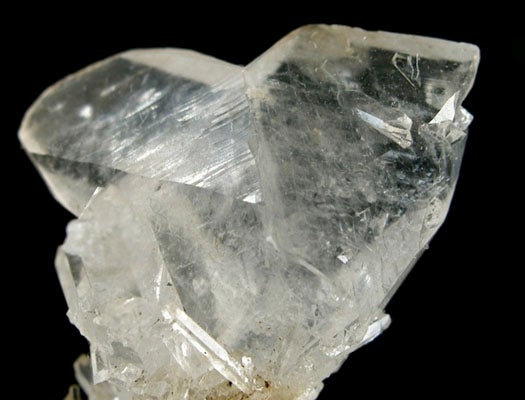
Calcite, an abundant crystalline form of calcium carbonate that forms naturally (it’s the primary stuff of sea shells), has long been known to have peculiar light-bending properties, and if the Birmingham and MIT findings are any indication it might have a future in cloaking devices.In both experiments, researchers had to finely tune their crystals—they’re technically composite crystals, as the researchers basically glue together two crystals with opposite crystal orientations—then placed them over small but entirely visible objects (MIT used a small metal wedge the size of a peppercorn; Birmingham went bigger, concealing a paperclip). In both experiments, the calcite crystals essentially reflected and refracted the light coming through in such a way as to conceal the objects on the other side, making it appear as though there weren’t there.
For now, the technology is nascent and somewhat two-dimensional, though the MIT team says it has some ideas regarding how they could make the cloaking three-dimensional. And, at least theoretically speaking, the calcite cloaking technology is limited only by the size of calcite crystals, which can grow well more than a dozen feet long—large enough to conceal a person or an average New York City apartment.
To think: all that work with metamaterials when all it really takes to make oneself invisible are some special crystals. Perhaps science fiction had invisibility right all along.
Five amazing, clean technologies that will set us free, in this month's energy-focused issue. Also: how to build a better bomb detector, the robotic toys that are raising your children, a human catapult, the world's smallest arcade, and much more.


Online Content Director: Suzanne LaBarre | Email
Senior Editor: Paul Adams | Email
Associate Editor: Dan Nosowitz | Email
Assistant Editor: Colin Lecher | Email
Assistant Editor: Rose Pastore | Email
Contributing Writers:
Rebecca Boyle | Email
Kelsey D. Atherton | Email
Francie Diep | Email
Shaunacy Ferro | Email
no video, or pictures? we want to see how efficient it is.
pics or gtfo!
As cool as making something invisible is, if you have to put a bigger, still visible thing around it, it has all the practical purpose of, say, hiding in a box.
It is invisible- right in fornt of the rock. Can't you see it?
Hey, if I go behind a tree, it makes me invisible too! Seems like a waste of time to me.
@stlcardinalsguy, there is no tree to hide behind in open space.
@-my name here-, the fact that you DON'T see it should be a clear sign of how efficient it is...
nah, I was thinking more like a before and after, kind of thing.
@xalar: that is why you must bring your own freakin' gigantic crystal to hid behind.
I completely agree with Solace. Sure, we won't see the tank coming, but that tank-sized calcite crystal inching towards us seems oddly suspicious...
-IMP ;) :)
@stlcardinalsguy
and
everyone else.
you cant be that DENSE can you? are you telling my you dont think it would be a good idea to cloak a tank??? if you had a tank batalion in an open field and you have plane fly over or a artilly spotter 20 km away, you dont think it would be nice if they could not pinpoint your location???
AND you are not going to walk around with ONE giant crystal!!! it would many sliver, or a film, or a layer of crystals.
use your heads before you post inane comments.
In absence of further explanation, I'd tend to agree with Solace. Nothing in the article even hints that the calcite is itself invisible, and it's hard to imagine how it could be. It's also hard to imagine how this complex optical effect could be partitioned and bent over the surface of military hardware.
If the crystal was itself invisible, I imagine that would have been its own news story. Seriously, that would be fairly incredible in itself.
I don't know what concept this is supposed to be in proof of.
Well at the very least they can learn something from the way it actually makes an object appear invisible and go from there. But i agree that it doesn't sound practical.
By the way there are more means of locating a high tech vehicle, the least dependable one is probably field of vision...
No to pictures, yes to video.
@ inaka_rob:
No, given your scenario, it would not be worth the cost of developing this technology to cloak a battalion of tanks. Why? Their tracks alone would give them away. If we're talking about the tanks in the defense, cammo netting at minimum would be used. What kind of optics is your spotter using? Visual spectrum over that distance the cammo netting would blend into the country side. Thermal would be mostly the same.
In the offense, tanks become far more observable due to noise and smell, not so much visually, except for any dust plume being kicked up.
Cloaking would be useful for scouts, artillery observers, and other dismounts, though.
I think this is what Big Foot has been hiding behind all of these years. Find the crystals and we find big foot.
@bgdavison "cloaking" refers to a number of things. radar cloaking. infrared cloaking, visual light cloaking. Smell????
I don't think they have missiles that track the smell of burnt fuel or soldiers farting.
lets just say for the sake of argument you can just spray this stuff on the surface of a tank. You have a dude 20 km with a binoculars. He knows something is there, but when he looks he just see a bunch of blurry blobs. he doesn't know if a its a bunch of horses kicking up dust, artillery, or m1-a1 tanks. Thats makes a HUGE difference right?
Even a little camo helps right??? I mean why dont we paint our tanks ORANGE?!?! our tanks used to be green. now we are fighting in the desert. oh my god!!!! SURPRISE!!!! we painted our tanks tan like the color of sand. ANY amount of camo helps. I am not talking about a harry potter cloak. no one is. i mean even in Star Trek cloaking land you can still detect the cloaked ships somehow, but the romulans and Klingons still landed plenty of surprise hits.
my only point is that I dont think DARPA is suggesting carrying around a giant rock to hide behind like some people are ignorantly suggesting.
@inaka_rob: It doesn't matter if you use one giant crystal or several layers of calcite. Either way, the calcite itself will be visible, and thus the cloaking effect is rendered useless.
-IMP ;) :)
Video would be a great way to show this!
@IceMetalPunk did you read my post at ALL????
if you look at a PURE laboratory grown calcite crystal it is virtually clear. I am not talking about the pic or the chunk you buy at you local rock shop. have you ever heard of something called GLASS?!?!? you know the clear stuff that is...um... everywhere. guess what. before it is refined it is not clear at all!!!! and again would you rather a orange tank a or blurry blob that you can not make out.
;) :)
;) :)
;) :);) :)
;) :);) :);) :);) :);) :);) :)!!!!!!
I'm invisible!! As long as i don't move, you don't move, and no one else from any other angle looks at me, I'm invisible!!!!
Seriously, until this technology can change seamlessly in real-time, and in 3 dimensions, it is little more than a parlor trick. While its a "neat" technology it really has no practical applications outside of perhaps making extremely expensive privacy screens.
@inaka_rob,
"and again would you rather a orange tank a or blurry blob that you can not make out."
That's called camo... not "invisibility".
If I look out and see a bunch of zebras, I can't say "okay, that's the one zebra I'm going to attack"... but if I wanted to shoot artillery shells at the zebras I wouldn't really give a crap whether I can make out a single one in HD--I just need to know where they are.
*looks around, see's nothing... keeps looking*
*looks around, see's a bunch of blurry blobs, aims artillery at them and opens fire*
See the difference?
An invisible thing can run around in front of you and you won't be able to see it. A camouflaged thing blends in to the surroundings and is hard to notice if it sits around perfectly still.
A stealth plane is "invisible" to radar while it flies around and drops bombs. It's not just "really hard to distinguish apart from a bunch of rocks if it hides amongst them and doesn't move".
@B.V. I agree with you to a point, but you are 100% wrong about Stealth aircraft technology. As an Air Force Electronics Warfare Specialist, I learned all about RADAR (Radio Detection And Ranging), radar jamming, chaff, flares, signal displacement, etc. Steath technology bounces **MOST** of the incoming radio waves away from the aircraft thus creating the "stealth" effect, however it is not completely invisible to radar, Stealth aircraft technology reduces the radar signature of the aircraft by upwards of 80-90%. So, rather than seeing a large blip on your radar sweep, you see a much smaller blip, one that could either A) be missed or B) be mistaken for birds.
Isn't this exactly the same thing magicians have done for years with mirrors? The effect is "somewhat two-dimensional" meaning if you are looking from just the right angle, the light is reflected around an object.
@B.V. no. you are dead wrong. because that blurry blob could 1000 differnt things and the enenmy doesnt know what that thing. What if it is an AA battery and the enemy says. oh well its a blurry blob, its the enemy. lets send in the planes. well those blurry blobls just shot down your ENTIRE airforce. What if those blobs are carrying medical aid and wounded. I believe it is against the rules of engagement to attack such units. What if it is a tank battalion. but it could be artily. you can only protect one target. you have radar that the tanks might go after. or you have a base that the artillery would go after. The benefits of being a "burry blob" are endless. If you dont know what your enemy is, you dont know how to fight it or defend against it.
@inaka_rob,
I think you missed my point.
Yes, disguising yourself from the enemy is advantageous... but it is completely different from them being unaware of your existence.
Invisible = the enemy doesn't know you're there.
Blurry Blob = the enemy knows you're there, but doesn't know what you are.
@inaka_rob
Presicely my thoughts. How they hell do you expect us to haul around the bigass crystals needed to hide a tank? The answer; Don't! Instead, use either A(.a sheet made from billions of minute crystals, all less than half the size of a corn kernal, and use it like a tent, or B(. A mist of such tiny crystals that is confined to a very thin perimeter around the object you're hiding, which is also somehow recaptured and used again (Think super-efficiant invisibility-granting version of a force field)
@inka_rob. Please, inform us of exactly how you would go about carrying an application of the crystals onto our tanks/artillery. Since you've enjoyed calling out the other "inane comments" and how others are "DENSE", I would like to hear your opinions. I have read that you suggest using a "thin film or layers of crystals", how would you go about doing this? Another question, how are you going to effectively camo tanks/artillery from ground and air eyes at the same time? Sure it can be done, but I would like to hear what you have to say.
Plus, if you are a ground troop and you can't pick up the smell of diesel exhaust from a battalion of tanks in the middle of a desert, you deserve to be pulverized by the battalion that's perched on the other side of the sand dune. We are talking about "soldiers farting" that's causing the sightings and if you're too "DENSE" to realize that, you shouldn't post on this.
and the "We are talking about" in the last sentence should have read "We aren't talking about". That was a typo on my part.