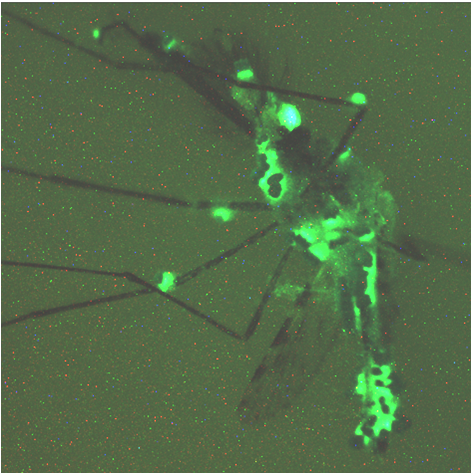
To combat malaria, why not skip the step of genetically altering mosquitoes and try some transgenic fungus instead? In a new study, researchers sprayed mosquitoes with a fungus that had been modified to deliver compounds that target the malaria parasite. They found the treatment could reduce disease transmission to humans by at least five-fold.
Researchers at the University of Maryland, who were funded by the National Institutes of Health/National Institute of Allergy and Infectious Diseases, say the method could be an effective treatment against malaria, especially as mosquitoes increasingly evolve to resist insecticides. Even better, the fungus modification can be targeted to almost any disease-carrying insect, potentially allowing fungus-based prevention for maladies like Lyme disease or dengue fever. The study was reported today in the journal Science.
The Metarhizium anisopliae fungus naturally attacks mosquitoes, and it has already been used to reduce disease transmission — but it only works if the bugs are sprayed with fungus soon after they picked up the malaria-causing Plasmodium falciparum parasite. What’s more, the mosquitoes often die before reproducing, leaving fungus-resistant mosquitoes to take over and render the spray useless. So rather than enhance fungi to better kill mosquitoes, entomology professor Raymond St. Leger and colleagues modified the fungi to block the development of Plasmodium in the mosquito.They used genes for a human antibody and a scorpion toxin, both of which specifically target Plasmodium, and inserted them into the fungus. They fed some mosquitoes a Plasmodium-infected blood meal, and separated them into three groups. One group got a dose of the transgenic fungus, another got a natural fungus and the third was not sprayed at all. Two weeks after the bugs were exposed to the malaria parasite, the researchers checked for its presence in their salivary glands (this is how it’s transmitted to humans).
Spraying mosquitoes with the transgenic fungus significantly reduced parasite development, the team found.
Malaria is found in 106 countries and there are an estimated 225 million malaria cases every year, including 781,000 deaths, mostly in sub-Saharan Africa. Prevention usually involves spraying bed nets and interior walls with pyrethroid insecticide to kill the mosquitoes, but the bugs are evolving to resist it, and there are no promising prospects for a chemical replacement.
Other teams have genetically altered mosquitoes to resist Plasmodium, and modified other mosquitoes to be sterile in order to reduce their populations. But transgenic mosquitoes could pose some ecological problems. A fungal treatment can be modified to keep up with mosquitoes’ natural adaptations, St. Leger said.
“Mosquitoes have an incredible ability to evolve and adapt, so there may be no permanent fix. However, our current transgenic combination could translate into additional decades of effective use of fungi as an anti-malarial biopesticide,” he said.
Five amazing, clean technologies that will set us free, in this month's energy-focused issue. Also: how to build a better bomb detector, the robotic toys that are raising your children, a human catapult, the world's smallest arcade, and much more.


Online Content Director: Suzanne LaBarre | Email
Senior Editor: Paul Adams | Email
Associate Editor: Dan Nosowitz | Email
Assistant Editor: Colin Lecher | Email
Assistant Editor: Rose Pastore | Email
Contributing Writers:
Rebecca Boyle | Email
Kelsey D. Atherton | Email
Francie Diep | Email
Shaunacy Ferro | Email
stop using living-organism-eating fungi! it's going to evolve and eat US!
it's not going to eat us, there are billions of fungi that are already evolved to eat us, haven't you ever heard of decay? the only difference is that our immune system is specifically designed to literally eat and digest any foreign body within you. the only way this could become dangerous is if your immune system was weakened to where the fungi could take hold, or the fungus spores were at such a concentration that it would overwhelm us.
just as a food source for thought, my mother used to manage properties for a living, it would be a sadly common thing to come into an apartment that had been destroyed by the tenants. some of these apartments were so bad you could actually see the mold spores in the air. this is the kind of mold that eats you when you die, and the tenants would breathe this stuff daily.
if nothing else that is my proof that there isn't much to worry about when it comes to weapon-ized mold.
way to take the fun out of an apocalyptic scenario.
besides, there are fungi that eat living bugs in madagascar, if that fungus were, strictly for study, to get crossed with HIV, and attack our immune system, and then take US over, there would be no hope.
sigh, fine enjoy your apocalyptic scenario, your just gonna end up calling it towards you anyways...
Why not skip the mosquitoes? Because they're ANNOYING! Why not just modify us to be immune to the mosquitoes?
@-my name here-
I'll leave it to you to come up with an apocalyptic scenario out of that one.
@ Lord Elliot -
Well obviously during the genetic modification process, a subset of patients would become mosquitoes as a side effect. What are human-mosquitoes also known as? Vampires! Of course, since they wouldn't fit in with the rest of society, we would wind up in a Vampire-Human apacolyptic war.
There's your scenario, lol.
Stupidest thing I've heard.
Don't they know everything on the planet is part of what it would take to make us. All failed attempts, however successful species.
We as well are susceptible to fungal infection. GM a organism that can go through multiple life cycles in one.... you guess. Mutation at an astronomical rate.
What I like about this is that mosquitoes are finally being punished for their crimes
@Insaneperson
Thats what scares me the most, nature may finally succeed in the same thing.
Well, why not modify the mosquitoes to crave fruit instead of blood, and while they get a little sip of orange juice they could help pollinate the crop? THAT would be evolution.
But of course Evolution is not reality in the first place.
Just sayin' - the author is the one who brought up the 'e' word.
Is this the fungus that's responsible for killing the bat population in NE United States? Refering to white-nose syndrome might be helpful. If so please tell us
how to kill the fungus and save our bat population.