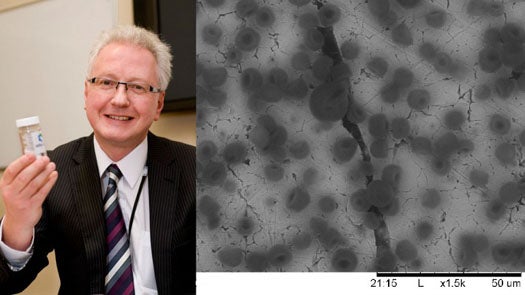
We’re going to go ahead and write this one because it’s all kinds of interesting, but know that we are doing so with all kinds of skepticism, fair readers. Because anytime anyone claims to have created inexpensive synthetic fuel that will burn in conventional automobile engines with no carbon emissions, you simply have to be on your guard. Nonetheless, UK-based Cella Energy claims to have done exactly that by devising a hydrogen-based synthetic fuel that could replace gasoline in cars.
The technology—reportedly incubated at the Rutherford Appleton Laboratory near Oxford in a top secret four-year program—is based on complex hydrides that are highly unstable, usually degrading rapidly in air. Put simply, the company claims it has found a nanotech-driven method that encapsulates hydrogen at usable concentrations in micro-capsules, allowing it to be handled and burned in conventional engines without the need to store it in dangerous high-pressure tanks or super-cooled environments. From Cella’s website:
Cella Energy have developed a method using a low-cost process called coaxial electrospinning or electrospraying that can trap a complex chemical hydride inside a nano-porous polymer that speeds up the kinetics of hydrogen desorption, reduces the temperature at which the desorption occurs and filters out many if not all of the damaging chemicals. It also protects the hydrides from oxygen and water, making it possible to handle it in air.This means that basically the micro-capsules are stabilized hydrogen that moves like a fluid, meaning you could pump it into your automobile as-is, with no engine or fuel injection conversion—though Cella readily admits that preliminary deployment of their product would likely be as a fuel-additive that helps to cut down on carbon emissions.
Moreover, Gizmag writes that the fuel could be produced at a fixed price of about $1.50 per gallon, a price that would be stable and immune to the whims of OPEC or anyone else (except Cella, it seems). We’re not exactly sure where to attribute that dollar value, though Gizmag did interview the company’s CEO.
So: $1.50 per gallon carbon-free nano-liquid hydrogen fuel that burns in existing engines. Sound too good to be true? In theory the science makes sense assuming the “electrospinning” process works as well as Cella claims it does. But until those hydrogen micro-beads are powering our flying cars, we remain optimistically skeptical.
[Cella Energy via Gizmag]

140 years of Popular Science at your fingertips.
Each issue has been completely reimagined for your iPad. See our amazing new vision for magazines that goes far beyond the printed page
Stay up to date on the latest news of the future of science and technology from your iPhone or Android phone with full articles, images and offline viewing
Featuring every article from the magazine and website, plus links from around the Web. Also see our PopSci DIY feed
The 6th annual Invention Awards are here, from an inflatable tourniquet to a better lobster trap to spring-loaded hocket skates. This issue is all about the celebration of invention.
Plus: Making synthetic biology breakthroughs in a garage, building a constantly-moving ping-pong table, and a ridiculously overpowered barbecue.
So where are their huge refineries? If they can do this then governments must be scrambling to get this stuff into production. Not. Believe half of what you see and none of what you hear.
"a price that would be stable and immune to the whims of OPEC or anyone else"
Which is why it will never go public.
The whims of OPEC topple governments and drive fuel costs to 3.50 a gallon for literally no other reason than they want more money.
"a price that would be stable and immune to the whims of OPEC or anyone else"
Which is why it will never go public.
The whims of OPEC topple governments and drive fuel costs to 3.50 a gallon for literally no other reason than they want more money.
That is why governments should introduce a floating fuel tax.When OPEC jacks the price up,the tax decreases,and when the price drops,the tax increases.That way,a stable retail price is set,and alternate fuel companies can invest in product development without the fear gasoline will drop so low it would make their efforts financially untenable.
@Seatellite
Completely agree, and on that note, an energy claim as cheap as this would probably get bought out by some large corporation within oil industry and then never applied. Hell, it's happened before and it could for sure happen again.
On the bright side though, if something like this works (as explained in the article) as nicely as they say with the reduction of having a fuel injection system (or for that much, a few components other than the fuel injector) could provide some interesting benefits and revolutionizing modern energy and engineering, while helping reduce carbon emission.
Sounds cool to me, but I'll check to see what happens.
whats the fuel economy for this type of fuel?
whats the fuels energy density?
burn without emissions... like destroying matter?
According to Cella's website the hydride they use is ammonia borane (NH3BH3), which releases hydrogen gas at 80 degrees Celsius and above. They state that ammonia borane releases 12% (by weight) hydrogen in this process, so the energy density of the fuel seems to be a problem. With gasoline you burn nearly 100% of the mass of the fuel, whereas with this setup you only burn 12%! I believe this is a very exciting concept, but it will require cars to have massive fuel tanks.
Well, I won't go putting Gizmag down they are my brothers!
Just kidding!
directly from their site,
"...it is not currently a viable commercial material: it is expensive to make..."
cheers to progress though
" That is why governments should introduce a floating fuel tax.When OPEC jacks the price up,the tax decreases,and when the price drops,the tax increases.That way,a stable retail price is set,and alternate fuel companies can invest in product development without the fear gasoline will drop so low it would make their efforts financially untenable. "
Then what's to stop OPEC from jacking up the prices and forcing the government to pay for the raise? Sure, the public will get decently low and stable fuel prices, but the goverments would have to take a HUGE hit each time OPEC decided they wanted more money. The only thing stoping them from doubling the price right now is decreased demand when they do it, but it the government 'hides' that doubling in price from the public, OPEC will do it.
You'd put the tax at point of sale so that it has no effect on the backend, I think. It would come directly from the consumers and not affect the distributors' decisions.
"According to Cella's website the hydride they use is ammonia borane (NH3BH3), which releases hydrogen gas at 80 degrees Celsius and above. They state that ammonia borane releases 12% (by weight) hydrogen in this process, so the energy density of the fuel seems to be a problem. With gasoline you burn nearly 100% of the mass of the fuel, whereas with this setup you only burn 12%! I believe this is a very exciting concept, but it will require cars to have massive fuel tanks."
Weight doesn't matter, brah. When we're talking about chemical energy, the only thing that matters is the number of potential bonds you bring to the table. With H, that's one - usually two Hs to one O. With carbon, of course, it's the reverse, two potential bonds usually with one oxygen each. A hydrogen atom is also 1/12 the weight of a carbon atom, so 12% by weight is 1.44 times as many atoms and 74% as many potential bonds. Obviously, it doesn't scale directly, because how spontaneously exothermal something is - how much energy it actually releases when burned - varies from chemical to chemical. Still, if you're counting anything, count atoms, not ounces.
No, what'll kill this is price. We have to produce already-expensive hydrogen fuel via nuclear electrolysis plants, then turn it into a carbon-based nanoparticle? Yeah, right. (Still, I'm hoping.)
Um. I meant 72. Someone is going to call me on that. = )
@dahiteman
I can tell you now why goverment is not flushing money into it. well in our counrty anyway. because David cameron wont even spend money on the police and national defence of our country never mind our fule. England went down hill further due to him. Were due to fall further.
Not saying this "clean fule" is viable or real but its certin it wont have money spent on it by our gov
This article is a true example of all the doubting Thomas's in America. Wouldn't it be real easy to check this new fuel out. Just have CEO Stephen Voller show us how it works. Just because America couldn't come up with the idea doesn't mean it won't work or its too good to be true. In theory, if this new fuel works, America can keep its old out dated fossil fuel vehicles on the road for another century or two.
from Northfield, Vt
@JamesDavis
i don't know if its "doubting Thomas's" or the boy who cried wolf, remeber ethanol the end all cure all fix to oil, except it destroyed engines and drmatically increased food prices, I feel that electric cars with wide spread use of Nuclear fission technology that has increased in efficiency and productivity in the decades since its development, and future advancment of Fusion, will be the end of fossil fuels, and fossil fueled cars, but we are too scared from TMI and Trenobyl(sp?)but we need to have faith in nuclear technology again!!
guaranteed you wont hear of this again... as we speak opec is probably buying a multibillion dollar gag for them.
OPEC has come close to hanging itself on a number of occasions.
Every time the price of oil rises above the refining costs of other sources ( Like the oil sands in Canada and ANWAR) they drop the price. All it would take is a Gov. with some cahones to just continue on with the development of the resource despite any short term losses. Then OPEC would have to keep up and follow suit until the price continues to plummet.
Hydrides are a renewable source and arguably still a fossil fuel. The best source for these in the future will be the ocean floor. The concept here of suspending a gas in a polymer is a novel approach. The concept could be used on a number of other combustibles to facilitate the inclusion of these fuels in the current infrastructure.
One more thing to consider for those who think it will mean an end to fuel. 90% of all food crops are fertilized with petro chemical fertilizers derived from the refining process of oil. You can’t just take oil out of the equation without finding a replacement for the chemical fertilizers.
According to Cella's website, they will be presenting the technology in Washington DC on February 14th. http://nha.confex.com/nha/2011/anal/papers/viewonly.cgi?password=pr0tium&username=5190
Don't know exactly where in DC this is going to be. But it's definitely a lecture I'd like to hear first hand.
I'd say we'll hear more details after that.
tell me, if its all OPECs fault, why do petrol companies continue to rake in record profits since 00?
I dont care what the fuel's made of if you can bring it to me cheaper it can be made of fermented aborted fetuses for all i care
Definitely sounds too good to be true...but it would be really cool if it is true...
Wonder what would happen if I swallowed some of the beads with trapped H2 gas and waltzed onto a flight across the country. Could I ignite myself and blow the plane up? I'm sure the terrorists will give it a try! Dangerous concept!
Gasoline has 100,000 BTU's per gallon (amnt of energy)
Hydrogen has 28,000 - 40,000 BTU's per gal (not sure of the exact number)
I'm wondering how this could be all that effective if it's stored energy is lower than liquid hydrogen.
OPEC has slowed the modernization of almost all the 3rd world countries. They have outlived their use and need to be dismantled.
OPEC will raise the price of oil again like they did when ethanol was added to fuel. They directly fund terrorism. They are controlled by hostile enemies of the United States.
We have to wage war to keep OPEC in their place, and also so our economy does not collapse due to inflated oil prices.
If I started a business in any country and had a unionized-monopoly that threatened the government I would go to jail.
@my name here:
Matter cannot be destroyed period. Emissions are by-products of fuels into the environment. Pollutants from carbon based fuels are commonly referred to as "negative externalities" due to their adverse affects on the environment.. When you burn hydrogen it bonds with oxygen to form water, the emission would be water (Two hydrogen and one oxygen: H2O) water is good.
It says nano-beads in the title, yet they're clearly about 10 microns on the SEM image.
Average man:
My question is? if my car was to be converted into using this new method of fuel. what are the chances of this method being monopolized by one man? what reassurance would i have that $1.50 approximately would turn into $3.00 in a matter of weeks? this tech, is it being viewed by experts? not just employees by Cella's CEO Stephen Voller? has the US GOV. researched this method? If it's something that could come true, what profit can an every day small time investor profit from?
AM no tech just everyday.
im no genius but im prety sure the rubber seals and injection systems on any new gas or diesel vehicle would not hold up to hydrogen based liquid
Ok, so the hydrogen is still a gas, and held in the ammonia-borane fluid-like porous nanoball by the remnant of a charge? I just don't see how we are going to keep their fuel from breaking back down, even with the creative use of their ammonia-borane delivery. I seems to me that enough quantity of this alone is going to want ground out the basis of the bond. If this can be put into application in current technology as they say, it looks more to me that it would function on a basis of 'allowable inefficiency', or the simple concept that though this fuel is pretty stable, allowing it to be stored and pumped, it does actually break down into a stream comprised mostly of ammonia-borane, but that the now simply immersed hydrogen is of sufficient quantity to keep the typical EFI with auto choke sensor to inject a fuel that still burns. Keeping enough of it's bond through the normal movement of the vehicle and therefore the fuel. Seems to me the fuel would lose it's bonding charge, and soon it's hydrogen as well, in a vehicle not operated for a time, and the hydrogen become a danger before then. Both the ammonia and the hydrogen are greatly affected by heat as well, so the stability of the bonds are the only thing giving the appearance to me that the lesser-dense quality fuel could actually allow us to ever drive any significant amount of distance on a tank of this stuff or give it a safe aspect, so if an actual chemist could clue me in on it, I'd be greatfully grateful. Also, if the fuel itself turns out as initially advertised, but through it's lesser fuel density we become a nation that never gets home or to work because we are all in a line at the gas stations, then I'd anticipate that the only people getting rich off of this would be the industry, the politicians mandating it; and the now poor people who try to sell us fruit while we wait in hours of gridlock. If they don't study this a lot more comprehensively than ethanol, then a whole lot of people should really be replaced sooner rather than later.
Ya know, an enterprising chemist could probably mix up a batch of this, PopSci; and I'd be willing to bet that auto scrapyard would be willing to donate the use of an engine for testing, too, just so they could be on the leading edge of it if it's viable.
Patent laws don't keep us from making something, just making it and selling it.
OK seems like a great idea, and somebody is ready for a break-through, but, and its a big BUTT that it can spark my interest only when you tell me that the "new fuel" used on x-car, drove x-miles/km, without coughing or sneezing and which proved the affordable cost.
The OPEC is not the only greedy culprit, oil companies, refineries, oil middlemen such as the hedgers, the Wall-Street gamblers, they all take a big bites out of your wallet.