Few things have inspired as much mythology and mystique as the moon. We’ve credited it with triggering madness, housing deities and rousing werewolves. Even after the age of Enlightenment, astronomers hyped up the moon so much, that the more we found out about it, the more unglamorous it became. By the time Popular Science came around, most astronomers were fairly certain that the moon was dead. In fact, by 1887, we declared the moon a “frozen and dried-up globe, a mere planetary skeleton, that could no more support life than the Humboldt glacier could grow roses.”
Click to launch the photo gallery.
There’s only so much you can figure out about the moon with a telescope, though. Between the late 19th century and the mid-1950’s, we studied our pale satellite for answers about its origin, perhaps signs that it’d once sustained life as dynamic as ours here on Earth. Where did those craters come from? How tall are its mountains? And of course, what lies on the dark side of the Moon?
In 1917, just thirty years after we published a piece speculating that an ancient, now dead, civilization had once resided on the moon, we featured more recent findings lamenting it as little more than a desolate wasteland of volcanic debris. Two decades later, we confirmed that the moon virtually lacked an atmosphere. All the while, astronomers continued debating the origins of the moon itself. One camp believed that it’d been thrust by gravity out of the Earth’s crust, while another camp believed that the moon was the shell of an ancient, miniature sun.
If there’s one thing that remained consistent within the pre-Moon Landing era of our archives, however, it was our eagerness to send a human being up there to study the lunar landscape for himself. In 1920, Robert H. Goddard hinted at the possibility of sending a rocket to the moon and having it explode upon impact, providing people on Earth with a brilliant light show. Although people scoffed at his ideas, 40 years later, another scientist wrote about the possibility of exploding atomic bombs on the moon (as if it didn’t have enough craters, right?)
If anything, the gorgeous illustrations within our pages show that despite our increasingly desolate discoveries about the moon, the idea of it is as romantic as ever. Click through our gallery to read more about how we studied the moon before we had the technology to go there.
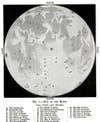
Map of the Moon: August 1887
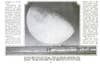
During the late 19th century, we ran “Astronomy with an Opera-Glass,” a regular feature where writers discussed how laymen could study the cosmos using basic theater binoculars. The map pictured left identifies key areas of the moon using translations of their Latin names. The lunar maria, or dried, basaltic lava-filled lunar plains, were called seas by ancient astronomers who mistook the darkened areas for water. But what of the moon’s condition and topography? There was only so much you could figure out via telescope. By this point, telescopes had shown us that the moon was “a mere planetary skeleton” devoid of liquid water, vegetation, and sentient life. From Earth, the whole thing looked pretty lifeless, but there was no reason to believe that the moon completely lacked an atmosphere or soil capable of sustaining life. At any rate, the rugged mountain ranges and vast craters were alien enough to capture our fancy. “If we could visit those ancient sea-bottoms, or explore those glittering mountains,” we wrote, “We might, perchance, find there some remains or mementoes of a race that flourished, and perhaps was all gathered again to its fathers, before man appeared upon the earth.” Read the full story in “Astronomy with an Opera-Glass: The Moon and the Sun”
Moon View: August 1917
This drawing by Scriven Bolton, a noted astronomical illustrator, accompanies a piece where he imagines taking the reader on a trip to the moon, which he calls “a scene of dreary desolation, but nevertheless one of sublime grandeur.” So, what’s on the moon? In terms of life, he said, nothing. No atmosphere, no vegetation, no life. The sky perpetually black since there’s nothing to refract the sunlight, making Earth all the brighter is it floats among the stars. The landscape lies desolate, mountainous, and scarred with volcanic debris. Bolton puts it more eloquently than we ever could: “Indeed we realize that we are in touch with a world which is typical of a dream of lifelessness, an apparition denoting not death, but a world upon which life has never appeared.” Read the full story in “What’s On the Moon?”
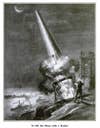
Rocket to the Moon: April 1920
Professor Robert H. Goddard, eventual inventor of the first liquid-fueled rocket, caused quite a stir in January 1920 after The New York Times reported that Goddard believed he could build a rocket capable of reaching the moon. In truth, the writer had taken a small part of Goddard’s reports on rocket experiments, and sensationalized the portions that talked about hurling a rocket filled with flash powder to the moon. The rocket would explode upon impact, giving people with a telescope the impression of fireworks bursting on the moon. The story, while popular, took a hit from skeptics would criticized Goddard’s calculations. He responded a week later with regret that the media had chosen to focus on his flash powder to the moon experiment, which was more of an idea than a plan anyway, than on his research toward using rockets to explore the atmosphere. Nevertheless, his studies and papers made for an entertaining feature, one that we didn’t hesitate to expand on even after Goddard had attempted to redeem his image. Read the full story in “Hitting the Moon with a Rocket”
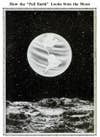
Telescope Eyes: June 1920
These days, we have NASA. Back in the 1920’s, though, our readers had only their telescopes, opera-glasses and imaginations. In a piece titled “If the Eye Were a Telescope,” writer Latimer J. Wilson described how the sun, moon, and planets would look if we could supersize their appearance on the horizon. Instead of seeing the Man on the Moon, people would see winding valleys and “phantom peaks of mountains protruding from pits of bottomless light.” For an optimal view, spectators would have to stand several miles away from the moon, lest they go blind. Incidentally, Wilson also included a description of Mars clearly written before researchers knew much about its topography. He told readers that if the planet were magnified, they would able to see snowcaps, yellow exerts, frosty plains and blue-green forests across the Martian landscape. Read the full story in “If the Eye Were a Telescope”
Moon Crater: October 1920
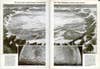
If there’s one thing that distinguishes the moon’s surface, it’s the abundance of craters. Where did they come from? Why are some bigger than others? Even more compelling was their size compared to their counterparts on Earth. While our craters measured a maximum of fifteen miles in diameter, lunar craters stretched to over a hundred miles across, meaning that they could accommodate whole cities and counties with room to spare. This illustration shows how one crater, presumably formed by meteors, could hold Philadelphia, New York City, and parts of Jersey within its mountain ranges. Read the full story in “A Crater Big Enough to Hold New York and Philadelphia”
Earth’s Miniature Moon: March 1924
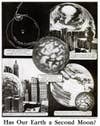
Scriven Bolton, you daring man. Here, he discusses not our actual moon, but a theoretical meteoric iron body that revolves around earth every three hours at 3.5 miles per second. Compared to the moon, the second moon is tiny. So tiny, in fact, it could fit snugly onto the streets of New York. You’d need a telescope to see it. People only began to suspect its existence in the first place because they’d seen a mysterious speck pass between between the sun and the moon. Although people had filed reports of sightings, none of them had been confirmed at the time of this article’s publication. Read the full story in “Has Our Earth a Second Moon?”
Cinder Moon: December 1929
Ancient astronomers had hyped up the moon so much, that the more contemporary scientists studied it, the more unglamorous it became. Here, researchers confirmed that the moon’s “soil” was actually made of volcanic ash. Evidence came from a moon thermometer, which was attached to a telescope, that measured heat rays. Scientists concluded that moondust was made of a porous material, like pumice, after observing how quickly it changed temperature throughout the day. Dr. Paul S. Epstein, a physicist at the California Institute of Technology, heated up various types of earth rocks to compare them to how fast the moon heated up. Granite, quart, and sandstone were all very different, but the rate at which pumice and the moon heated (and lost heat) was almost the same. These conclusions reinforced the volcanic theory of lunar origin, which stated that the moon was formed after a sizable portion of the Earth’s crust broke off billions of years ago. The event was so extreme, that it heated up the moon and turned it into a volcanic body — hence all the volcanic dust and craters, which were presumably formed by explosions originating within the moon’s core. Read the full story in “The Moon is Made of Cinders”
The Midget-Sun Hypothesis: January 1936
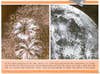
Oops, we take that back, astronomers said. The moon’s largest craters were not formed by volcanoes (at least volcanoes as we know them on Earth) after all. Firstly, the craters of a volcano on Earth are situated in the mountain peak, which is of course taller than the surrounding landscape. The moon, on the other hand, is covered with several large craters that are below the level of their surroundings. A moon “volcano” is essentially a wide pit pockmarked with smaller pits. Where would those craters-within-craters have come from, if they were really caused by volcanoes? Researchers came up with plenty of alternative theories, the most sensational of which were explored in this article. There was the impact theory, which posited that a slew of exploding meteors bombarded the moon during ancient times. Then there was the “midget-sun hypothesis,” pictured left. According to this now unlikely idea, the moon was once a miniature sun, while its craters are the remains of sun spots. Read the full story in “Did Exploding Meteors Dig the Craters on the Moon?”
Germans to the Moon: September 1953
By the year 1953, we were well into the Cold War. Although Germany wasn’t a prime contender in the space race, they did conduct some research of their own. At an interplanetary show in Dusseldorf, visitors learned that they’d land on the moon in an globular ship. An artificial satellite would serve as a spaceport, while rockets would be furnished with couches for comfortable travel. The whole mission would cost 4 billion dollars and use 5 million tons of fuel for 1,000 trips into space. Read the full story in “How Germans Plan to Go to the Moon”
To the Moon We Go: May 1958
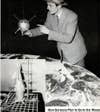
Just 11 years away from the moon landing. Dr. I.M. Levitt that humans would land on the moon in the year 2000 A.D. Why the delay? Well, he assured us, we couldn’t just shoot off whenever we wanted; we had to deal with an impending war, with our lagging technology, our lack of a space station, and with decades’ worth of incomplete research. His timeline to the moon unfolds as follows: 1958 – 1960: Marking the moon. The first man-made object to arrive on the moon would be a device that would give scientists a better idea of how to forge a path for manned rocket ships. 1960: A-bombing the moon. Bombing the moon would send a huge cloud of moon dust into space, and to scientists needing to study its composition further before sending a man up there. 1968: Instruments on the moon. Power supplies ahoy! 1975: Lunar dust brought to earth. Two moon rockets, one with an atomic bomb, will blast the moon again. The second moon rocket would swoop down and collect the lunar dust to be brought back to our planet. 2000: Man on the moon. Victory at last. Once there, he and other astronomers would finally figure out the origins of lunar rays, of the giant craters, and whether or not the moon really explode from Earth billions of years ago. Read the full story in “New Timetable to the Moon”
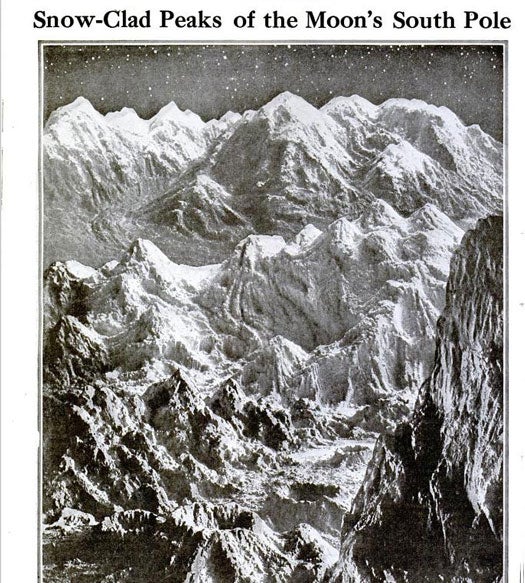
Lunar Snow: March 1924
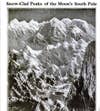
Why are the poles of the moon lighter-colored than their surrounding regions? Back in the 1920’s, many astronomers attributed the contrast in color to snow. Although they accepted that the moon could not sustain liquid bodies of water, they found reason to believe that the towering Leibnitz Mountains, pictured left, were covered in ice. Read the full story in “Snow-Clad Peaks of the Moon’s South Pole”