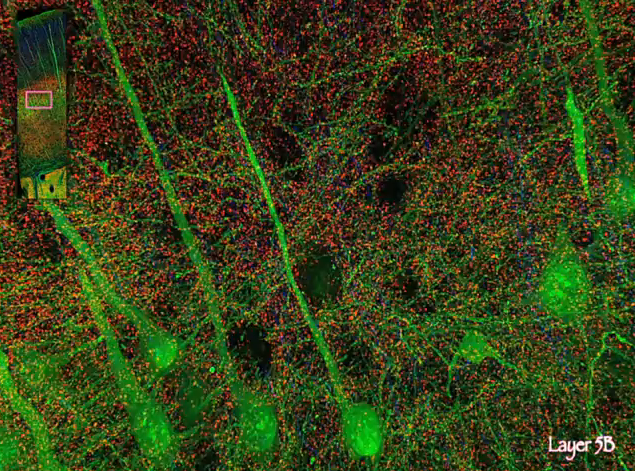
Billions and Billions of Synapses In this image, green bulbs represent neurons in a mouse brain, and the multicolored dots represent individual synapses. There are about one billion synapses per cubic millimeter of tissue. Stanford Medicine via YouTube

A new brain imaging method highlights all the synapses in a mouse cortex, allowing scientists to count these connections between nerve cells in the brain with unprecedented detail. The high-resolution synapse map could help neurologists better understand how brain cells communicate.

A human cerebral cortex holds about 125 trillion synapses, which are connections among neurons, packed into an ultra-thin layer of tissue. That’s equivalent to the number of stars in 1,500 Milky Way galaxies, according to Stanford professor Stephen Smith. These electrical interfaces, found throughout the brain, control all our thinking, feeling and movement.

The sheer number of synapses makes it nearly impossible to see them — even the best traditional-light microscopes cannot resolve them all, Smith explained in a Stanford news release. A single neuron might have tens of thousands of synaptic contacts with other neurons, he said.


But his new method, which involves taking nano-thin slices of a mouse’s cortex, lets scientists actually count the synapses and catalog them according to their type. Called array tomography, it uses high-resolution photography, fluorescent proteins and a supercomputer to put everything together.

Smith and colleagues took a slab of mouse cortex and sliced it into 700-nanometer-thick sections. The sections were then stained with antibodies that would match 17 synapse-related proteins, and the scientists also added fluorescent molecules that glow in different colors in response to light. The antibodies were added in groups of three, and the brain tissue started changing colors. A computer took massive amounts of high-resolution pictures during each staining session, which were ultimately stitched together into a 3-D image. Take a tour through the resulting picture in the video below.

The result is a map of every synapse’s position in the cortex, with colors corresponding to different synaptic types. Smith, author of a new paper on the method that appears in the journal Neuron, said the brain’s overall complexity is hard to comprehend.

“One synapse, by itself, is more like a microprocessor —with both memory-storage and information-processing elements — than a mere on/off switch. In fact, one synapse may contain on the order of 1,000 molecular-scale switches. A single human brain has more switches than all the computers and routers and Internet connections on Earth,” he said.


[Stanford Medicine via Technology Review]

10 Comments

Color me excited! I can't wait to see these developments speed up the process of reverse engineering the human brain. Might this affect the work on the Connectome Project?

The image and the video it's nothing more than amazing.

"A human cerebral cortex holds about 125 trillion synapses, which are connections among neurons, packed into an ultra-thin layer of tissue. That’s equivalent to the number of stars in 1,500 Milky Way galaxies, according to Stanford professor Stephen Smith."

"A single human brain has more switches than all the computers and routers and Internet connections on Earth”

Space exploration is cool and everything, but there's a whole universe inside our heads! Very exciting advances! Hopefully this will eventually lead to unlocking the full potential of the human mind.

No surprise that the only thing more intricate and complex then the entire universe is the connections and functions of the human brain.

why a mouse

Theory- A complex compact computational system can not be reverse engineered.
for example if we give our microprocessors to an alien,will he be able to reverse engineer our micro processors,considering the structure of a MP,which inherently does not permit reverse engineering...

why, mr. Anderson, why, why do you persist?
Because I Choose To...
Regards

User comments: 6
Spam comments: 9

Think that's a problem? I sure do. Real moderators don't get weekends off. What did PopSci hire?

That said, this article really highlights the nearly incomprehensible complexity of the human brain. I'm left in awe once again.

So how many years until we can get a human brain picture (preferably without slicing it to pieces).

good news,there's Fashionable.
☆ ☆
╭⌒╭⌒ ★ ╮╭⌒╮~╭⌒
☆ ╭⌒╮ ╭⌒
our websit: ★∴ ☆
☆ ( http://www.shoppinglove.org )
accept paypal╭⌒╮⌒╮★∵╭⌒ ★∴ ☆
╱◥██◣ ☆
|田|田田│ ☆Free Shipping ★
╬╬╬╬╬╬╬╬╬╬╬

( http://www.shoppinglove.org)
gfhfgrtyrty

This is what we destroy when we declare war in the name of God, or bully someone because they don't "think" the way we do (also in the name of God).


July 2013: The Future Of Flight

The incredible innovations, like drone swarms and perpetual flight, bringing aviation into the world of tomorrow. Plus: today's greatest sci-fi writers predict the future, the science behind the summer's biggest blockbusters, a Doctor Who-themed DIY 'bot, the organs you can do without, and much more.


Online Content Director: Suzanne LaBarre | Email
Senior Editor: Paul Adams | Email
Associate Editor: Dan Nosowitz | Email
Assistant Editor: Colin Lecher | Email
Assistant Editor: Rose Pastore | Email

Contributing Writers:

Kelsey D. Atherton | Email
Francie Diep | Email
Shaunacy Ferro | Email

circ-top-header.gif
circ-cover.gif
bmxmag-ps