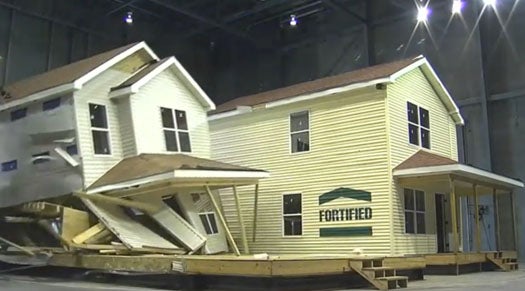
IBHS's New Disaster Lab

On a rural spread of acreage in South Carolina, insurance companies are looking to cover themselves against losses by knocking down houses. That might sound counterintuitive, but from an engineering standpoint it makes perfect sense. The industry-funded Institute for Business & Home Safety yesterday opened a $40 million, 2,300-square-foot disaster lab yesterday that is among the best in the world, with the ability to subject entire homes to tornado-strength winds or Category 3 hurricanes.

The idea is to put standard construction practices and building codes to the test, creating real-world catastrophes within the confines of the facility. One wall contains 105 giant fans that can simulate extreme winds (they cranked gusts up to 96 miles per hour yesterday), and a 750,000-gallon water tank can introduce water to that mix, simulating tropical storm and hurricane conditions.

For such a large, powerful scientific instrument, the science that will take place here is surprisingly simple. Build two houses to different standards and set them side-by-side in the hangar-like space. Flip the switch. See which one is still standing post-tempest. A large hurricane simulation costs about $100,000 to conduct, but given the fact that a Category 3 storm can render damages in the tens or even hundreds of millions, it’s a small price to pay to make sure it knows exactly how sturdy the buildings that insurers cover. Call it insurance for the insurers, who together hold policies on $9 trillion worth of property exposed to hurricane risk alone.

And how better to inaugurate a giant destroyer of buildings than by destroying some buildings? The IBHS fired up its facility for media yesterday, putting a conventional house next to one fortified with about $5,000 extra dollars worth of improvements. In 96-mph winds, the conventional house was ripped from its foundation and smashed in just minutes. But you don’t want to read about it. Witness the destruction below.


[WSJ, Bloomberg Businessweek via Discovery]

10 Comments

That looks just a smidge bigger than 2,300 square feet. Maybe the houses they built were that big??
I'm just sayin'
I always mess up some mundane detail like that...

Plus, that would mean it cost almost $17,400 per square foot! I don't know how the construction industry works in South Carolina, but I think they might have overpaid a little...

ummm. shouldn't they test it being hit by another home? i'm just saying. it may be fortified against wind and all, but debris, a tree, a car, a cow, everything i didn't mention?
I don't think so. again, just sayin'.

@Drewpers

2300 sq ft is the footprint (since it does not have a second level), which is actually pretty substantial. The high cost comes from the equipment as well as making the building itself sturdy enough to handle the tests. I would estimate that the houses you see in the video are probably in the 1200 to 1500 sq ft range which would give them about a 600-800 sq ft footprint which fits neatly into the space, as you can see.

This is a very useful facility and I really appreciate the work they are doing. I lived in Charleston, SC long enough to survive 2 hurricanes, the worst of which was Hugo. My grandmother's condo unit could have definately used the better building practices that this test demonstrated. Hugo blew her condo out entirely and deposited its mangled contents in the wharf nearby, along with most of the other condos in the high-rise. Only the reinforced support walls of the main building were left standing like empty honey-comb.

@MannyA

I had the same thought...hopefully subsequent tests will involve airborn objects. I remember seeing a piece of hay/dried grass literally driven into the side of a tree like a dart. It's definately an aspect of severe weather that this particular test did not really take into account. They did mention that they have the ability to introduce water into the fray, so I hope that projectiles will be the next logical step for them.

@ Odd - No, I think someone at PopSci simply misread the original article, where they specifically say that the *houses* are 2300 square feet and that the lab can hold as many as 9 of them. 2300 = 47^2, so for a two-story house, that's a fifty-by-twenty-five footprint.

@ Dirk

You're right. The actual test chamber is 145'x145' (21,000+ sf). Actually, there are five structures on the campus that cost less than half of the $40 million budget. The fans, variable frequency drives, switchgear, cabling, and other equipment was certainly more than half the total cost of the project.

While the results of the tests themselves will get most of the attention, I hope that there are eventually more details come out about the actual facility and the science behind it.

So we don't have enough real world disasters yet to know how to build a house?

This is pretty cool.

Will they be testing fireproofing homes for wild fires at all? Just curious. Will you continue to follow what works and what does not too?

How many conventional buildings do you think they will destroy before they try an unconventional building?


June 2013: American Energy Independence

Five amazing, clean technologies that will set us free, in this month's energy-focused issue. Also: how to build a better bomb detector, the robotic toys that are raising your children, a human catapult, the world's smallest arcade, and much more.


Online Content Director: Suzanne LaBarre | Email
Senior Editor: Paul Adams | Email
Associate Editor: Dan Nosowitz | Email
Assistant Editor: Colin Lecher | Email
Assistant Editor: Rose Pastore | Email

Contributing Writers:

Kelsey D. Atherton | Email
Francie Diep | Email
Shaunacy Ferro | Email

circ-top-header.gif
circ-cover.gif
bmxmag-ps