
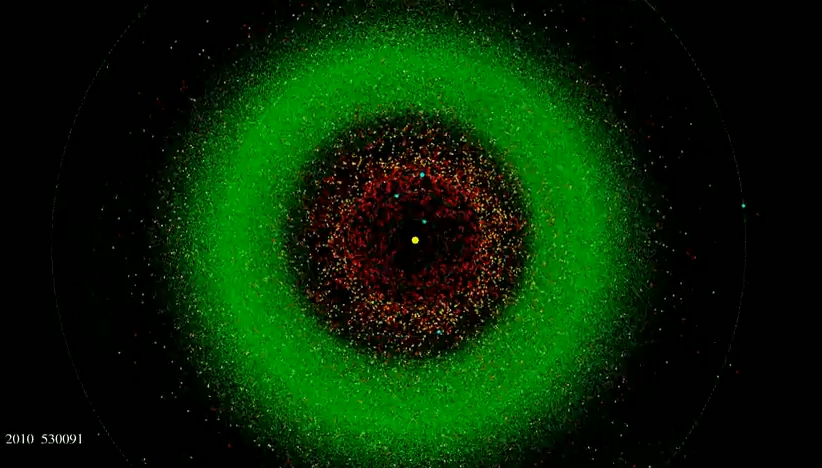
500,000 Asteroids Discovered From 1980 to 2010

In this amazing video of the solar system, the asteroids that were discovered from 1980 to 2010 appear in the sequence as they were discovered. It's very cool to watch the process of discovery. You can observe patterns, as technological innovations come online and spur new batches of findings; and as groups of astronomers all look in the same direction at once -- for instance, when Voyager passed Jupiter, a lot of asteroids suddenly started to be discovered around that region of space.

Watch the video in HD.

[via Slashdot]

17 Comments

Video is soooo...... awesome. I really don't want to criticize it. But why didn't they put a rolling date in the corner of the video. It's awesome, I just wish I could put a time to it. Now I'm gonna go smash my hand with a hammer for having something negative to say. lol

Here's a simple formula for that alias007:

1980 + A = Year of asteroid discoveries

A = revolutions of the earth around the sun

1 revolution of the earth around the sun = 1 earth year

Was that so hard?

Very interesting. How is it we can send probes past the asteroid belt at all?

@TheFourth
Because space is so void and the distances between objects is so immensely large that our space probes have no troubles at all passing through the asteroid bet or the Kuiper belt... the average distance between two asteroids or comets is more than 1 million km squared.

i'm blown away by the shear density of it.
of course that view is around 1.5 M Km and means there is still a lot of space in between objects, but still.
also impressive is the amount of objects crossing earth orbit.

That literally gave me chills. Amazing.

Fummfur, why the attitude? If I misread something point it out but don't try to make someone look like an idiot just because you feel like it. Besides, when I'm looking at Mercury (which whips around really fast) I lose count of the Earth revolutions since my focus isn't on Earth. At all. So counting doesn't work.

But when I see a blast of asteroids get discovered all of the sudden and my focus is currently on a different planet or the sun, or maybe a particular asteroid with a crazy loop - and then I notice a wave of discoveries and wonder what Month/Year it is at that moment, I don't want to have to replay the video and count the revolutions.

That's why having a rolling Month/Year would be great.

Now If I'm still missing something in your logic, please let me know. But try to be more civil if you do respond.

I see now why we changed our focus from the Moon and even Mars for human exploration. The real "resources" in space are easily going to come from asteroids. We need to get our space gas stations up there ASAP, and build spaceships that never come back through the earths atmosphere to ferry material back and forth. Why go through the expense and difficulty building landers, when you can just dock with your resources, or just attach rockets to them and bring them close to home to mine. Could probably just hollow out an asteroid and build a bio dome inside one to project from radiation in long missions. Just fly asteroids around the solar system. Good thinking Obama's administration scientists.

Really good video though, imagine the size of the rock if all those got together to from one big one.

Amazing to watch. It was actually pretty quiet, steady discoveries, gradually increasing the level of green, then 1998 hit and BOOOM! Huge sprays of discovery! Which new telescope corresponds with that year? And also, which new telescope(s) correspond with the discovery pattern we saw around 2009-2010 in the video? The three patterned beams of discovery? Just curious.

xucai - History

Member for
10 hours 35 min.. and already spamming.(2 pages worth of comment spam, 13 in total) shame on you!
popsci add report function and IP bans, etc. so we can sign them up for mass junkmail or something

there is a report function :P

Amazing video!! A time lapse bar would make it even better :)

This is an excellent clip.

Following Earth I noticed discoveries came in bursts always when they were in opposition to the Sun, and therefore reflecting most light back to Earth. Until right at the end that is when there are a few bursts of discoveries at 90 degrees to the Sun-Earth line. What technique was being used here I wonder?

I would have liked a clock in a corner . It would make the clip accessible to a much wider audience.

The post-video motion sickness is almost as good as the video itself.

There is a clock and asteroid counter, you just need to full screen the video.

tuohy69

The sci-fi greats have suggested asteroids as a prime source of resources for years. I remember seeing it mentioned in Asimov's books as far back as the 1970s. While it is a wonderful idea and needs broader introduction to the mainstream, to put credit where due it's not any sort of new thinking on the part of the new administration, though I will give them kudos for being the first administration in a very long time to actually listen to the scientists whose job it is to know these things.

A great science leader does not need to know the science. He just needs to know who does have the knowledge and how to best make use of these people. On the flip side however, compare ANY annual NASA budget in the last 30 years to the money GIVEN to the US auto industry in the bailout, and you'll see there hasn't been one administration in that whole time, including this one, that truly invests in the future.

wow. yeah. pretty amazing. I dint notice any comments on the asteroids that that were not in the belt. I saw a lot that came swooping through into inner orbit. near the end it was clouded with bodies all inside the inner orbit of the planets.


June 2013: American Energy Independence

Five amazing, clean technologies that will set us free, in this month's energy-focused issue. Also: how to build a better bomb detector, the robotic toys that are raising your children, a human catapult, the world's smallest arcade, and much more.


Online Content Director: Suzanne LaBarre | Email
Senior Editor: Paul Adams | Email
Associate Editor: Dan Nosowitz | Email
Assistant Editor: Colin Lecher | Email
Assistant Editor: Rose Pastore | Email

Contributing Writers:

Kelsey D. Atherton | Email
Francie Diep | Email
Shaunacy Ferro | Email

circ-top-header.gif
circ-cover.gif
bmxmag-ps