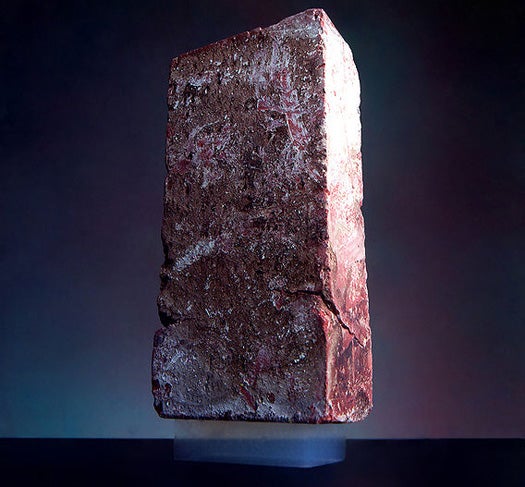
Cellulose isn’t new – it’s been around as long as woody plants have – and aerogels aren’t either. But when researchers recently combined the two, they created something wholly new: a flexible, lightweight, super-absorbent sponge that can also be crushed down into a flat piece of magnetic “nanopaper” capable of supporting 400,000 pounds per square inch.
Aerogels are highly porous yet very rigid solids with extremely low densities – they are commonly used as thermal insulators – typically made by replacing the liquid component in a gel with air. Describing their cellulose aerogel in the latest issue of Nature Nanotechnology, the researchers said they found the best method was to freeze-dry the cellulose, sucking out the moisture and leaving behind a structure of solid fibers. That leftover structure is very light and porous – it’s mostly air at this point – but can still sustain a good deal of weight.
But what happens if you first soak the cellulose in a solution of metallic nanoparticles? By marinating the cellulose in iron sulfate and cobalt chloride, the researchers were able to infuse their aerogel with some of the properties of those metals as nanoparticles were absorbed into the fibers, imparting magnetism among other characteristics.As an aerogel, the material is flexible and foldable (aerogels are usually quite rigid) while still be extremely absorbent; a 60-milligram piece of the material can hold about a gram of water, a pretty decent absorbency ratio. Further, the material can be hammered flat, removing most of the air and resulting in a piece of magnetic “paper” capable of holding huge amounts of weight.
The researchers see a bright future for the stuff in microfluidic devices like fuel cells or used to make small actuators. But given the low cost of materials – it’s basically freeze-dried plant matter – a super-strong, flexible, absorbent, magnetic sponge could likely find a variety of roles to play in materials science.
Five amazing, clean technologies that will set us free, in this month's energy-focused issue. Also: how to build a better bomb detector, the robotic toys that are raising your children, a human catapult, the world's smallest arcade, and much more.


Online Content Director: Suzanne LaBarre | Email
Senior Editor: Paul Adams | Email
Associate Editor: Dan Nosowitz | Email
Assistant Editor: Colin Lecher | Email
Assistant Editor: Rose Pastore | Email
Contributing Writers:
Kelsey D. Atherton | Email
Francie Diep | Email
Shaunacy Ferro | Email
they should make bullet proof vests out of the magnetic super nano paper. it'd definitely leave a few souvenirs behind for the person wearing it.
"a super-strong, flexible, absorbent, magnetic sponge"
thats just insane. but question, what does it absorb? can it absorb oil type fluids? Say I take that super paper and weave it like carbon fiber to build my car out of, when I wreck will it start absorbing all the fluids from the busted hoses?
sounds perfect for a certain feminine hygiene product.
u all realize that piece shown in the picture would be about $3000 right? bullet proof vest indeed
Let's make a star ship out of it.
Run enough power through a hull made of this stuff and you might be able to make a warp bubble...
This stuff may be the best thing since sliced bread, but right now they're just guessing -- or as the source article says "speculating".
I didn't see any numerical data in either article, so they probably don't have any yet. At this point, it's an "interesting phenomena".
I love new discoveries, but this over the top hype gets old.
@vivioo7 - You do realize that the piece of aerogel shown in the picture is not the material that is written about? Read the caption.
Also,you can purchase it for rather cheap, considering a 25mm x 9mm disc of it only costs $35 online.
The Royal Institute of Technology (KTH) in Stockholm, , have invented this cellulose gel, doped with magnetic ferrite particles.
www.kth.se/en/aktuellt/magnetiskt-nanopapper-visar-vagen-for-nya-skogsprodukter-1.64142
Also the Swedish nanotech company Aeroel AB, have discovered a new manufacturing process, which is made, chemically, in room temperature without autoclaves. This areogel wont get ALL the properties an autoclaved aerogel will get, but good enough to be a very attractive product, for just 10% of the production cost of the autoclaved aerogel.
www.aerogel.se/