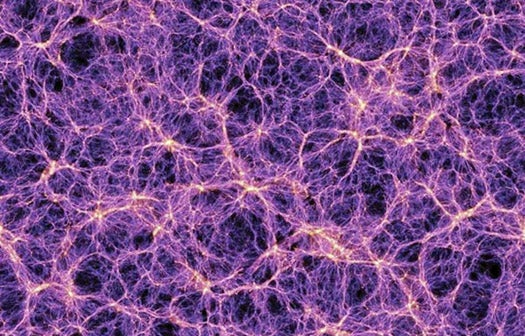
The Cosmic Web of the Universe Nickolay Y. Gnedin, Nature, 435 (2 June 2005)

It took mankind centuries to map the Earth, and even with all of the indexed knowledge in the world behind it Google can't always figure out exactly where the nearest Pinkberry is. So one might imagine how even with the amazing leaps in technology over past decades, mapping the universe is no small undertaking. But a new technique could allow cosmic cartographers to map 500 times as much of the universal landscape as they have thus far at a fraction of the cost.

We don't know a whole lot about dark matter, outside of the fact that gravity suggests that it's there. But we do know that galaxies exist in a sort of dark matter web that runs throughout the universe. Using luminous galaxies as waypoints, astronomers have been able to map this cosmic web to some extent, but galaxies more than 5 billion light-years away are too dim to survey. Since we know that the leftovers of the Big Bang have left us with a far-off waypoint that we've determined to be about 45 billion miles away, we can be sure that we haven't mapped the vast majority of the observable universe because we simply can't see it.

Instead of looking for the light emitted from individual universes, the new technique looks for red-shifted radio waves emitted from hydrogen atoms clustered in gas clouds within galaxies. These red-shifted waves are distinctively red-shifted 21 centimeters, indicating the presence of hydrogen and hence a galaxy. The technique can detect galaxies far beyond that 5-billion-light-year boundary, plotting the locations of galaxies as far as 12-billion-light-years out.

A radio telescope optimized for the task could do even better, and researchers are presently developing plans for just such an instrument. What's more, it should cost about $20 million. In terms of space telescopes, that's dirt-cheap. With it, they think they will be able to map as much as half of the observable universe faster and more cheaply than galaxy surveys can.

Now all we need is a vehicle that allows us to put these intergalactic maps to good use.

[Science]

16 Comments

why are we so into mapping the universe? we cant even get to mars.

"why are we so into mapping the universe? we cant even get to mars."

You answered your own question. Because we can.

Give to every human being every right that you claim for yourself.

We can go to Mars but we don't. Perhaps because we can't make it just yet. That was the point nizeke was making. The shuttle is and obsolete 1970's technology.

We can do better.

Unfortunately we don't. I thought by now we would be out of our solar system, perhaps explored more then five percent of our oceans, but we don't.

Considering the dismal science education, and low graduation rates for people in STEM fields, and with children nowadays jockeying for political, athletic, or business careers, is it any wonder?

Or there is the obviouse reason, there is no money in it, or at least not enough to make it worth anyone to do it. Rememeber when Pizza Hut paid around a million to put their log on a NASA rocket. They need to do more of that in order to fund the research. NASA tends to do everything in house and relies on funding instead of creating their own. Orivate companies are much faster and as long as say, NASA was to tell them, " yeah, we will use your technology as long as its safe and meets guidlines." they will hapily do it. Of course in turn, NASA would have to put their advertising on it and promote them. Thats the way of the world and has been. Money talks.

Astronauts would make more money in promotional advertisements than NASA can pay them if they did it, just like Athletes like football players. Imagine how much money NASA could make if they built a giant electronic Billboard in space and got paid advertisements.

Millions I say...Millions.

"why are we so into mapping the universe? we cant even get to mars"

The same reason that we decided to look past the horizon or into the heavans...we want to see whats out there!
Whats next!

My cousin has the same attitude as you appear to have:
"I cant see myself doing anything else, so why bother looking?".
He has worked at Pathmark for 10 years and is STILL a stock boy.

If we took the mentality that we wont bother to look ahead (or farther) than we can now just because we cant GET to the first stepping stone....then we fail as a species and should just give up now.

"Since we know that the leftovers of the Big Bang have left us with a far-off waypoint that we've determined to be about 45 billion miles away, we can be sure that we haven't mapped the vast majority of the observable universe because we simply can't see it."
What does that sentence mean - what waypoint? 45 billion miles? that's really close - about 3 lightdays. Do they mean the traces of the Big Bang seem to indicate it happened 45 billion lightyears away, indicating the observable universe has to be a lot more than 90 billion lightyears across, since the Big Bang would be in the centre and we aren't on the edge? That could have been said a lot better, and without the glaring 'miles' mistake. Things like this really confuse and misinform less technical readers.

Not to mention "looking for the light emitted from individual universes"... individual universes - well, that would be quite the trick, wouldn't it. I guess they mean galaxies. A bright kid could read this article and come away with some very mistaken ideas. I love PopSci, but i wish mistakes like this got caught.

"indicating the observable universe"

'observable' how?

Isn't anything further away than the age of the universe, beyond our observation forever?

Ever have a tired day at work?

People are too fucking critical of everything anymore, it's really god damned tiring.

Lighten up.

@ podboq
Your point about 'observable' is well taken. It should just be 'universe'. It's just that the limits, if there are any, of the universe are so theoretical, i hesitate to be so cut and dried.

But pointing out errors is important. People read PopSci to learn about things, not just to be entertained. This is a science magazine, if it isn't accurate, it isn't serving it's purpose.

Still too critical, it's popular science, not a scientific journal

Popular science still has to be science. Allowing gobbledygook into an article alienates informed readers. I've been reading Popular Science for 50 years (my grandfather was a subscriber since the 1930s) because its one of the best describers and interpreters of science around. I'd hate to see standards drop. A little more proof reading and sanity checking please.

That's simply fantastic, incredible model. At first glance, it looks like a brain neuron network. Than I realized, there's no empty space between those galaxies. Furthermore, that's not just a distribution of hydrogen, because particles are moving and they're smeared around. Looking even deeper reveals sort of tunnels inside a structure, like at lower right corner.
If picture would be filed and in familiar reddish color, it would almost look like the sun. Are we living inside the giant Sun?

How bad do you want the space ship and why do you need it?

"the light emitted from individual universes" -- multiple what, now?

"a far-off waypoint that we've determined to be about 45 billion miles away" -- 45 billion miles is 484 AU, outside the Kuiper belt but well inside the Oort cloud, and thus definitely part of our solar system. Perhaps 45 billion light years was intended, which is roughly the comoving distance to objects near the edge of the visible universe.

"distinctively red-shifted 21 centimeters, indicating the presence of hydrogen" -- 21 cm is the Hydrogen line, and light from other galaxies is (usually) red shifted, but it is certainly not "red shifted 21 centimeters". Redshift is normally expressed as a dimensionless quantity.

This article may be popular, but it ain't science.

"Now all we need is a vehicle that allows us to put these intergalactic maps to good use."

I don't know if anyone is aware, but there is a design for a rocket engine that would get us to Mars in a couple of months (rather than a few years). It would need an energy source more powerful than we currently have. Then there is the "BlackLight Process" that ought to do the trick (200X the energy from hydrogen than burning it).

Unfortunately, I have posted the article on the new rocket engine design and the information on the "BlackLight Process" on my blog (www.myspace.com/dobermanmacleod), but can't easily access it right now. Will provide both upon request.

By the way, here is a short CNN clip of that new clean and cheap energy production technology: www.youtube.com/watch?v=Ymlc8nk7Mdk

As a bonus, here is a CNN article on the subject too: money.cnn.com/2008/07/01/smallbusiness/blacklight.fsb/index.htm

http://www.uggbootspp.com/

this is an online shopping store operated for many years.have lots of new and old customers from United States and Europe now.
you can find many of cheap price,high quality,fashion ugg boots here .

in order to meet christmas ,if you order more .we will give gift be free.

more info of ugg boots .please link this site
------------- http://www.uggbootspp.com/


June 2013: American Energy Independence

Five amazing, clean technologies that will set us free, in this month's energy-focused issue. Also: how to build a better bomb detector, the robotic toys that are raising your children, a human catapult, the world's smallest arcade, and much more.


Online Content Director: Suzanne LaBarre | Email
Senior Editor: Paul Adams | Email
Associate Editor: Dan Nosowitz | Email
Assistant Editor: Colin Lecher | Email
Assistant Editor: Rose Pastore | Email

Contributing Writers:
Rebecca Boyle | Email
Kelsey D. Atherton | Email
Francie Diep | Email
Shaunacy Ferro | Email

circ-top-header.gif
circ-cover.gif