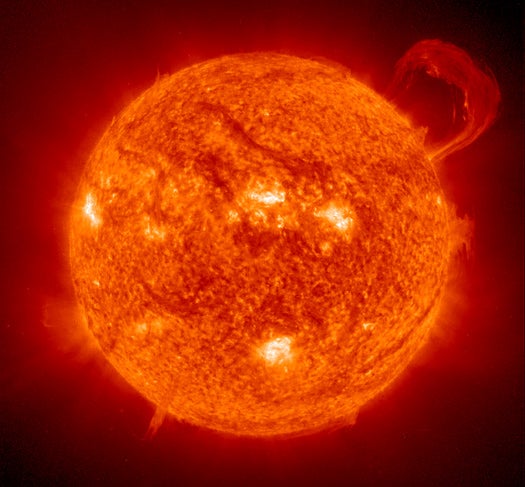
Of all the bodies in our solar system, the sun is probably the one we want to give the widest berth. It gushes radiation, and even though its surface is the coolest part of the star, it burns at about 9,940°F, hot enough to incinerate just about any material. As such, there are no plans to send a manned mission in its direction anytime soon (Mars is much more interesting, anyway), but it can’t hurt to figure out at what distance a person would want to turn back. You can get surprisingly close. The sun is about 93 million miles away from Earth, and if we think of that distance as a football field, a person starting at one end zone could get about 95 yards before burning up.
That said, an astronaut so close to the sun is way, way out of position. “The technology in our current space suits really isn’t designed to withstand deep space,” says Ralph McNutt, an engineer working on the heat shielding for NASA’s Messenger, a new robotic Mercury probe. The standard space suit will keep an astronaut relatively comfortable at external temperatures reaching up to 248°. Heat coming off the sun dissipates over distance, but a person drifting in space would begin encountering that kind of heat (the five-yard line) some three million miles from the sun. “It would then be a matter of time before the astronaut died,” McNutt says. Above 248°, the suit would transform into a close-fitting sauna—the temperature would climb above 125° and the person would become dehydrated and pass out, eventually dying of heatstroke.
Riding in the space shuttle, though, someone could get much closer to our star. The ship’s reinforced carbon-carbon heat shield is designed to withstand temperatures of up to 4,700° to ensure that the spacecraft and its passengers can survive the friction heat generated when it reenters the atmosphere from orbit. If the shield wrapped the entire shuttle, McNutt says, astronauts could fly to within 1.3 million miles of the sun (roughly the two-yard line). But the integrity of the shield degrades rapidly above 4,700°, and the cockpit would begin to cook. “I would advise turning away from the sun well before that point,” McNutt says. Much hotter than that, the shields would fail altogether, and the vehicle would combust in less than a minute.
Of course, just getting that close to the sun would be quite an accomplishment, says NASA radiation-health officer Eddie Semones. The constant exposure to cosmic radiation during the voyage would most likely prove fatal before the astronauts crossed the 50-yard line.
Have a science question you've always wondered about? Send a tweet to @PopSciFYIGuy or email to fyi@popsci.com
Five amazing, clean technologies that will set us free, in this month's energy-focused issue. Also: how to build a better bomb detector, the robotic toys that are raising your children, a human catapult, the world's smallest arcade, and much more.


Online Content Director: Suzanne LaBarre | Email
Senior Editor: Paul Adams | Email
Associate Editor: Dan Nosowitz | Email
Assistant Editor: Colin Lecher | Email
Assistant Editor: Rose Pastore | Email
Contributing Writers:
Rebecca Boyle | Email
Kelsey D. Atherton | Email
Francie Diep | Email
Shaunacy Ferro | Email
Interesting, thanks for the info!
Now all we have to do is figure out how much shielding it would take to get within 3 million miles(not to mention, a reason for undertaking such a mission)!
Reason: IMAX film. That was reason enough for people to drive a big souped-up armored vehicle into a TORNADO, so it should be enough to get some similar crazies to fly near the sun.
I'd love to be an astronaut, though personally, I want to be on the first manned Mars mission, not a mission to the sun.
good to know if one day we must send a massive nuclear weapon into the sun to reignite it's core.......a gold star to anyone who knows what I'm referencing
All logic aside....How cool would the sun look if you were 1-3 million miles away from it?
Yes, I know, blindness and all the considerations of reality...but still. If you could actually view it comfortably (big welding goggles)...I bet it would be beautiful!
Sunshine
I loved that movie
plenty of sci-fi books have offered very interesting and possibly realistic ideas of explore the outer layers of the sun. Most using magnetic shielding. Probably the only way to ever truly enter the cronosphere (sp?) unless our control of creating materials increases 1000 fold before our manipulation of magnetic fields. and yeah sunshine rocked... BUT to plays devils advocate a movie with about 70% of the exact plot was made called solar crisis that came out 2 decades before.
Easy! Just go at night!
What SPF do they recommend for astronaughts at those distances?
Is this so we can go back in time and get whales?
Sounds like a death wish, Good luck to the astronomers who'll enter the solar field's wild wild west.
Turn the Chandra X-ray Telescope inside out.
In other words turn the outside of your Shuttle into a giant grazing mirror.And probes or humans would survive a much closer approach.
If one went at night all those issues could be avoided. It's certainly alot cooler and darker at night.
We could probably get a lot closer if we built a Tardis.
Then, we could even watch the sun be born if we wanted~
Never understood Sunshine... Why not just use "all of the fissionable materials on Earth" to power an underground society rather than wasting it in the sun which is going to emit all of the energy everywhere BUT Earth (0.00000000001%)... It's all about surface area!
Although the ship design was absolutely amazing! The idea of having a radiation/impact shield on the front of the craft is a good idea, then perhaps make a diffusion sphere around the craft to reduce cosmic radiation to a manageable level. I would think zero gravity construction would make sphere-building rather easy...