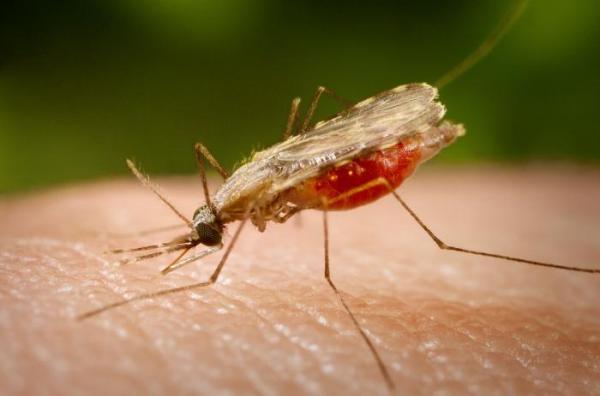
Scientists at the University of Arizona have successfully bred genetically modified mosquitoes that are 100 percent resistant to the malaria parasite, rendering the mosquito incapable of infecting humans with malaria.
For years, researchers have tried to engineer mosquitoes so that they're immune to the parasite that carries malaria -- a single-celled organism called Plasmodium. But previous attempts only succeeded in destroying about 97 percent of malaria parasites in mosquitoes' bodies. The difference between 97 and 100 percent might seem negligible, but Michael Riehle, who led the new study, says that 3 percent means the difference between success and failure. "If you want to effectively stop the spreading of the malaria parasite, you need mosquitoes that are no less than 100 percent resistant to it," he said.
In the new study, Riehle's team designed a piece of genetic information that inserts itself into a mosquito's genome. When the researchers fed malaria-infested blood to the modified mosquitoes, the Plasmodium parasites did not infect a single animal in the study. And once the anti-malaria molecule is injected into the mosquito's eggs, the next generation then carries the altered genes and passes it on to future generations.
The team also found that the anti-malaria molecule shortened the mosquito's lifespan, which minimizes chances that the malaria parasite will develop. Wild mosquitoes typically live for 2-3 weeks, but the malaria parasite needs 12-16 days to develop within the mosquito before it can be transmitted back to people. "The oldest mosquitoes are responsible for most malaria transmission, so reducing the lifespan of the mosquito can reduce or eliminate the number of people the mosquito can infect," said Riehle.The malaria parasite is carried by the female Anopheles mosquito. When transmitted to a human, the parasite travels first to the liver and then on to the bloodstream, where it reproduces and destroys red blood cells. An estimated 250 million people contract malaria each year, and about 1 million die -- many of them children. There are currently no effective or approved malaria vaccines, although a few have been tested. Riehle says that even if a vaccine were developed, distribution would be a major challenge.
According to Riehle, completely eradicating the malaria parasite carried by mosquitoes requires three things: the ability to engineer the mosquito, finding genes or molecules that can kill the malaria parasite, and giving the modified mosquitoes a competitive advantage so they can replace the wild population. The first two components have been accomplished, but Riehle says the third represents a bigger hurdle. "A lot of research is being done now to give the mosquitoes fitness advantages so that they can replace the wild populations," he said. "But it's probably at least a decade away, and if this is ever used for malaria control it will take several years for population replacement to actually occur."
Riehle stressed that complete blockage of the malaria parasite is essential to any future control strategy -- if some of the parasites slip through the mechanism, then the next generation will likely be resistant to it. "If you release the mosquito and within two or three generations, it's no longer resistant to the malaria parasite, then you're back where you started," he said.
The genetically altered mosquitoes from the new study are being held in a secure lab environment that ensures they won't escape. Once researchers find a way to replace wild mosquito populations with lab-bred ones, the altered genes will hopefully spread through the natural population. If the approach ultimately succeeds, malaria could be a disease of the past.
The results of the new study were published today in the journal Public Library of Science Pathogens.
138 years of Popular Science at your fingertips.
Each issue has been completely reimagined for your iPad. See our amazing new vision for magazines that goes far beyond the printed page
Stay up to date on the latest news of the future of science and technology from your iPhone or Android phone with full articles, images and offline viewing
Featuring every article from the magazine and website, plus links from around the Web. Also see our PopSci DIY feed
Science is reinventing play, from extreme sports to gamification to ridiculous roller coasters to the playgrounds of tomorrow, and this issue is chock full of fun. Also, on a less fun note: Did global warming destroy my hometown?
I wouldn't wish malaria or death on anyone.... but does the earth really need more people?
I worry that the same groups that allow Africans to starve to death by protesting genetically modified foods would also rather see them die of malaria than introduce a genetically modified mosquito.
@podboq - Is it only Africans that should have their population limited, or are you willing to forego medical care when you are dying?
the whole more people deal isnt as big of a deal as you would think. the earth can support plenty more. and if you look at the numbers population growth around the world is diminishing. many countries dont even have a positive birth/death ratio. and in more modern countries, family sizes are decreasing. even america is only slighty over the birth/death ratio. it may not be long before we see a negative. something interesting to look at is a map of the world with country breakdown of birth numbers. considering you need 2.2 children per family to have growth, most countries hover around 1-3. http://www.sublimeoblivion.com/wp-content/uploads/2010/06/world-fertility-map.png (world fertility map)
If the entire state of New Hampshire was made up of buildings like the city of Brooklyn, the entire U.S. population could fit into it. Population isn't the problem.
@podboq like nizeke pointed out a lot of developed countries are moving towards or already are at a steady population (no growth) while others are even shrinking due to low birth rates... assuming the entire world can be brought to that level the population problem will sort of solve itself... but getting to that point before too much damage is done to the earth (obviously technology will play a key role in reducing that damage like better land use especially in agriculture and speeding up the progress) and avoiding anything that would increase birth rates like some catastrophe/war capable "un-developing" (e.g. blowing up/mad max-ing) countries or unforeseen social changes is the part that needs to be focused on... or something.
The article said it reduces the lifespan which I'm guessing would be selected against but I suppose since malaria would become quickly resistant to them like they pointed out you only need those genes in most of the population for a few generations, after that point it will be sort of useless either way (malaria being resistant or extinct) and as a bonus they can tell nagging GMO haters "that the modified ones will die out by themselves so fuck you!" Of course all of this lies on the assumption I made that they would be selected against...
Engineering a malaria-free mosquito is nice, but I hope that other mosquito-borne diseases, such as dengue, could be the focus of follow-on efforts as well. While they're at it, I wouldn't mind at all if they could engineer the mosquito out of existence altogether. I know there's this school of thought that says we should value every creature no matter how dangerous, disgusting or merely annoying, but I for one would not mourn too much the dropping of mosquitoes, leeches, guinea worms and the like from nature's roster. Extinction should not only be reserved for the cute and cuddly!
PS: And will someone start producing that anti-mosquito laser already?
This is a really brilliant idea that could save a lot of lives, but I was just wondering if any research was yet conducted on what impact these genetically-altered mosquitoes would have on the ecosystem if they became the dominant species of mosquito. This is a rather radical concept, and I think humans have messed around with the natural order of life enough.
I'm not FOR killing anyone now alive... Those countries with food problems, and thus population problems really need to start using their brains before their sexual organs... There are other ways to be sexually gratified other than procreative sex.
I imagine, for that's all I can do, that if i had problems getting food for myself, I'd refrain from having children that I'd have a high likelihood of watching starve to death.
Just sayin....
I wonder what happens when an altered mosquitoe is bred with a normal one. Does the next generation carry the genes to completely resist or simply "resist-enough" to give another avenue for the parasite to adapt; perhaps, just enough to be able to overcoming the lab modified versions as well?
The key is keeping the next generation 100% resistant. If cross-breeding is possible, then I have doubts that this will be acomplished... mutations with limited restance are bound to appear in the long run. It's not always the fittest that survive, sometimes just the lucky ones.
Even though i don't totally agree with podboq, I think he brings up a good point. Educating, or at least informing the Africans about sexual education, would really help big problems in poor African countries like Ethiopia and Kenya about AIDS and other STDs. Additionally it would help with starvation by stopping the Africans from having malnourished children that would eventually die or have more malnourished children that would live a terrible existence and be susceptible to a myriad of deadly African diseases.
Ok back on topic rather than flaming. BTW as we come closer to the end of our ability to strip the ocean floor of nutrients for farming we will see where the old able to support X humans comes back into play. However that is not the point of the topic. The point is that they have created a way that possibly stops malaria in its tracks. That is great seeing as it is a life long disease. You never out grow. My Dad got it in Vietnam, guess what not African or black, but white American. This is a non selective disease. It doesn't care where you come from or the color of your skin.
Anyway the point of my rant is that years ago there was another story where they claimed that mosquito's played little or no niche roles in the environment. What that interprets to if I remember correctly is that the loss of the species would not impact known wild life out side of that species. In the story I am referring to they claimed that they had a way to genetically remove mosquito's from the world. Now they say remove the virus. After all the itching days of child hood I am still ok with the removal of the species. I know evil on some lame level. But I am ok with the evil of ridding the world of mosquito's.
Better child health and survivability always comes first in the cycle of a developing country before family sizes start to become smaller. This happened dramatically between 1970 and 1990. Many developing countries got over 70% child survivability and then their family sizes began to decrease. If you're worried about the African's breeding like rabbits, then their health needs to improve and this is a big step in that process.
The world's best population control is prosperity. If Africa prospers it will hit the same demographic transition as Western Countries. So stop buying only local fruit, stop subisdizing farmers, and let Africa compete.
Re: Africans over-breeding: There's no reason to let a child starve because his parents made a bad decision to conceive him.
OK, this gene will remove 100% of malaria,that is only known strands- don't you think it only takes one malaria parasite to find a way around the mosquitoes new defense mechanism (these new genes) before malaria is a problem again-it wouldn't take long~sorry, just telling the truth~it will save lives at first, but who knows.....
This could be a huge breakthrough for the people of the developing world. I think that most people don't realize that Malaria still is the most deadly disease in the world killing 1,000,000 a year. It is a little scary to think that we could possibly genetically engineer a wild population through breading. I feel like this is a slippery slope and we need to be careful. Scientist in the past have done ok with fighting malaria but recently have made a huge breakthrough. The have effectively created a cure for Malaria called Artesinate. It is scheduled for FDA approval and could change the game for people inflicted with this horrible disease. I'll post a link to a video all about this new cure. It's truly amazing!
http://www.ndep.us/Fighting-Malaria
Didn't PopSci already post this "news" a few months ago.
Recall that I never mentioned any specific racial group...
There is no humanity, only science.
so immunity means the body kills the invader, not they live together in harmony, with no ill effect on the host, but the host is free to spread the disease to the rest of the world.. ok. good to know. but what happens when the invader gets immune to the host species' immunity? something worse, like drug resistant staph? what would cost more, designing a malaria killing mosquito and flooding the ecosystem with it, or a massive mosquito screening initiative? idk, that's why i'm asking, but i do know which one would create more jobs. yes, there are still ways to get malaria either way. evolution in the mosquito case, being outside the screen, mosquitoes getting inside the screened environment in the other case.
i do know one way to combat starvation and the spread of disease. yes i said combat. give them more guns. ok that's not funny, plenty of people will take offense. when it all gets out of hand, just drop a nuke. pretty sure nukes are one of the more effective cures for HIV and malaria and most importantly (leading to the spread of disease, and starvation) overpopulation.
i do in no way condone genocide. well except for genocide such as in the context of this story, genocide against malaria, in this case. i also support the illegalization of cancer, which would stimulate the development of cancer detection systems, and make it necessary to confiscate, or possibly destroy the illegal substance. yep, problem solved. cancer scanners and free cancer removal surgeries.
obviously being retarded. trolling maybe? freedom of speech & press, even if what you're saying is stupid.