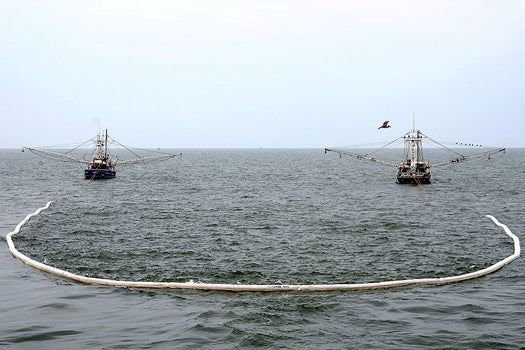
As BP sits down for a not-so-friendly back and forth with Congress this morning it seems the oil giant is resigned to let the Gulf oil leak flow until the relief wells are completed in August. But a nuclear physicist from California thinks he’s devised a method that could stop the gushing well by pumping steel balls into the riser. It’s likely to work, he says, and even if it fails it won’t make matters any worse. Naturally, not everyone involved is so optimistic.
Saying things can’t get any worse in the Gulf at this point seems like a dubious claim, but Willard Wattenburg’s idea has made it all the way to the desk of Energy Secretary Steven Chu. Why? Wattenburg orchestrated the capping of 500 wells in just seven months in Kuwait in the aftermath of Gulf One, a job that was estimated to take 5 years, so he’s got the oil industry chops. But naturally there are some who think the idea is a bad gamble that could indeed exacerbate later efforts to stem the flow of oil.
Wattenburg’s simple idea involves pumping steel balls into the leaking riser that are heavy enough to sink downward in spite of the upward pressure from the upward-surging oil. Once the balls get deep enough down they’ll begin to settle and slow the flow – the job the drilling mud failed to do during the top kill. Once the flow is decreased, we can pump in the concrete and cap the well. We’ll need a bout 200 tons of steel balls, Wattenburg says. Total cost: about $100,000.What’s more, if it fails if fails without leaving an environmental crisis in its wake, Wattenburg says, and the relatively low cost make it worth a try.
Other engineers are skeptical. For one, they say, the oil is rushing up not through the central pipe, but through the space between the central pipe and the outer casing. The balls would likely take the easiest route downward into the central pipe, where they won’t make a difference. Further, a bunch of steel balls in the well could complicate capping efforts once the relief wells are complete.
The real question now is: Do we make the conservative play and wait for the relief wells to be drilled or should the government go in and attempt new methods of plugging that damn hole. And if those attempts make matters even worse in the Gulf, does that take the blame off of BP to some degree?
Five amazing, clean technologies that will set us free, in this month's energy-focused issue. Also: how to build a better bomb detector, the robotic toys that are raising your children, a human catapult, the world's smallest arcade, and much more.


Online Content Director: Suzanne LaBarre | Email
Senior Editor: Paul Adams | Email
Associate Editor: Dan Nosowitz | Email
Assistant Editor: Colin Lecher | Email
Assistant Editor: Rose Pastore | Email
Contributing Writers:
Rebecca Boyle | Email
Kelsey D. Atherton | Email
Francie Diep | Email
Shaunacy Ferro | Email
BP is 'on' the hook regardless, and frankly so are the sub-contractors used to drill the well.
Lack of Engineering oversight and blatant cost-cutting to the detriment of proper engineering is the root cause - "Do the job right the first time" ~ Mike Holmes
I'd say give it a shot. How would it complicate our efforts later? If the hole has steel balls in it that will just add to the framework for the concrete to bind to (think rebar). At $100,000 its worth a shot, even at $100,000,000 its worth a shot. While some of them may take the easiest route around the edges all of them can't. If you slide 200 tons of ball bearing into the pipe some are bound to bind together. I seem to remember a game like this when i was a kid....a tube with sticks in it with marbles that were suspended by the sticks so you had to remove the sticks until the marbles fell. If tyco can figure it out why can't we?
Found it, its called Ker Plunk and mattel made it, not tyco. my bad.
I have a solution: Please pay attention. They attempted to cut off the pipe and put a coupling over it. But the cut was done with a ragged edge, so the oil likes out around the seals of the coupling.
But there is a another way to stop or reduce the quantity of flow. You install a down size pipe INSIDE the existing oil pipe. This pipe will be extremely as long as you can force the pipe down inside the existing pipe. Then his pipe will stick out above the pipe by 1 /3 that distance and have places to couple it to the existing outside piper coupler\structure. This will keep the pipe from being shot out from the pipe with the pressure of the oil. Repeat this procedure many times, reducing the flow of oil finally coming out of the pipe, with additional pipe reducers. Perhaps at the tail end you have the choice of capping the well or just capture the reduced oil flow to a tanker above. But the over all quantity of the oil to the environment can be reduce by a larger percentage.
Basically, Put a smaller in pipe(1) inside the pipe(0); add another a smaller pipe(2) inside pipe(1); add another smaller pipe(3) inside pipe(2); add another smaller pipe(4) to inside pipe(3).... cap well or attaché pipe line and pump remainder oil to tanker........... The over all oil being spilled to the environment is largely reduce or stopped.
Finally, take the 20 billion money from BP just offered, lay a large network of hundreds of miles of pipe in the Gulf. BLOW AIR in these pipes and assist the natural bacteria to chew and eat the polution really fast, extremely fast. This will reduce a enviroment disastor of 50 years to maybe 5 years or less..
Third, employee any GULF coast boat, tourist, fishing or any other kind that is out of a job, to drive their boat to a specified area of the GULF, drop extremely long lines of hose or pipe with AIR COMPRESSORS running. Give these BP unemployed workers a job and clean the environment too. If their boats get damage from this, let them bill BP for this expense too. Employee as many people as you can, give these people new boats at the end of the clean up and clean the environment in the process!
If this problem continues for a few more months, I wonder if we'll hear dismissals of the efforts to cap the well as "science fiction fantasies," "poorly informed techno-utopian speculation," "progress porn" and other pejoratives you could just as well apply to many of the futuristic visions "Popular Science" has published over the years.
Fourth, get involved water processing plant engineers on this task as fast as possible. All across US, in every city of the USA, we have water plants that process bad water to clean water. There is intelligent science to deal with this problem. Most of the time, if you assist nature (bacteria) with lots of air (oxygen), the process of clean up goes extremely fast, the toxins become non toxic and just settle to bottom, harming nothing. The left over is just clean water.
Fifth, BP is currently doing a lot of burn off the oil now, suggestion this is a clean process of dealing with the oil. In the extreme short term, this is correct, but in the long term, this burning of oil on a large scale is just planing POLUTION with CO2 added to the air. I am confident everyone in the world is aware added more POLUTION and CO2 is bad for the air and bad for the OCEANS too! Burning of the oil, is a dumb, long term solution. Yes, on the video is looks like BP is doing something productive, but in reality, its not a healthy solution; it’s a bad solution.
Oh by the way! The GULF does not belong to the USA and did you know there is lots and lots of other countries drilling oil in the GULF. We have no control over this 3rd party oil riggs, safty or the manner of how they drill their oil. If any of this other countries or oil rigs fail, we are sunk!
I don't think the water filtration idea won't work....To the best of my knowledge, the types of treatment done to our drinking water usually isn't sufficient to filter out oil or oil emulsions. Once you get the majority of the oil out of the water, which isn't terribly difficult, its really tough to get the water to very low concentrations of oil (ppm or ppb) required for drinking water standards. One of the most common methods is by using an air stripper, but it's typically neither fast nor efficient.
Ok... I am taking a little look at my google\maps...hmm. Ok, got it. BP gave USA 20 BP, check. Every South American country touching the GULF waters with dead fish and dead coral reefs and their economies are not mention. Hmmm, seems BP is getting off easy. You know if you are rich and become poor, most of the time you can eat. But if you are poor and you have nothing, you just die. "BP!" Many of these people in the GULF region are from poor economies! DO NOT FORGET THEM in this disaster. YOU DO NOT GET OFF THIS EASY BUB!
City industrial plants process bad water to clean water quickly. Yes, my flipped ideas of clean up this oil mess with blowing AIR into the water is not a quick solution. I do make the point this is going to be a 50 year environmental disaster and if we act proactively, we can reduce this to a much less time. I also make the point we NEED to have REAL SCIENCE and REAL ENGINEERS PROFFESIONALS, that are experience with dealing with oil and environment poisons and water clean up. There are solutions, but it has to be done on a large scale. We have a large scale disaster. To reduce this problem from 50 years problem to a 5 year or less problem would be a reasonable goal.
Having seen and participated in a lot of remediation efforts dealing with hydrocarbons, I can tell you that the goal of 50 years is even way too optimistic. For example, I led remediation efforts for about 3 years on an underground spill of hydrocarbons that was, at the very most, 500bbl's. That cleanup has been going on for a total of 17 years now, and the end is just now coming into sight. I realize it probably sounds like comparing apples and oranges, by comparing an underground spill to an underwater spill, but the spread of hydrocarbons in an underground spill is actually restricted by the permeability of the rock and the characteristics of the aquifer in which they're released. Basically, in the gulf we have the issue of an ENORMOUS amount of hydrocarbons that are very, very mobile, especially in the case of severe weather entering the Gulf region. The more I think about this spill realistically, the more I just feel sick. In my honest opinion, I think that saying we could clean this up in 100 years is being overly optimistic. This is a problem that can't be completely solved by throwing a ton of money at it.
OK, here we go. The cap is maybe not the best design for this problem. Too much pressure, and the cap gives no time to the robots that have to fasten it and weld it. So, imagine one of those coffee cups that is very large on the bottom, tapering up in a cone shape to a point where it goes up vertically to the rim a couple inches wide; you know, they keep the coffee from tipping over, and keep it warm. So, you see my basic shape. Hole in the bottom large enough to fit over the damaged riser. What I've got in mind would be bigger than the topcap they have, by quite a bit. you weld a LARGER pipe than is on the riser on to the rim of my cap, and you lower it straight down over the damaged riser, no extreme pressure transition takes place because my new pipe is larger than the riser below it. Regardless, the shape gives us time to get the welds on connecting my overgrown spill proof coffee cup to the damaged riser. If it needs closable vents to be able to get it over the damaged riser, fine. It won't be anywhere near the pressures they are dealing with now because it uses the larger volume pipe AND the large volume cap. Suspend the weight using salvage balloons and ships till it can be more permanently installed. It ain't pretty, but it should work till pressure at the wellhead (blowout preventer) lowers enough to do something totally solid.
Now to get someone to read it and tell it to one of the planning engineers to verify. This WILL work.
The MythBusters would have solved this in a week. They would have done a small scale experiment on Monday and gone full scale by Friday.
Someone call Jamie Hyneman!
The neat thing is that with this design, the jagged edge of the damaged riser makes no difference, it would be inside a cavity larger than itself. I'm thinking now on the placement. One piece or two piece fabrication. One piece gives the ability to somewhat control placement from the surface, but two piece might be the better way to go. It would be much easier to weld this way, because no oil would be streaming out of the gap between the casing pipe and the new cap. This seems a critical point to me. The pipe coming down from above would fit over the rim to be welded, and once again, it loses pressure as it transits up into the new pipe. Simple, no?
Ok a little crazy idea here but bear with me. I don't know what materials are similar to silly putty. Anyway soemthing of that sort to act as a soft seal mold attached at the end of a pipe that is much larger than the hole that is leaking. This material would have to be able to make a decent seal around the surface of the ocean floor.
OK with me here? Moving on now inside the large pipe that the putty like material is on, insert a smaller tube that could inject some kind of molding material that would harden. (see cement) The reason for the tube inside a tube concept is to let pressure out as you fill the space of the large pipe with the putty lie seal. Once the molding cement or whatever would be more appropriate hardens you can leave all items in place.
Anyone think this idea has any kind of validity, I just came up with it on a whim. If so maybe the editors here at popsci could forward the idea to some official and make it happen.
O this tube could be as big as say the ones found in playgrounds of old made of cement like a sewer tube... though obviously there would need to be some added ballast to to keep everything in place while the cement inside the tube hardened.
Almost forgot after you put the cement into the tube you would need to seal off the top of the tube. Then of course add the ballast as I mentioned earlier.
If someone knows of a material more suitable that has similar properties to silly putty... for flexibility while setting... with maybe a slow hardening property maybe that would work. Keep in mind the pipe need to be well set before the tube would be filled with cement. The sealing material could have some kind of slow hardening catalyst that reacts with say salt water?
Wait so simple dig a ring the size of one of those large cement pipe from the playground. (Kind like a shallow mote around the oil geyser) Then fill said mote with cement and set the tube into the cement filled mote. Heavily Anchor the tube to surrounding sea floor as well. Then wait for the cement to harden. Then fill the tube with cement as well as cap and seal the tube to prevent the oil pressure from blowing through the cement while it sets inside the tube.
First, I really appreciate anyone here that is donating any kind of idea to stop the oil flow. I also encourage anyone that knows anyone they respect or has great knowledge and skill to donate their thoughts and ideas to this subject matter. PoPSci is read by a huge market. I wish we could all also make blogs and commentaries on CNN, ABC, CBS or anyone else that is extremely read. Communication is the POWER to STOP BP from getting off their bottoms and doing something productive quick. I really encourage as many people as possible to BLOG and make good positive comments in as many places as possible. This environmental disaster is going to effect the environment for 50 years or more and its surrounding economies. If we all pull together for a good and common goal, invest our experience and wisdom, we the USA can build a clean up and infrastructure that will solve this problem, give more jobs and perhaps we really focus and put our efforts wisely, we doing make an overall better, cleaner USA. The USA needs to move to a clean energy, cheap energy country. If our production cost goes down, if your environment becomes cleaner, we will be a more Powerful Producing Richer Economy on the world market place. This GULF OIL crisis needs to be attacked aggressively as if it’s a WAR! We should really invest our whole country to a CLEAN, MUCH CHEAPER LOWER COST OF PRODUCING ELECTRICITY. EVERYONE IN THE US WINS ON THIS!
I have to wonder what this would be like if B.P. was an American company?
Surely there has to be strict health & safety regulations on deep sea drilling. I think the American government are covering up their own regulation failings or lack of regulations with this showboating in Congress.
In England if you have shown to be negligent with regard to health and safety, the MD of the company is answerable to the Health and Safety Executive and liable for manslaughter.
Clearly this isn't the case in the U.S.
I just did a quick Google and ask how much public land does the USA own. My first response, ' Altogether, government land makes up about 30% of the entire territory of the United States. Now imagine if this is made into solar cells making electricity or hydro electric or solar concentrator making focus sun into steam\electricity. Then follow this clean energy driving water pumps and pumping up to lakes on hills and mountain tops to reserve power for later us. Also use this same technology to create clean water and store more of it on hills and mountains, to be use for farms and the general public. Now imagine all the labor that would have to install and maintain this infrastructure. Now imagine all these 100s or 1000s of electric companies all competing with each other to keep power low, capitalism. WOW! This would be so cool for the future of USA!!!!!!
The environment gets cleaner. More clean water is made for the farms, industry and public. Electricity cost is reduced. More jobs is created IN USA. USA on the world market becomes stronger and more independent, more powerful, our government is less influence by other world governments and the USA and its people become strong and more free!
I really hope our USA Government attacks this GULF oil disaster with the ambition of a WAR and take the opportunity to motivate the USA public into changing to a clean energy economy!
Big pipe, spewing oil, cant get a man crew that deep to work on it. Simple. Dome idea, kinda stupid but in the right direction. Slide a open end tube over the leaky pipe. Seal it around the leaky pipe. Pump the top. The pressure from the leak remains the same, forces the oil up to the top of the tube since it can no longer move freely into the ocean. Its like putting helium into a balloon. Your holding the the balloon firmly around the "leaky" helium. Only difference is your balloon has a hole on the top to catch the oil. It doesn't even have to be tight around the bottom. Just needs to give it direction. This will at least give the "big thinkers" enough time to come up with a better plan than watching it leak in HD. Any comments?
Stop drilling in water when any accident can cause a shitstorm like we have, let alone acts done on purpose.
Seems like everyone in the world's forgotten that an ounce of PREVENTION = a pound of cure.
Don't fucking drill in water: Don't shit where you eat.
(pardon my language, but i'm just about as pissed off about this as i can get and remain civil)
@TravisJunky - they tried that on one of the first attempts. The pipe at the top of the dome got clogged up with ice-like methane hydrates.
My solution - use a thicker pipe like a chimney, oil is less dense than water and as the pipe fills up it will hoover up the leaking oil and gush out at the surface. Hydrates shouldn't get stuck and will disassociate near the surface, reducing the average density and weight of the oil in the pipeline and improve efficiency.
See http://1hr.com/lc/ for an illustration.
I sent this solution to BP two weeks ago, but the response was a standard "we're considering something similar", but where is it?
BubbaGump: I'm a late arrival to this conversation and completely support the fact that you are trying to express your suggestions for the crisis here in the gulf, but after reading your ideas I find many flaws. The pipe idea will reduce the amount of oil but not as much as you think. By decreasing the size of the outlet, pressure will greatly increase causing the oil to spill out faster. This limits the amount by which you can reduce the size of the outlet and has been proven by an early attempt to reduce the amount of oil sppilled. There is also far too much oil to pump into a tanker. Pumping air into the pipe to help bacteria break down the oil was creative, but a simple experiment with a straw and waterbottle shows that this will increase the flow of oil to an alarming rate. The suggestion of filtering the water would not help as these processes are both ineffective and unneeded to remove the oil from the water. This would also upset the balance of fresh water and salt water in the gulf and further harm the ecosystem in the area. I mean not to put you down or insult you in any way. I only want you to rethink your ideas. I do admit that I have not yet put much effort towards the forming of my own ideas on the matter but am happy to see that people around the country are both concerned about and hope to help the situation in the Gulf. I suppose I should try thinking up solutions of my own now, and I strongly encourage you and others to do the same and do all you can for the aweful crisis at hand.
Regarding the article, I think that we should go ahead with the development of the relief plan ending in August but also go through with the idea of pumping steel into the pipe as well as many other attempts at reducing the amount of or stopping the oil from pouring into the Gulf in the mean time. I also agree with Bubba when I say that many of the balls will find their way to the space between the central pipe through some means of inginuity and will help the structure of the concrete plug later to come. I do think that the steel balls would more effective if they were more jagged or at least textured so they form an even better structure. This may be more expensive to manufacture (however I'm no proffessional), but with the ever present threat of the oil reaching the Gulf Stream and more and more oil pouring into the Gulf every day, again agreeing with Bubba, money is no object regarding this crisis.
I agree with Fedaykin! BP should hire the Mythbusters to to this! It could be all five of 'em! I mean seriously, Jamie's already a walrus, he could swim down there!
Here's a link to quasi44's original comment
http://www.popsci.com/science/article/2010-06/one-more-ballsy-idea-plug-oil-leak-can-we-afford-make-things-worse