Breakthrough In Magnet Technology Could Lead to Handheld MRI Scanners
Nuclear magnetic resonance spectroscopy is a handy scientific tool to have around (for instance, it’s the fundamental tech behind magnetic...
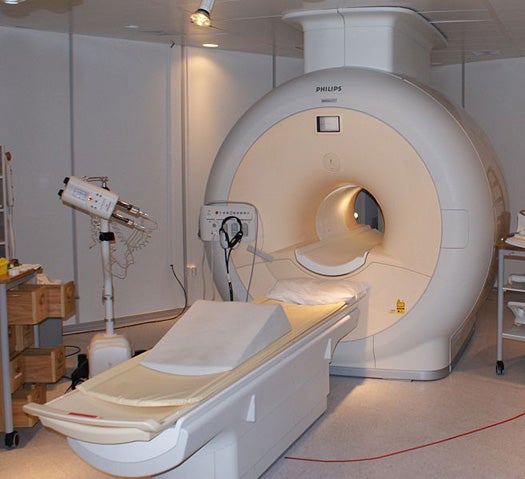
Nuclear magnetic resonance spectroscopy is a handy scientific tool to have around (for instance, it’s the fundamental tech behind magnetic resonance imaging, or MRI). It’s ability to identify and study things like protein structures and chemical compositions make it fantastically flexible, but there is a huge drawback: The size and expense of the superconducting magnets necessary for precision NMR make it an immobile and expensive process. But researchers in Germany have created a portable magnet that could shrink NMR devices from room-size to palm-size.
The breakthrough won’t replace the large MRI machines necessary for a good medical scan, but it could be the basis for handheld devices that analyze archaeological artifacts on-site or identify blood clots or cancer proteins right in the physician’s office, or even in remote areas far from conventional lab resources.
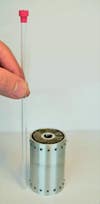
The Pocketable NMR Magnet
The construction of the magnet is naturally somewhat complex, but in a nutshell the researchers stacked three rings of samarium cobalt to create the tiny cylindrical magnet. Each ring contains trapezoid-shaped magnets with gaps in between. These gaps contain rectangular magnets that hold the key to the tech; by adjusting these rectangular magnets, engineers are able to smooth out irregularities in the magnetic field that are usually the bane of efforts to make small, precise NMR magnets.
Sophisticated computer models help engineers tweak the magnet to achieve never-before-seen homogeneity in the magnetic field. That uniform homogeneity allows the D-cell battery-sized, 35-millimeter diameter magnet to work as precisely as its massive superconducting cousins while retaining an interior diameter of 15 millimeters, plenty large to hold a standard five-millimeter NMR sample tube.
Such high-res, portable NMR can only reach a magnetic field strength of 0.7 tesla (large medical imaging magnets produce ten times that) but that’s just the beginning. Researchers think they can tweak the current design to wrench 1.5 tesla from a portable NMR device, and by using magnets of different materials they might even reach two tesla. Not bad for something that fits in the palm of your hand.