Research has implications for long-term spaceflight, future space procreation
Living in Space Has Its Perils A new study sheds light on some of the health hazards of living in space. NASA

Human stem cells grown in a simulated microgravity environment develop differently than those grown under normal conditions, an Australian study has found. The finding could have implications for space colonization and long-term spaceflight.

Using a NASA-developed rotating vessel that simulates microgravity, an Australian whiz-kid researcher found the stem cells' protein expressions were vastly different than when grown in normal Earth gravity, Discovery News reports.

About 64 percent of the proteins found in the microgravity cells were not present in control samples. The microgravity cells contained proteins involved in the breakdown of bone and the regulation of calcium, neither of which were found in regular, Earth-gravity cells. Embryonic stem cells can differentiate into any of the body's hundreds of cell types. 21-year-old Elizabeth Blaber, who co-authored the study, presented a paper last month at an astrobiology conference in Houston.

Spaceflight wreaks havoc on the body -- astronauts experience muscle atrophy, bone-density loss and slower heart rates in orbit. Plenty of research has been done in those areas, but the Australian team, supervised by Brendan Burns of the University of New South Wales in Sydney, says little has been done on the cellular level.

The finding that stem cells express different proteins under microgravity could help explain muscular and skeletal changes in adults.

The research also showed that anti-oxidant levels fell over time, which could shed light on why wounds heal more slowly in space.

More news is forthcoming on stem cells in space, as researchers pore over the results of a mouse stem cell experiment space shuttle Discovery brought to and from the International Space Station last month.

For that study, a ball of mouse stem cells sat in a small reactor, where they were allowed to differentiate. On Earth, mouse stem-cell balls are considered a model for understanding how stem cells differentiate and develop. NASA researchers are still analyzing the results.

Although adults don't have embryonic stem cells, the research is important for understanding the health effects of living -- and maybe someday procreating -- in space.

[Discovery News]

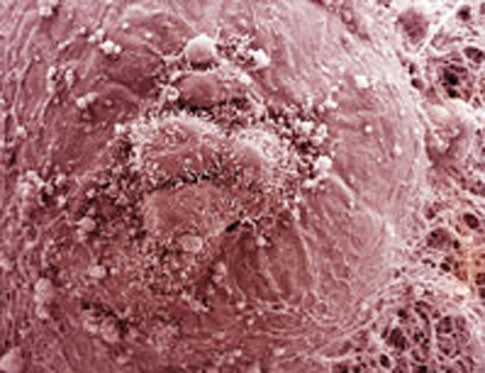
Human Embryonic Stem Cell: Magnified

16 Comments

The implications from this study are interesting, but I dont believe that they can't be overcome somehow.
The universe was not created so that we can only experience it from Earth.

Plus, our species could never survive with the limited resources available on the Earth.
Although, right now, I am not sure we deserve to be able to expand outward...but that is a totally other topic.

This proves once again that zero-gravity space environments aren't for us to live in. We need to think about making pseudo-gravity-generating stations like a torus or something.

Without gravity or something like it, we aren't going to make it very far anywhere in space.

Talk about opposing views. This is fantastic research. If we can learn why our cells act the way they do in space, then we can possibly influence them to act the way we want them to act. What if we could manipulate the stem cells so that they function more appropriately in space. Makes sense - just take space pills and viola - no bone degeneration, wounds heal quickly and no muscle atrophy.

Very cool research - scary obviously but very cool.

CDales1004

Your reasoning is false

The Universe was not "created" for any reason. It simply is.
You, and all you know along with our entire planet are insignificant side note in the vast timespace and there is no need for any reason.

Billions of species have survived for up to millions of years with the plentiful resources on the planet. They will survive and evolve for long after we bring our existence to an end in a war or environmental catastrophe of some sort.

The only way for us to avoid or postpone this is by limiting our urge to procreate and expand like a virus and learn to live with the resources we have.

Kinda makes you wonder what a human conceived, born and bred in zero gravity would be like.
VR
Don Gardon

No, tragula, it's your reasoning that's false. We can expand "like a virus," if we expand our habitat. Curiosity, the urge to explore, is not only self-gratification but the biological imperative to populate. If it doesn't extinguish itself, the human race has a glorious, endless future expanding its habitat in space, and I'm sorry I was born too soon, in an age of fatuous nihilism and self-absorption, to experience it.

There may be no "reason" for the universe, but that doesn't preclude our living as if there were. That's the difference between cleverness and wisdom.

This study is actually very crucial: Bone marrow stem cells, B-cells, are key to the human immune response since they support the production of human antibodies. Further research into the effects of zero-G exposure should be pursued to discover how bone marrow stem cells adapt to zero-G.

NASA needs to understand the potential risk to astronauts, and the general public, of long-term human immune response changes due to exposure to zero-G before engaging in a flight to Mars.

It is conceivable that the current spaceflight quarantine protocol needs to be revised to include a complete evaluation of each returning astronaut's immune response, before and after, each flight.

A potential benefit is identification of the cell signaling mechanism that triggers the adaptation to zero-G. That mechanism may be targeted by future drug therapies to assist in long-term spaceflight missions.

It may also be key to addressing the problems of aging and osteoporosis here on Earth.

tragula

Recent studies show that the earth population will cap at 9 billions. The earth can sustain that amount.
The big change that is required though is stopping the over consumption process that plagues the so called advanced countries of the planet:
- too much meat in the diet
- too many things
- too much garbage
Need to rethink the social models e.g. return to the homes that could shelter multi-generational families this would in turn help to save money (kindercare, commuting time, gas, gas electricity, material taken from the biosphere to build homes..). But this would require a change of mind that one´s worth is measured by one´s by ones possesions. State of mind that has been perpetuated for more than a century now.

PBO

@polo1970,

What has meat consumption got to do with anything? What if we started growing meat in the lab from cells? Can you please not bring Enviro-Whackoism into science?

In any case, it is not the "over consumption process" in advanced countries that is Over populating the Planet. Rather it is the Non-Consuming, Non Advanced Countries that are contributing to the 9 billion your talking about.

Back to the Article, I wonder what stem cell will do in an Over-Gravity environment, one with gravity greater than Earth's gravity.

The implications of this for the prospect of off-earth pregnancies is huge -- and who is going to volunteer to be the first human research subject for THAT?

We dream so large, and we know so little. What fascinating research!

Mellow_Nomah said: "The implications of this for the prospect of off-earth pregnancies is huge -- and who is going to volunteer to be the first human research subject for THAT?"

I'm sure that Lisa Nowak will volunteer, as long as they can recruit Bill Oefelein to do the impregnating duties!

CDales1004 said "...The universe was not created so that we can only experience it from Earth.

Plus, our species could never survive with the limited resources available on the Earth..."

If the universe was created you may be right. Then there may be another reason that we have not left the earth. But if it evolved then you must think that humanity is the ultimate of of evolution. Who says that is going or should survive?

I've always found the argument between creationism and evolution a bit moot point. If the postulation that space continues infinitely is correct, then there are infinite possibilities for another race to have evolved aeons before us and created other races. Statistically it seems more likely that some other pre-existing race created humans than that we randomly evolved because of chance.

Arguments about that other race being god or not put aside, it seems more likely that we were an engineered organism put here than that we randomly evolved, but that's just my opinion.

Avoiding livestock (meat, eggs, milk, ...) would indeed decrease the amount of food grown needed to feed mankind, paulbee. And when you insist on science, then please be so kind and don't talk about "overpopulation", because that is a political term, and doesn't even exist as scientific concept. Thanks.

What I am interested in though is if really the near-zero gravity was triggering that different behavior or the different form of cosmic radiation that cells/astronauts are exposed to. I have read articles about cells communicating via radiation with each other in order to adjust, for example when it comes to healing, and a change in the radiation compared to earth seems likely to trigger a change in cellular processes as well.

At least now we've identified the problem. We can find a solution. :-)

It does create implications for food supply for space travelers or Lunar/Martian colonists.

If these cells are reacting to environment in ways that will ensure proper growth I wonder what they would do if started outside the sterile environment. I see them adjusting to the different gravity so that what they grow into will be properly attuned to thier environment. If I were experimenting on these things I would attempt to grow them near radiation to see if they build immunity, I would try all sorts of stuff.


June 2013: American Energy Independence

Five amazing, clean technologies that will set us free, in this month's energy-focused issue. Also: how to build a better bomb detector, the robotic toys that are raising your children, a human catapult, the world's smallest arcade, and much more.


Online Content Director: Suzanne LaBarre | Email
Senior Editor: Paul Adams | Email
Associate Editor: Dan Nosowitz | Email
Assistant Editor: Colin Lecher | Email
Assistant Editor: Rose Pastore | Email

Contributing Writers:

Kelsey D. Atherton | Email
Francie Diep | Email
Shaunacy Ferro | Email

circ-top-header.gif
circ-cover.gif