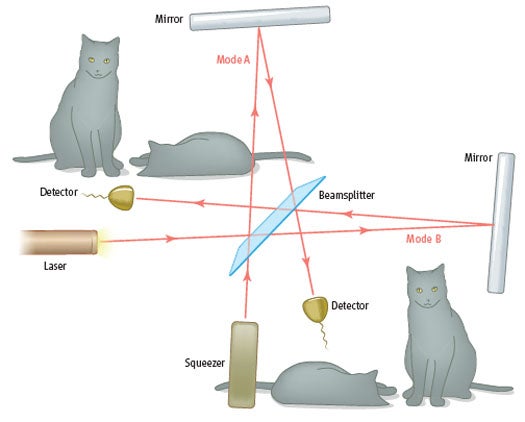
Entangling Multiple Photons Using a beamsplitter, a photon "squeezer" and a couple of mirrors, researchers were able to create the right kind of quantum interference to generate an almost-perfect state of quantum entanglement for five photons. The cats were mainly for show. Science

How many cats have to be both dead and alive before researchers are content that they've entangled enough particles? The current count is now five, but research published today in the Science suggests that it could be many more than that. Perhaps that's bad news for Schrodinger's cat, but it's great news for quantum pursuits like precision imaging and ultra-fast computing.

Israeli scientists have for the first time developed a technique that can entangle numerous particles at the same time -- meaning each particle (in this case photons) exists in two possible states at the same time -- and demonstrated it on a set of five particles. When particles are entangled, exerting a change on one also exerts a change on the other, even if the two are separated by miles or even light years.

Einstein called this "spooky action," but taking advantage of quantum entanglement has already yielded some pretty amazing results in the realm of data encryption, and by creating larger and larger entanglement systems scientists might someday be able to build quantum computers that make today's "zero-or-one" computing systems look primitive.

Quantum computers can carry out computations exponentially faster than traditional computers because rather than being limited by the "on" or "off" nature of semiconductor chips, quantum systems can calculate several solutions to the same problem at the same time.

But the big news from the Science paper isn't just that researchers were able to entangle five particles at once, but that the technique for doing so appears to be scalable to just much higher numbers of photons. There's some trade-off here; the entanglement between particles is less than absolutely perfect, but it still retains the useful properties that researchers are looking to exploit.

Unfortunately the quantum states of these particles are quite fragile, so while researchers can demo this technique in the lab, next-generation computing is still a good ways off. But a scalable, demonstrable technique for entangling multiple particles is a big step toward the kinds of quantum systems that could rewrite the underpinnings of modern computing.

[Science, Reuters]

13 Comments

I have been theorizing that entangled photons not only can be created, but that we are surrounded by rivers of entangled photons being emitted by diamond white dwarf stars or other natural sources that create entangled photons hundeds of millions of miles from earth, which have been bathing this planet in entangled photons since the beginning of time.
The problem as i see it, is that we havent checked for this possibility yet. I am proposing experiments using satellites to check for this possibility. The propsed experiment is to take two satellites, and align them such that they are equidistant from a suspected entangled source of photons. Then allow the detector of one to "observe a series of photons" The other photons striking that other detector should collapse into its opposite.
If it can be proven that there are existing sources of quantumly enttangled photons, it would allow for the possibility for instantaneous communication without having to be limited by the catch 22 of current schemes. The problem with current schemes is that you have to use local limitations to seperate detectors than then fire a beam and split it. The time it takes to do such a thing is essentially the same as it takes to communicate using conventional methods. But if there are sources of quantum entanglement that are already existing, then all you have to do is find a source of quantum entanglement so that the radii of the selected detectors to the source are equal, and then you can communicate through vast distance instantaneously. the source of the existing quantum entanglement merely has to bisect the distance between the two objects, so a star which produces quantum entangled photons that strike a mars rover for example, and a sattelite above the earth at the same time, would allow ground control to make near real time maneuvers to the rovers rather than have to rely on autonomous software which is much more unsophisticated than real time human interaction. A natural beam splitter could be a gravitational lens or light passing through an asteroid belt millions of miles away, or millions of light years away. The further the better. Why? because if quantum entangled light can travel from millions of light years away, then it is possible that distance between selected targets for instantaneous communication becomes larger and larger. Simple experiments can determine whether quantum entangled light exists, and under what conditions. We can see what kind of wave/particles and at what energies are associated with the distance of quantum entangled survival under natural condtions. Are Cosmic rays for example, quantum entangled? Or xrays from other stars? These are questions that if answered will provide a vast new way to communicate.

I was wondering about "spooky action" in recent weeks. I read on other science sites that scientists estimate that the states of the changes (apparently) travel at 10 million times or more the speed of light. Another report from Livescience details that scientists were able to move one of the photons and observed that it changed the opposite photon too.

If we can use that effect, could we create an indirect communication device that uses that? If so, then we could be looking at something fantastic.

Schrodinger's cat is about superposition (being in two places or states at once) not entanglement. I know quantum physics can be confusing but thats the basic stuff get it right, you reputable journalists you.

"Israeli scientists have for the first time developed a technique that can entangle numerous particles at the same time -- meaning each particle (in this case photons) exists in two possible states at the same time" Now I read more and have to post again I already defined superposition so now I'll correct your definition of entagle ment (which is actually the definition of superpositon) Entanglement means that what happens to one particle happens to everyothe rparticle entangled with it at the same time. I.E. Spin a photon clockwise and all others entangled will spin clockwise even if they are on the other side of the galaxy without anything being done to them.

ok third post I read further and you turn around and get it right but without pointing out or correcting the previous mistake. Your confusing the two and calling them both one thing. Quantum physics is hard enough for those not well studied to understand, stop making it worse.

Is there a way to know that a proton is entangled? Is there some property to it that clearly means it has a equal somewhere else in the universe?

If not, who is to say we don't all have an entangled self somewhere else? Who's pulling the strings on that one!?!

If a quantum physicist gets tangled up in his equipments wires, but nobody sees it, is he really stuck? :P

TlDR but hey look cats

I'm certainly not well enough informed on the subject to offer anything constructive, but I'm a little confused, if not skeptical, about this. It seems to me that this could just be the result of a misunderstanding or misapplication of the uncertainty principle. Certainly, a finding this sensitive would require a massive amount of low-quality data to be collected and refined, and then analyzed for the appropriate probabilities in the measurements. I guess my point is that, in my mind and with the limited information given in the article, the results could just as easily be a proof of retrocausality as quantum entanglement, because the bottom line is a probabilistic compilation of low-quality data.

Ok, let me summarize lol...can someone explain how the experiment was actually done, and/or any explanations out there for the mechanism of quantum entaglement?

I'm certainly not well enough informed on the subject to offer anything constructive, but I'm a little confused, if not skeptical, about this. It seems to me that this could just be the result of a misunderstanding or misapplication of the uncertainty principle. Certainly, a finding this sensitive would require a massive amount of low-quality data to be collected and refined, and then analyzed for the appropriate probabilities in the measurements. I guess my point is that, in my mind and with the limited information given in the article, the results could just as easily be a proof of retrocausality as quantum entanglement, because the bottom line is a probabilistic compilation of low-quality data.

Ok, let me summarize lol...can someone explain how the experiment was actually done, and/or any explanations out there for the mechanism of quantum entaglement?

A beam of light was split in two, one of which was spontaneously parametric down converted, creating half-energy quantum photons. The other beam was left as a regular light beam.

The two beams were then recombined, and once again split in two, with detectors placed separately on the two split paths. By analyzing the preference for one of the two final paths, they could determine the degree of quantum entanglement.

Here's the experimental setup: http://www.sciencemag.org/content/vol328/issue5980/images/large/328_879_F2.jpeg

Their results were 12 standard deviations over what would be minimal evidence for entanglement. They are pretty damn sure they are entangled. Their only limit in the number of NOON states they could create was bad machinery.

Maybe these entangled particles aren’t as distant as we think. Maybe there exists another dimension linking quantum spin of particles. That would result into that the particles are “close” to each other in the “quantum entanglement dimension” even if they are far away from each other in space-time. Anyone got other idea?

This needs to be implemented into worm hole theory so that they can plan designated exit points! I also can't wait til my home computer has this kind of computing power, lol


138 years of Popular Science at your fingertips.

Innovation Challenges


Popular Science+ For iPad

Each issue has been completely reimagined for your iPad. See our amazing new vision for magazines that goes far beyond the printed page


Download Our App

Stay up to date on the latest news of the future of science and technology from your iPhone or Android phone with full articles, images and offline viewing


Follow Us On Twitter

Featuring every article from the magazine and website, plus links from around the Web. Also see our PopSci DIY feed


February 2012: The Future of Fun

Science is reinventing play, from extreme sports to gamification to ridiculous roller coasters to the playgrounds of tomorrow, and this issue is chock full of fun. Also, on a less fun note: Did global warming destroy my hometown?


circ-top-header.gif
circ-cover.gif
bmxmag-ps