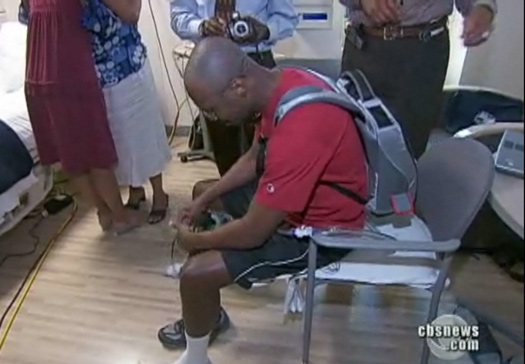
For two years, Charles Okeke, 43, was just another patient confined to a hospital while awaiting a human heart transplant. Now, he's the country's first test subject for a battery-operated, backpack-sized console, called the Freedom Driver, which will power his artificial heart and allow him to go home for the first time in two years.
Charles Okeke, 43, received a heart transplant 10 years ago after suffering a blood clot. After his body rejected the heart in 2008, he had no choice but to spend his days hooked up to a 400-pound machine while surviving off of a "total artificial heart." Although the artificial heart pumps blood just like a human heart, it restricted Okeke from living normally as a husband and father of three.
The device, which was developed by SynCardia systems and received FDA approval less than two months ago, weighs just 13.5 pounds and connects with tubes attached to the artificial heart. While the driver comes with two onboard batteries and a power adapter, wearers can also charge it with wall power or through a car outlet. A small display screen shows the wearer's beats per minute, fill volume, and cardiac output. The driver also comes in two styles: shoulder bag and backpack, as Okeke demonstrates in the video below:
Although Okeke still awaits a new human heart, doctors have said that he can live off the console indefinitely. Still, there are risks. Since no one else in the country has tested the Freedom Driver, doctors are unsure whether the console will provide enough power to maintain Okeke's liver and kidneys, as well as his heart.
In the meantime, Okeke said that he will try to stay healthy while enjoying time at home. The Syncardia total artificial heart costs about $125,000 and around $18,000 per year to maintain, but for Okeke, the chance to sleep in his own bed and play freely with his children is well worth it.
[CBS]
Five amazing, clean technologies that will set us free, in this month's energy-focused issue. Also: how to build a better bomb detector, the robotic toys that are raising your children, a human catapult, the world's smallest arcade, and much more.


Online Content Director: Suzanne LaBarre | Email
Senior Editor: Paul Adams | Email
Associate Editor: Dan Nosowitz | Email
Assistant Editor: Colin Lecher | Email
Assistant Editor: Rose Pastore | Email
Contributing Writers:
Rebecca Boyle | Email
Kelsey D. Atherton | Email
Francie Diep | Email
Shaunacy Ferro | Email
Good for him. I wish him the best of luck. I hope that he lives every moment he has. 2 years in a hospital unable to be with his wife and kids must have been very depressing.
Lets hope he lives a good long time and that this device get more wide use for others waiting for a heart transplant.
kind of reminds me of iron man with that giant battery he had to carry around. perhaps with time, the device can shrink a little bit.
Equiponderant...the weight of this story and the weight of his backpack. You can be as tough as you want but life is fragile and short.
"Still, there are risks. Since no one else in the country has tested the Freedom Driver, doctors are unsure whether the console will provide enough power to maintain Okeke's liver and kidneys, as well as his heart."
What is the main concern here?
To SJak:
The risk would be inadequate perfusion. An artificial heart operating while someone is lying down and not exerting themselves by standing and moving may require much lower output to maintain adequate blood flow to the liver and kidneys. Both are essential for basic filtration and metabolic activity. If by standing and moving against gravity the challenge of maintaining blood flow is greater than what the device can supply, then he may experience organ failure which could be lethal.
Just imagine when they can shrink that backpack down to the size of a penny. With our current nano-technology, this looks very promising. I say another 10 years, and this backpack will be extremely small, maybe not the size of a penny, but well on it's way.
they used to have a small plutonium-238 powered battery that fit inside the person, that never had to be changed, I'd rather have that
^ the comment above made by lilizhuang is spam please delete ^
^ the comment above made by lilizhuang is spam please delete ^^ the comment above made by lilizhuang is spam please delete ^
Since most comment-ers are talking about how nano-technology will shrink the battery, here's my bit. The battery is only part of the system. If they truly want this on a nano, or man-portable (without a backpack) scale, the computer needs to be shrunk or eliminated altogether. Maybe a DNA computer to control the rhythm. Better yet, build an artificial heart (or any other organ) that can translate the body's nerve signals leading to the corresponding part and respond when appropriate. Artificial organs today do all the monitoring by themselves, consuming a good amount of electricity in the process. So if we can eliminate most of the need for a processor (albeit we would still need one to carry out the actual functions of the organ, a large amount of space is freed up. Partly from the smaller battery, or maybe eliminating the battery and using a device utilizing energy from the body...
Whew, what a long comment! I felt I needed to write it down and share it. So feel free to expound on it and tell us about your geeky, medical ideas, like mine!