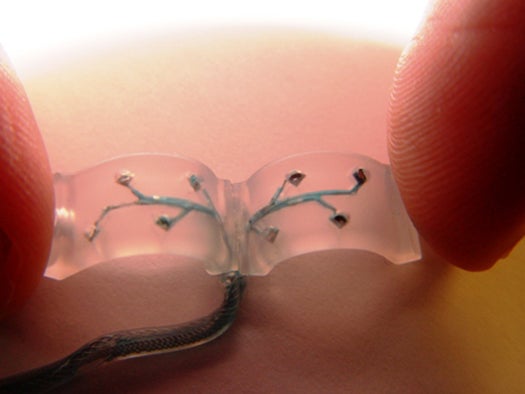
Flat Interface Nerve Electrode Matthew Shiefer, via Case Western University

When Matthew Schiefer, a neural engineer at Case Western Reserve University in Cleveland, Ohio, first managed to stimulate the leg of an unconscious volunteer by wrapping an electrode around a nerve bundle, he knew he was on to something. Now, four years later, Schiefer has created a new kind of nerve-activating electrical interface that could allow people with paralyzed limbs to activate their legs with the push of a button.

Schiefer's new device flattens out the nerve fibers, exposing more of them to the full electrical current. By attaching this flatter contact to the femoral nerve, Schiefer succeeded in activating four of the six leg muscles needed for a person to go from sitting to standing. Additionally, the flexing knee muscles actually generated the level of force needed to lift someone out of their chair.

The significant amount of power in the knee muscle has already led Schiefer to plan longer trials. However, the other end of the connection seems like a taller hurdle. Flexing a muscle with electricity is one thing, but controlling that flexing with a brain attachment or computer program robust enough to allow locomotion may be a whole other story.

[New Scientist]

6 Comments

This could give hope to people that thought they would never walk again. I wonder if it could work on moving the arms and opening/closing the hands.

I hope this isn't a sick April Fools joke.

The problem with using this technology with paralyzed patients is that when the nerve is cut (which is usually the cause of such paralysis) the distal part of the nerve is no longer electrically active, and atrophies. Thus, stimulating the nerve will have no effect.

In addition, in nerves that are not electrically active the motor end plates (which cause the release of calcium and the actual movement of muscles) tend to detach and migrate along the nerve till they find a place where they receive electrical input. So stimulating these nerves after a long period of inactivity will have a severely limited or no effect.

This is cool, but reconnecting spinal cord is the big thing on the wish list. Right now they try putting stem cells in the severed spine, but the new nerves cannot grow long enough. However, if we combine stem sells with electrical stimulation to lengthen nerves we could possibly bridge the gap of cut spinal cords. To do this we create conductive bioplastics to make a stint full of stem cells. Insert this conductive stint, or straw shaped plastic with holes in it, for the stem cells to grow past the injury. Apply a mild electrical current to direct their growth until the plastic dissolves into the body. Control the inflammation and damage with spinal injury drugs, and we have long growth nerves. Possible out come, greater mobility maybe the ability to walk again. However, they’d be unlikely to run again. Possible side effects greater spinal cord damage loss of some mobility in exchange for others, or even risk of death. Some Paraplegics would choose to risk death to walk again. Both stem cells and electrical growth of nerves are well established, but not combined yet.

This is a great first step, and although there will be many challenges to develop fully, it would just be such an amazing technology that can change peoples lives...

Ivan Malagurski

BiomedEng...you have to admit, this is a very good article. What I'm interested in is how many could benefit from this technology. Nerves do retain functionality for a period of time before losing their ability to pass a signal. And rehab facilities across the county are waiting for this kind of opportunity. Tests in this technology promotes interest and investment, which paves the way for a further research.


June 2013: American Energy Independence

Five amazing, clean technologies that will set us free, in this month's energy-focused issue. Also: how to build a better bomb detector, the robotic toys that are raising your children, a human catapult, the world's smallest arcade, and much more.


Online Content Director: Suzanne LaBarre | Email
Senior Editor: Paul Adams | Email
Associate Editor: Dan Nosowitz | Email
Assistant Editor: Colin Lecher | Email
Assistant Editor: Rose Pastore | Email

Contributing Writers:

Kelsey D. Atherton | Email
Francie Diep | Email
Shaunacy Ferro | Email

circ-top-header.gif
circ-cover.gif
bmxmag-ps