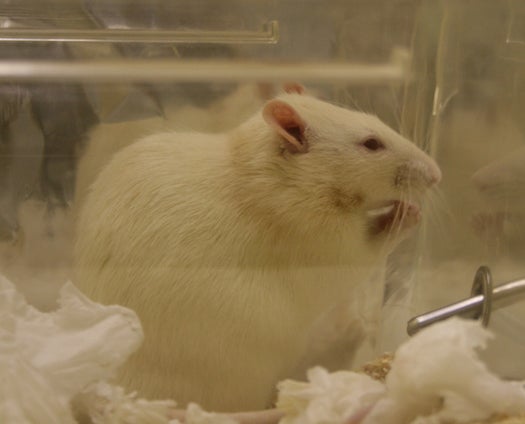
Sure, the maze gets boring every so often. And yeah, there's not much variety in the food. But compared to the kill or be killed world of the wild, being a lab rat is a pretty good life. So good, in fact, that researchers at the National Institute on Aging (NIA) believe many lab rats are so overfed they distort research results from experiments intended to help cure everything from cancer to Alzheimer's to, you guessed it, obesity.
According to the NIA, the common practice of allowing lab rats and mice constant access to food, but not exercise, has resulted in some test subjects getting so fat that their health fails as a result. Not only does the high weight of the lab animals compromise any comparisons between the effects of drugs on the animal and the potential effects on a health human, but the animals develop weight-related health problems that researchers mistake for drug side effects or disease symptoms.
To combat this problem, the NIA suggests simple solutions like only feeding the animals every other day or putting a running wheel in the cage with the rats.
Rats and mice are model organisms used as proxies for humans in a wide range of pharmaceutical, behavioral, and genetic experiments. This new finding casts suspicion over an entire body of research. Scientists, doctors, researchers, please, let's get these rodents a personal trainer or something, because I don't want to potentially miss out on a cure for cancer because Micky and Minny didn't want to run some laps.
[Nature]
Five amazing, clean technologies that will set us free, in this month's energy-focused issue. Also: how to build a better bomb detector, the robotic toys that are raising your children, a human catapult, the world's smallest arcade, and much more.


Online Content Director: Suzanne LaBarre | Email
Senior Editor: Paul Adams | Email
Associate Editor: Dan Nosowitz | Email
Assistant Editor: Colin Lecher | Email
Assistant Editor: Rose Pastore | Email
Contributing Writers:
Kelsey D. Atherton | Email
Francie Diep | Email
Shaunacy Ferro | Email
Given current rates of obesity in the human population, maybe the research is not so skewed after all...
I guess we can't "only feed the humans every other day or put a running wheel in the cubicle".
Wow. Really? One would think that these scientists would take better care of their subjects and consider all possible variables...like they're supposed to. If they can't even think of simple things like these that can possibly skew results, then why on earth should I take their findings seriously?
Excuse me, but since "Rats and mice are model organisms used as proxies for humans in a wide range of pharmaceutical, behavioral, and genetic experiments", doesn't that sort of imply that they have similar feelings as well?
The animal-conscience experiment showed that a rat refused to eat if it means another rat will get electrified; something many humans will not do. Discovery after discovery shows that animals act and feel just like people; which is why they're successfully used in behavioral-drugs experiments in the first place.
I think it's time we realized that tormenting an animal for humanity's sake is no different than tormenting a weak, mute and small person for a big and strong person's sake.
I dont think that anyone ever denied that animals have feelings... just that it is far more acceptible to test on animals than on humans.
That, or its just nerds getting back for all those years of swirlies and wedgies on smaller creatures. j/k
I totally agree with this article and I am glad that scientists try to do everything possible to find a cure for cancer.
Visit Hungary: www.hungriabonita.com/hungria