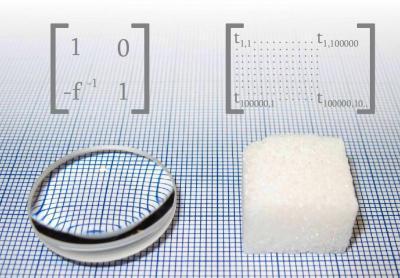
Light is essential to vision, at least the kind we perform with our naked eyes. This is why we can see through a glass lens but not through a brick wall (though we're working on that). But what about materials that let some light pass while scattering it in seemingly chaotic ways? Our naked eyes can't reassemble that light into coherent images, but using some clever math, a team of researchers has devised a way to focus light through opaque materials to "see" objects on the other side -- provided they have enough data about the material.
The team developed a numerical transmission matrix based on the way light passes through a layer of opaque zinc oxide, a common ingredient in white paints. The matrix captured the various ways the light changed upon passing through (and by various, we mean various; the matrix included over 65,000 numbers detailing the way the material scattered the light), creating a model for how light should pass through zinc oxide every time.
Using that transmission matrix, they were able to manipulate the beam on the transmission side such that it came out the other side focused. They then flipped the experiment on its head, measuring the light emerging from the opaque material and using the matrix to assemble an image of an object behind it.Theoretically, such a transmission matrix could be developed for any opaque material, but while seeing through paper and white paint may not seem so terribly tantalizing, the experiment really shows the potential for opaque materials in optical devices. At the nano-scale it become increasingly difficult to construct transparent lenses. With a good enough transmission matrix, researchers could better peer through opaque biological materials like cell walls and other membranes that currently obscure our view of what's happening on the other side.
138 years of Popular Science at your fingertips.
Stay up to date on the latest news of the future of science and technology from your iPhone with full articles, images and offline viewing
Featuring every article from the magazine and website, plus links from around the Web. Also see our PopSci DIY feed
Share links with friends, comment on stories and more
This month, a look at the future of secret warfare, the dangerous search for Afghanistan's mineral wealth, a backyard flamethrower, and the most amazing college labs.
Read the issue here.

Editor: John Mahoney | Email
Associate Editor: Paul Adams | Email
Contributing Writers:
Clay Dillow | Email
Rebecca Boyle
opaque = "blocking the passage of radiant energy and especially light"
translucent = "transmitting and diffusing light so that objects beyond cannot be seen clearly"
transparent = "having the property of transmitting light without appreciable scattering so that bodies lying beyond are seen clearly"
(Thanks, Webster!)
The article repeatedly uses opaque where it should be using translucent. A brick is opaque for visible light. A sheet of paper is translucent for visible light.
Years ago I was briefly associated with a project to shoot down ICBMs with a chemical laser. Analyzing a carrier pulse allowed use of "rubber mirrors" to pre-scatter the killing pulse so that it would arrive at the target focused by the atmosphere. During testing, clear pictures were taken through frosted glass (like some shower glass). This seems similar....
[Rubber mirrors consisted of a large array of small hexagonal mirrors, each controlled by piezo-actuators directed by individual Z80 microprocessors - similar in some respects to the element in a DLP projection TV.]
This tech could give whole new life to light microscopes!
from Kent, OH
If you could create matrixies for flesh, bone, fabric, steel etc... couldn't we create an invisible soldier?
Screw seeing through paint, paper or making an invisible soldier. I want my X-Ray glasses so I can do like Superman and see through Lois' clothes!
Would this work in an airport?
And would a babe look more sensational than she does in those microwave scattering things?
Has anyone seen this? Its a piece of Scotch tape being used to see through frosted opaque glass: www.cli.gs/tape. Certainly seems simpler than a universal transmission matrix.
Some information as below:
Materials such as paper, paint, and biological tissue are opaque because the light that passes through them is scattered in complicated and seemingly random ways. A new experiment conducted by researchers at the City of Paris Industrial Physics and Chemistry Higher Educational Institution (ESPCI) has shown that it's possible to focus light through opaque materials and detect objects hidden behind them, provided you know enough about the material.
Marko
www.allpetproblems.com
hahaha math is a magic...
http://www.sialnity.com/ | http://www.mywishstuff.com/
Would this work in an airport?
And would a babe look more sensational than she does in those microwave scattering things?
Kettering
http://burnwiigames.org/