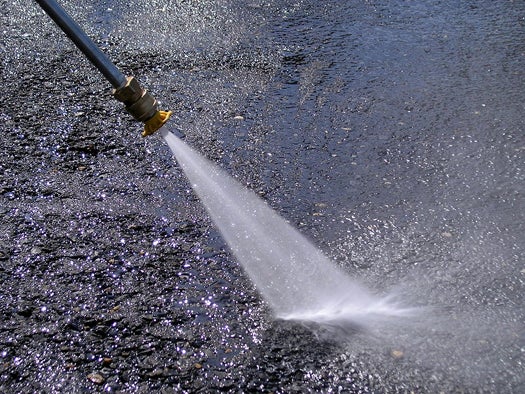
Spray-On Liquid Glass In the future, adding a protective coat of silicon dioxide "liquid glass" to just about anything could be as simple as merely spraying it on. Mschel

Much as it did for hair styling products and fake tans, spray-on technology now stands to revolutionize everything from locomotives to winemaking to textile design, thanks to a versatile new spray known as "liquid glass." Applied to nearly any surface, an invisible non-toxic layer of silicon just one millionth of a millimeter thick can protect underlying matter from water, bacteria, dirt and even UV radiation.

Made almost entirely of pure silicon dioxide, liquid glass is harmless to the environment and could replace a variety of harsh cleaning chemicals. The coating can be cleaned with water alone, and tests by food-processing companies have shown that a good hot water rinse left liquid-glass-coated surfaces as sterile as normal surfaces doused with strong disinfecting bleach. The coating is also flexible and breathable, so it can be applied to both static and non-static surfaces.

Owned by German company Nanopool, liquid glass can be produced in a solution of alcohol or water, depending on the needs of the surface. The company still has some proving out to do before we'd recommend coating the entire globe in a cleanable, wipeable layer of glass several hundred times thinner than a human hair, but the range of possibilities is a bit mind-blowing. Companies from train car manufacturers to clothing designers to food and beverage producers are looking into ways to leverage the material's unique properties into cleaner -- both in the compositional and aesthetic senses of the word -- products, surfaces and public spaces.

[Telegraph]

23 Comments

Pretty cool.

Water glass dose not cost much and has decent supply lines in place. It has loads of uses in industry, for things like making aerogel to hardeners for sand cast molds to fixing auto engines or breaking them. If you coat a fresh egg in the stuff it will stay fresh for nine months with out refrigeration.

Liquid glass is not really silicon dioxide it's real name is Sodium silicate when water glass is exposed to the air it absorbs co2 and forms Sodium carbonate which is dissolved away in water and silicon dioxide (sand) which is left behind in thin films. So really this is coating everything in film of sand.

so could this be used to cover roads and stuff to keep them from deteriorating from harsh winter's/summers?
JB

What effects does this material have to ones health. I imagine if a person touched or was exposed to this long enough there would be serious health issues. But I don't know nearly enough to make that kind of an assumption.

I wonder if the glass coating would crack when pressure is applied.

uhmm, that's what glass is sand melted, and then cooled with a different structure, and as for hazard, the only hazard would be to the person applying it, it should be perfectly safe (like glassware) to touch, and that hazard can be taken car of by wearing protective clothing and a breathing mask

This looks amazing!

Very cool, what occurs to the splash off though? Does it turn crystalline in the air? Should we be concerned with
Pneumonoultramicroscopicsilicovolcanoconiosis? Kinda reminds me of asbestos the wonder material.

More dishes to wash.

Mifdeath, I bow to your abilities to work Pneumonoultramocroscopicsilicovolcanoconiosis into a sentence not related to "the longest word in English".

Hurrah!

Pretty cool, but....

How durable is it? Will the 3rd rinse start to wash away sections of the coating?

Does it fragment into tiny hazardous particles due to abrasion or whatever? Is there a deterioration mode to be concerned with?

COOL

Silicon dioxide is a common ingredient in food and vitamin supplements. It is completely inert and harmless. It is only a problem if it becomes a dust and you breath it in. But at one millionth of a millimeter thick it would most likely produce negligible amounts of dust. The act of biting into a vitamin tablet would produce more.

Great article PhysOrg website goes intio more detail if you guys want to know more.From what i found out on their site this new nano product will only be sold in europe. It was deemed it would make cleaning products obsolete so to protect those companies it will not be sold in the United States, and yes it is totally safe it can be used on medical implants and has been proven that seeds sprayed with the liquid glass increase their resisantce to fungus due to the quantum forces of its nano-scale bonding.

Where I come from, this stuff is called "paint".

Last time I checked, glass get's pretty slippery when it's wet, are you sure you would want to cover a floor or street surface with this stuff?

I also must bow to you mifdeath! That was a sweet word.
One thing: did you find it or make it up? If found thats cool... if made up? KUDOS!

What I can't wait for is 'sprayable' diamond coatings...
Layer up that stuff and have 'unbreakable' windows.

Yo dawg, I heard you like glass, so we sprayed on some glass on your glass so you can slip while you slip.

This is a wonder product. There are so many applications that I can think of just as I am writing. Wow! Those painted lino tiles where you love the color but chips and flakes. The painted concrete, or even unpainted concrete. The list is endless. I can even see this being applied to bathroom walls.

I am also thinking it might be used to protect photographs, anything that can age and fade.

Rob
www.ellinghamglass.co.uk

Can they put this on clothes?

Granted it sounds cool, but unless the silicon dioxide is truly bound to the material it is intended to protect, I think the concerns raised regarding silicosis are warranted. I keep thinking about the law of unintended consequences.

Mendy
www.trezora.com

yeah it does sound cool. Liquid glass is a great sealant and protective surface. The only downside is its cost compared to other sealants.

Jimmy
www.pestcontroltoronto.com


June 2013: American Energy Independence

Five amazing, clean technologies that will set us free, in this month's energy-focused issue. Also: how to build a better bomb detector, the robotic toys that are raising your children, a human catapult, the world's smallest arcade, and much more.


Online Content Director: Suzanne LaBarre | Email
Senior Editor: Paul Adams | Email
Associate Editor: Dan Nosowitz | Email
Assistant Editor: Colin Lecher | Email
Assistant Editor: Rose Pastore | Email

Contributing Writers:
Rebecca Boyle | Email
Kelsey D. Atherton | Email
Francie Diep | Email
Shaunacy Ferro | Email

circ-top-header.gif
circ-cover.gif
bmxmag-ps