It's traveling toward us at about 100 kilometers per second, you know

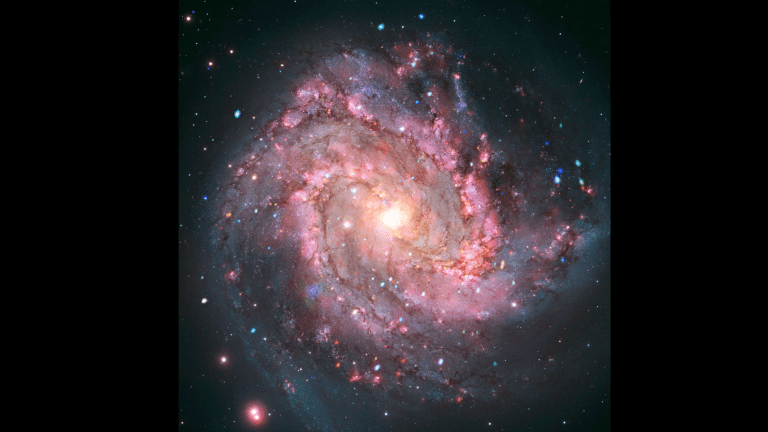
WISE Sees Andromeda Somewhere out there ... NASA/JPL-Caltech/UCLA

Scientists have known that the huge Andromeda galaxy is headed on a collision course with our Milky Way some 4.5 billion years from now. But until then, NASA's Wide-field Infrared Survey Explorer (WISE) has taken the opportunity to snap a new mosaic image of the galaxy using all four of its infrared detectors.

Andromeda represents the closest large galaxy to the Milky Way Galaxy, and currently sits 2.5 million light-years from our sun. Two satellite galaxies known as M32 (above left of center) and the blue M110 (below center) represent the largest of several in gravitational thrall to massive Andromeda.


The new infrared view from WISE shows mature stars as blue highlights, with larger newborn stars appearing yellow and red. Andromeda may appear larger and hosts more stars than the Milky Way galaxy, but the Milky Way still has greater mass due to its share of dark matter.

Our view of the eventual Andromeda collision with the Milky Way probably won't be as complete as this or this. But we'd wager that it'll still provide for quite a show, assuming that anyone is still around to watch.

4 Comments

I just want to see the universe get rip apart.

as it gets closer to our galaxy it should begin to accelerate, though by how much cannot be determined because there is no way to find how much mass is in each galaxy.

Our Sun is of mid size with a life span of aprox 50 billion years. Predicted to be half way threw its life span with another 25 billion years ahead of it, so we'll be here for the show.

It is spectacular and I read it on http://www.rssfeedshtml.com about the dark matter thingy too.

Jav


138 years of Popular Science at your fingertips.

Innovation Challenges


Popular Science+ For iPad

Each issue has been completely reimagined for your iPad. See our amazing new vision for magazines that goes far beyond the printed page


Download Our App

Stay up to date on the latest news of the future of science and technology from your iPhone or Android phone with full articles, images and offline viewing


Follow Us On Twitter

Featuring every article from the magazine and website, plus links from around the Web. Also see our PopSci DIY feed


February 2012: The Future of Fun

Science is reinventing play, from extreme sports to gamification to ridiculous roller coasters to the playgrounds of tomorrow, and this issue is chock full of fun. Also, on a less fun note: Did global warming destroy my hometown?


circ-top-header.gif
circ-cover.gif