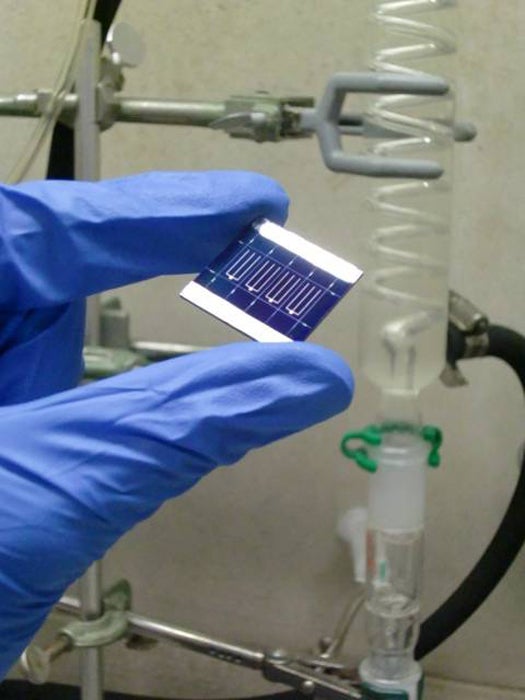
While IBM is primarily known for its information technology products, the company has recently begun expanding into the alternative energy market. So far, that change has mainly taken the form of a new ad campaign. But IBM is now backing those words up with action, by unveiling a groundbreaking solar cell, 40 percent more efficient than any similar cells.
The cells operate at a power conversion efficiency of 9.6 percent. And while that isn't that high, the cells use only common elements like copper, zinc, tin, sulfur, and selenium. By comparison, the most efficient common earth element solar cell on the market today only operates at 6.7 percent efficiency.
By shying away from the rare earth elements employed by so many other solar cells, IBM hopes to both keep the cost of their cells down, and prevent reliance on foreign sources for rare earth elements.
Ultimately, IBM plans to lease the technology to other companies, rather than getting into the solar manufacturing business.
The incredible innovations, like drone swarms and perpetual flight, bringing aviation into the world of tomorrow. Plus: today's greatest sci-fi writers predict the future, the science behind the summer's biggest blockbusters, a Doctor Who-themed DIY 'bot, the organs you can do without, and much more.


Online Content Director: Suzanne LaBarre | Email
Senior Editor: Paul Adams | Email
Associate Editor: Dan Nosowitz | Email
Assistant Editor: Colin Lecher | Email
Assistant Editor: Rose Pastore | Email
Contributing Writers:
Kelsey D. Atherton | Email
Francie Diep | Email
Shaunacy Ferro | Email
But I want some noooowww! Cheap, efficient solar cells. Awesome. Someone in IBM hook me up, pleeease! lol
This is a good step in the right direction. I think this path of research needs to be followed out more. The less expensive the materials and the more prevalent then the more likely that we can get wide acceptance of the Tech.
What is the cost per what hour produced with this new method?
@mitEj Solar usually is not rated by watt hour but simply in watts because rating it in energy units would require assumptions about its useful life and cloud cover longitude and an array of other considerations. And to answer the question the cost is over 9000 monetary units per power unit.
Something this article could have included was the efficiency compared to more expensive, rare metal solar cells.
None-the-less, this is great news! It's amazing that it has taken this long for a company to make an advancement in the cheaper, more economic solar cells. Incredible that it was IBM to revolutionize in this. I may be wrong in assuming they're relatively new to the energy industry?
Still, now that you know how to make it, start mass producing! Get America off the foreign oil and fossil fuels. Let's finally embrace the future of clean energy!
@Animemaster: Is the "9000 monetary units per power unit" in reference to the common solar cells in use or to these new cells?
I find it interesting to note that common solar cells are currently running around 20% efficiency but they have a theoretical limit at 29% efficiency. The most efficient solar cells rate at over 40% efficiency but they are made from rare earth elements and are not in mass production. I am looking forward to see this common earth element solar cell become more efficient and prolific. My understanding of the actual workings of solar cells is limited but I would like to know if solar cells based on graphene or some other nano product are possible.
From what I understand, the cost of todays solar panels for powering your average house (8000 watts a day). Is around $50-60k. The problem that I see, besides the huge cost of buying solar cells is the average life span of your solar cells. Cells break down over time - slowly decreasing your power efficiency - I've learned they are only good for around 20 years before you've got to replace your panels. (That seems silly to me) My hope is that not only will companies increase power efficiency but also the longevity of solar panels. It would be great if solar arrays would be something you could hand-down to your kids as a investment for their future and which would also increase your property value.
Peace
Fox
Fox nailed it. The efficiency of the cells is one thing. The fact that they "wilt and die" like actual plant leaves is another troubling issue. The 10s of thousands of dollars to get them installed is trumped by the fact that in most cases, before you can afford to pay them off or before they pay for themselves they will have stopped working or reduced vastly in output. It's unfortunate that there is no better means of harvesting such a huge and abundant energy source.
@animemaster
I am curious as to where you got your figure for the price of this new technology. How does it compare with traditional PV cells? The current rates of traditional PV cells are around $0.30-$0.50/kWh, and the cost to manufacture per Watt of power of a PV cell was recently dropped to $0.93/W by First Solar.
Its great to see us getting away from the Gallium/Cadmuim type PV cells and begin to use common, cheaper materials. I hope they continue to raise the efficiency past 9.6% to make it more competitive with the current technologies in the 35-40% range.
www.solarbuzz.com/FastFactsIndustry.htm
A residential solar energy system typically costs about $8-10 per Watt. Where government incentive programs exist, together with lower prices secured through volume purchases, installed costs as low as $3-4 watt - or some 10-12 cents per kilowatt hour can be achieved. Without incentive programs, solar energy costs (in an average sunny climate) range between 22-40 cents/kWh for very large PV systems.
An average crystalline silicon cell solar module has an efficiency of 15%, an average thin film cell solar module has an efficiency of 6%. Thin film manufacturing costs potentially are lower, though.
I've read other articles on this technology by IBM, it appears it's not as efficient as the current technology, but since it's using common materials and apparently is the first of it's kind, it's ground breaking and definitely a step in the right direction. The efficiency will follow and much can be gleened from the efficiency breakthroughs from similar technology.
If you are interested in learning how you can transition to solar energy or incorporate solar energy into your life, check out www.solar-energy-advantages-blog.com/category/solar-energy-facts for a practical approach.
But I want some noooowww! Cheap, efficient solar cells. Awesome. Someone in IBM hook me up, pleeease! lol
Evail
http://burnwiigames.org/
From what I understand, the cost of todays solar panels for powering your average house (8000 watts a day). Is around $50-60k. The problem that I see, besides the huge cost of buying solar cells is the average life span of your solar cells. Cells break down over time - slowly decreasing your power efficiency - I've learned they are only good for around 20 years before you've got to replace your panels. (That seems silly to me) My hope is that not only will companies increase power efficiency but also the longevity of solar panels. It would be great if solar arrays would be something you could hand-down to your kids as a investment for their future and which would also increase your property value.
www.tran33m.com/vb/
that will help us to git a moon base sooner