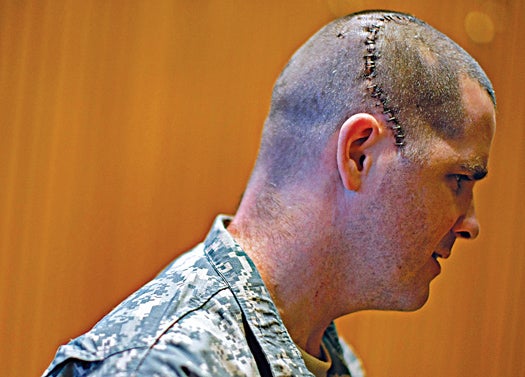
Band Aid Music could provide relief to hundreds of brain-injured veterans. Hanan Isachar/Superstock

The opening riff of “Takin’ Care of Business” thumps rhythmically from an iPod as a room full of middle-aged military veterans tap in time on drums. This is the sound of brain rehab.

Studies show that music can promote new neural connections, which Colorado State University neuroscientist Michael Thaut theorized could help overcome common symptoms of traumatic brain injury (TBI), such as short-term memory loss and impaired decision-making skills. Thaut and his colleagues enrolled 31 veterans suffering from TBI in a “neurologic music therapy” study where each drummer matches rhythms and tempos set by a bandleader. Last summer, they published results that show that after several 30-minute sessions, the group performed better on standard decision-making tests.

One beneficiary of the treatment is retired U.S. Air Force senior master sergeant Jim Dowding. After two stress-related strokes—a common non-combat cause of TBI—he didn’t dare take a wrench to his beloved 1979 Lincoln. “I couldn’t work on anything with more than two pieces,” Dowding says. But since he began drumming, “I work on my car all the time.”

Next Thaut and his team will compare the long-term effects of the therapy with today’s computer-based therapies. He hopes to eventually offer it to the hundreds of troops returning from war with TBIs.

3 Comments

This is fantastic. We do our best to protect our soldiers and in doing so, those who ordinarily would not survive come home with head injuries for which we just don't have enough information on how to address. I wish we spent 1/2 our money on protecting soldiers and the other half on healing the injuries.

We had a long discussion on this topic last night at my VFW meeting.

We all spend hours at the local VA hospital visiting with returning troops (when we are not there getting attention for our own injuries) with ghastly wounds.

The general public, through the media, hears statistics that indicate that fewer Service Members are dying in modern battlefields, with the insinuation that our current military operations must not be very dangerous -- so it's OK to prosecute the wars we are in.

But even up through the Vietnam War, the level of medical attention that Service Members were able to get to would have left the vast majority of those with such traumatic injuries dead. Vietnam appears to have been more dangerous and deadly. But the statistics are skewed. The number of traumatic injuries per capita is relatively the same. We are just able to allow them to survive.

But what is the cost of survival?

Bravo for the medical profession. And my best wishes to the brave men and women who serve in both peace time and war. But the best medical care possible for a Service Member is that which he or she never needs.

Let's find a way to stop having wars.

Maybe if we required the politicians who start them to lead from the front, they'd be in less of a hurry to send young men to do a job that most of them carefully avoided.

I forgot to add:

And my best wishes to my two sons, who have both placed themselves in uniform and in harm's way.

I hope neither of them arrives in Elysium before I do.


June 2013: American Energy Independence

Five amazing, clean technologies that will set us free, in this month's energy-focused issue. Also: how to build a better bomb detector, the robotic toys that are raising your children, a human catapult, the world's smallest arcade, and much more.


Online Content Director: Suzanne LaBarre | Email
Senior Editor: Paul Adams | Email
Associate Editor: Dan Nosowitz | Email
Assistant Editor: Colin Lecher | Email
Assistant Editor: Rose Pastore | Email

Contributing Writers:
Rebecca Boyle | Email
Kelsey D. Atherton | Email
Francie Diep | Email
Shaunacy Ferro | Email

circ-top-header.gif
circ-cover.gif
bmxmag-ps