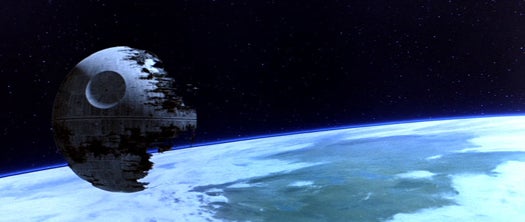
The Forest Moon Of Endor via The Force.net

So far, the search for extraterrestrial life beyond our solar system has focused on finding Earth-like planets. And sure, planets are great, since we know at least one of them harbors life. But David Kipping of the Harvard-Smithsonian Center for Astrophysics thinks that search might be a tad too narrow. In a new paper, Kipping described how current technology can be re-tasked to search for another life-bearing body: moons.

Looking for extraterrestrial life on moons is nothing new. After all, the search for alien life within our solar system generally focuses on Jupiter's ice moon Europa. However, this is the first time anyone has proposed looking for moons with life outside of our solar system.

The method suggested in the paper involves measuring changes in the orbit of large planets caused by the presence of moons. A similar technique, detecting the wobble of stars by the gravity of large planets, lead to the discovery of the first planets outside our solar system. This just refines that technique to smaller bodies. The paper identifies 25,000 stars close enough and visible enough to warrant further inspect, with a goal of finding a moon as small as 20 percent the size of Earth, and as large as our planet.

Of course, in the event that they find a habitable moon, we have to make sure it's not inhabited by annoying, ursine guerrillas, as they seem to be able to defeat an entire legion of the Emperor's best troops with nothing but sticks and rocks. Those are some aliens you don't want to mess with.

[ArXiv]

12 Comments

... and they all come with orbiting Death-stars. Do we still want to find these exo-moons?

Thats no moon. Its a space station.

LoL. I had to open this article just to see if anybody had quoted that line.

oh snap, no you didnt Nostrophyx.

Wow, really that idea has been floating around for a while, problem with that is of course seeing a moon orbiting a planet of a distance star is a crapshoot.

what if we really are alone in the galaxy for some reason are we actually a intergalactic race but earth is a test planet to see how humans react to different things? that would be cool but not nice

(1) We find Earth-size rock with possible life 10 years from now.
(2) We build giant lazer and start zapping prime numbers at them in 20 years.
(3) They get the message in 120 years.
(4) They happen to be devopled enough to notice it on a tiny rock far, far away.
(5) They build their own lazer and start replying.
(6) 190 years from now we get the first reply.
(7) For 100 years we are just trying to sync up and start developing a base language.
(8) 300 years from now we have the first true interstelluar conversation - just don't ask a question you can't wait 200 years to answer - instead, just keep shipping each other all your culture, tech, and history and maybe, after a few hundred more years, you will begin to understand life on another planet that no human will ever see.

The interesting thing about the possibility of habitable moons is that we've already found gas giants in the habitable zones of other stars. Considering that most of them found so far are bigger than Jupiter, they might have more total mass in their moon systems, as well, meaning possibly larger moons than our gas giants. In our solar system, Saturn's moon Titan has an atmosphere and is bigger than the planet Mercury. Perhaps a larger moon than Titan (maybe Mars-sized or larger) orbiting a gas giant in the habitable zone of one of another star could support an earth-like biosphere, instead of Titan's frozen methane atmosphere. For a fictional example of one of these exomoons (discounting the moon of Endor), you might refer to Allen Steele's Coyotes series, set on a hypothetical moon of the real gas giant 47 Ursae Majoris B. Given how common gas giants appear to be, and how many moons ours have, it's possible that there may be more habitable moons than habitable planets like earth.

@oakspar
but what happens if the laser is calibrated wrong and instead of communicating, we accidently start vaporizing everyone on that planet. we might end up in the first ever interstellar war when they start start shooting back.

yeh, like if they built tech in the 190 years that was easily fucked up by red light coz it doesnt exist in their system or something, and we accidentaly brought down their internet. then they`ed try to kill the stupid species that pissed them off so much by making them have to do work coz they cant play quantum solitare at work anymore.
i know i would

Hmmm, drunk postings, anyone?

Anyway, on a serious note, there are some potential life-supporting advantages to moons orbiting gas giants. For starters, we know that in the Jupiter system of moons, tidal heating keeps the subsurface of Europa a vast liquid ocean, as it feels tugs from the other moons and Jupiter itself. The same effect makes its sister moon Io the most volcanic object in our solar system. A little closer in to the parent star, and the moon of an extrasolar gas giant could have its habitable zone expanded by heating from plate tectonics and resulting volcanoes and hot springs. Also, the presence of plate tectonics on a body smaller than Earth (which probably would not exist without tidal assistance) could keep the carbon cycling, rather than becoming locked into rocks as in Mars, or in a runaway greenhouse effect like Venus (neither of which have active plate techtonics).

On the down side, Europa and Io exist within Jupiter's deadly radiation belts, so if such radiation belts are present around most of the extrasolar gas giants, their moons probably won't have habitable surfaces unless they are in orbits outside (or possibly inside, if the belts extend out far enough)these belts. There is also the problem with tidal locking, in which a moon is forced to keep one side facing the planet it orbits as the larger body's gravity slows the rotation of the moon to match its orbital period. This would make for some very long day/night cycles if the moon had a fairly slow orbit around its planet. However, a moon orbiting out beyond the radiation belts of the gas giant might not be tidally locked if it orbits far enough away. Or, if it is closer in but orbits fast enough, the day/night cycle might not be so long as to present a problem for photosynthesis or a stable climate.

At any rate, you'd have a pretty stunning view of the sky from one of these moons. Guess Star Wars might have gotten some of the science right after all.

lol The thing a bout extraterrestrial life is we can never come to the conclusion of their being no extraterrestrial life forms becaus following the belief of the universe being endless there could be an endless amount of life bearing planets in distant glaxies


138 years of Popular Science at your fingertips.

Innovation Challenges


Popular Science+ For iPad

Each issue has been completely reimagined for your iPad. See our amazing new vision for magazines that goes far beyond the printed page


Download Our App

Stay up to date on the latest news of the future of science and technology from your iPhone or Android phone with full articles, images and offline viewing


Follow Us On Twitter

Featuring every article from the magazine and website, plus links from around the Web. Also see our PopSci DIY feed


February 2012: The Future of Fun

Science is reinventing play, from extreme sports to gamification to ridiculous roller coasters to the playgrounds of tomorrow, and this issue is chock full of fun. Also, on a less fun note: Did global warming destroy my hometown?


circ-top-header.gif
circ-cover.gif
bmxmag-ps