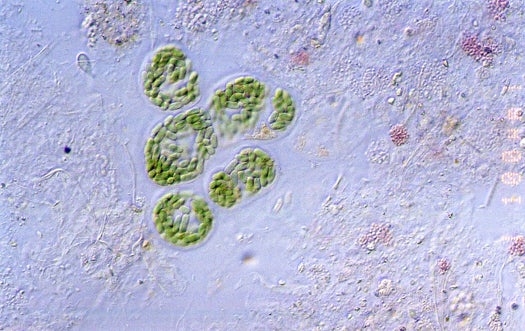
Blowing up Bacteria Cyanobacteria potentially could yield more biofuel than biomass, but the processing method is too energy-intensive; a new method of harvesting its fatty, energy rich interior by blowing the bacteria open using a genetic Trojan horse could change that.

Generating biofuels from bacteria would be easier and potentially more efficient than producing it from plant matter -- if it weren't for the energy-intensive chemical reactions needed to extract the fuel from the bacteria after they've manufactured it. But the most promising sources of bacterial fuel, like cyanobacteria, are wrapped in multiple layers of protective membranes that make it difficult to get at the fatty material. So a team of Arizona State University researchers got an idea: why not blow the bacteria wide open from the inside with a genetically engineered bomb?

Bacteriophages are the sworn enemy of bacteria, latching onto them and pumping them full of foreign genetic information that eventually causes the bacteria to burst. So the ASU team inserted into the bacteria bacteriophage genes that are triggered by the presence of nickel. Then they waited for their cyanobacteria to fatten up.

At harvest time, the researchers simply added nickel to the bacteria's growth media. The nickel was consumed, triggering the genes which in turn kick-started the production of membrane-eating enzymes inside the bacteria. In time: a very tiny boom. The bacteria are blown open, attacked from the inside out, their fatty cargo now easily harvestable.

The bacteriophage genes act as a kind of Trojan horse, waiting inside the membrane for the signal to attack. Since the process of blowing open cyanobacteria from the inside is completely natural, it doesn't require the high costs or energy expenditure associated with existing chemical or physical methods. Not to mention it's far cooler.

[Science Daily]

10 Comments

Arthur Rose

What could some of these genetically altered bacteria do if released into the wild and proliferate to smother natural ones and further dirupt our ecosystem. Anywhere there is nickel there could be oily sludge?

Usernameski

I doubt naturally occurring bacteria congregate in such numbers like ones that are farmed/raised for human purposes to create an "oily sludge" large enough for the human eye to even notice.

Even if the bacteriophages got loose somehow and started attacking naturally occurring bacteria, they would only be activated when the bacteria consumes nickel.

Unless you live in a world that is surrounded by nickel, you won't be drowning in an 'oil sludge' any time soon.

Besides that, bacteria are more numerous than probably all the grains of sand on all the world's beaches. I doubt we'd put a dent on their population even if we tried.

This is not creating a new super-bacteria - rather it is crippling an old one (by adding a genetic defect).

If released in the wild, it would be no different from other cyno's except that it dies in the presence of nickle (a generally common metal with little industrial use, which is likely why it was chosen, as opposed to say, copper).

It is like breeding three legged antelope for easier farm raising. Them getting out into the wild isn't an instant death sentence, but they won't be outbreeding and replacing normal antelope any time soon.

Lets breed geneticly defective hiv.

@Azorus

They are working on something very much like this for cancer. it is called imuno-therapy.

1 take a biopsy of tumor
2 Extract wbc(white blood cells) fighting in the tumor
3 Clone them (maybe increase TNF output or another attack vector in the cloned WBCs')
4 Re-inject into the patient
5 Run a fever and high wbc count for a little while
6 dead tumor.

That is the theory anyway but this article shows that the science is there to achieve the goal.

Downside is this will only work on tumor style cancers others will require differing treatment vectors.

\Science is Awesome.

Crap I posted that on the wrong article. My bad.

not creating a new super-bacteria - rather it is crippling

@ Azorus: HIV is a VIRUS-- the oil-producing organism above is a BACTERIUM. What works on bacteria does not often work on viruses-- antibiotics, for instance, are useless against viruses; they can kill bacteria, however.

Viruses are much smaller than bacteria, and are not considered to be living things, even though they have some of the same components. Viruses need help from living organisms in order to replicate.

Oakspar77777 said "it dies in the presence of nickle (a generally common metal with little industrial use,"

While it may be true there is little industrial use of ELEMENTAL nickel, it is widely used as a component of most kinds of stainless steel. Stainless is often used in places where corrosion is likely and therefore maybe used in holding tanks or other vessels used to process such a fuel.

So I just read an article on Interstellar space travel not being feasible for another 200 years, due to not enough fuel. Couldn't you use this technology, modified for space travel and put a Cyanobacteria fuel refinery onto an interstellar craft that would continue to reproduce and produce their biofuel pumped directly into the craft? C'mon start mixing scientific fields!!!


June 2013: American Energy Independence

Five amazing, clean technologies that will set us free, in this month's energy-focused issue. Also: how to build a better bomb detector, the robotic toys that are raising your children, a human catapult, the world's smallest arcade, and much more.


Online Content Director: Suzanne LaBarre | Email
Senior Editor: Paul Adams | Email
Associate Editor: Dan Nosowitz | Email
Assistant Editor: Colin Lecher | Email
Assistant Editor: Rose Pastore | Email

Contributing Writers:
Rebecca Boyle | Email
Kelsey D. Atherton | Email
Francie Diep | Email
Shaunacy Ferro | Email

circ-top-header.gif
circ-cover.gif
bmxmag-ps