
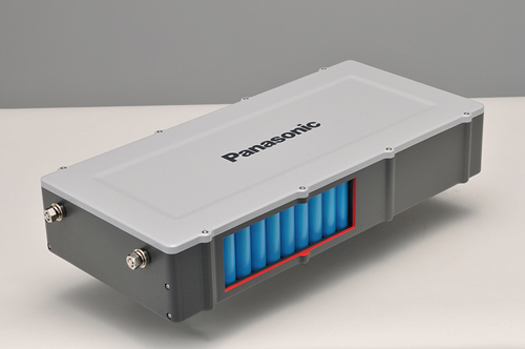
Bringing power storage to the people, Panasonic will bring a home-use lithium-ion storage cell to market in fiscal 2011, making it possible for homes to store a week's worth of electricity for later use. Panasonic -- along with the recently acquired Sanyo -- have already test-manufactured such a battery, which could allow for more widespread deployment of eco-friendly but inconsistent modes of power generation.
While generating wind and solar energy is obviously preferable to burning fossil fuels, the fact that they can't generate steadily and consistently throughout the day and night means that at best they can only supplement more consistent sources of power. But if households and businesses can store excess power when generation is peaking and use it during periods of low electricity output, we could make renewables a larger part of our energy diet.Saying that the battery will last "for about one week," as Panasonic's president has, is pretty arbitrary it seems, as different households have vastly different energy needs. Even so, batteries can be strung together into arrays, and something that could last the average homestead even a few days would open the door for more solar panels on roofs, and that can't be bad.
Five amazing, clean technologies that will set us free, in this month's energy-focused issue. Also: how to build a better bomb detector, the robotic toys that are raising your children, a human catapult, the world's smallest arcade, and much more.


Online Content Director: Suzanne LaBarre | Email
Senior Editor: Paul Adams | Email
Associate Editor: Dan Nosowitz | Email
Assistant Editor: Colin Lecher | Email
Assistant Editor: Rose Pastore | Email
Contributing Writers:
Kelsey D. Atherton | Email
Francie Diep | Email
Shaunacy Ferro | Email
Panasonic acquired Sony?!? That would be quite a story. I think you mean Panasonic acquired Sanyo. Are the editors on vacation?
i was equally puzzled by that little snippet
Recharge them with solar power? Great!
I'm sure it takes no fossil energy whatsoever to produce the batteries and no pollutants like heavy metal oxides and solvents are released in the manufacturing process.
Why let your home produce emissions when a factory can already do that?
Go green!
Wow. That is quite an unprecedented hostile takeover if Panasonic acquired Sony that quickly! Who would have thought?
Seriously PopSci, if you do not want to get sued and or continuously ridiculed I would suggest some fact checking and/or editing. I enjoy your articles as much as the next guy but come on.
You could hire someone like myself with a degree in professional writing for a pittance.
Seriously.
--GTO--
In regards to the battery: Cool. But how much? The only way green energy will really take off is to make it so the masses can afford it and actually provide some savings.
Green energy is still considered by many to be an upper-class luxury; elitist if you please.
Cost down, use up.
--GTO--
Will this fit into a electric vehicle ?????? and power it for more then 60 miles ????
This would be great, I wonder what the estimated cost will be and if it will be even close to a comparable amount of 12V car battery capacity ?
Oh no, Panasonic just took over Microsoft, and invaded Seattle!
Panasonic, if you are listening, I welcome you and would consider it an honor if I could be one of your minions.
Merry xmas dumb people, and merry xmas pop sci readers!
Heil Panasonic!
This may have a small niche but no way it can go mainstream, I've already seen estimates that there is not enough Lithium in the world to make enough batteries if we went all electric cars. And a lot of the esisting supplies come from South American sources
Duracell now offers DISPOSABLE Lithium Ion AA sized batteries, which is wastefull.
And there are better larger scale energy storage devices out there that would work on the street / village scale
So if Panasonic now owns Sony is my ps3 outdated and/or illegal (sarcastic voice).
clavier arabe clavier arabe clavier arabe clavier arabe clavier arabe clavier arabe clavier arabe clavier arabe clavier arabe clavier arabe clavier arabe clavier arabe clavier arabe clavier arabe clavier arabe clavier arabe www.clavier arbe.com
www.clavierarabes.com
Ah yes – that was indeed a slip of the keyboard; Panasonic acquired a more-than-50-percent stake in Sanyo recently, not in Sony.
This is great!!! But yes they will need to bring the cost down in order for this to really go far. But the thing is, is there probably isn't enough Lithium in the world to supply all of humanity. So since Lithium is non-renewable we will have to come up with a different kind of technology.
Even better,this could be configured as an interruptible power supply for the whole house,great for extended power outages,and kicking in instantly.
We're still on the grid , but I would rather use something like this instead of a generator in case there is an ice storm.
For MerryCP: Yes,stay on the grid,but cut your power bill by selling solar/wind power back to the grid,while keeping your Panasonic backup battery constantly charged up for ice storm outages.
I dont know where you people see "Sony", the article I read says "Sanyo".
One day the federal government will make solar power a required standard on all houses.
I've heard that being totally disconected from the grid is not as easy as it sounds.
#1- it costs almost $100,000 to be totally solar independant.
#2-most homes do not have enough roof surface area pointing in the correct direction for the amount of solar panels you need to generate enough power.
#3- the normal solar aray that most people today can afford (around $30,000)only reduces your monthly electric bill by $75.00 to $100.00 a month. Here in Florida thats peanuts. My monthly summer electric bill is $300.00, and thats reletivly small compared to larger homes.
For obiwan1968: If you factor in leased solar,it becomes doable for most people.See: www.treehugger.com/files/2008/04/solar-city-lease-money-down.php I live in southern Canada,and solar probably wouldn't work for me,but in Florida,even modest roof coverage with panels would make a significant dent in your utility bill.
Li-Po batteries are great during a power outage probably not as cost effective as a gas generator, but definitely more streamlined and convenient.
Large scale solar like Spain's solar towers are more efficient, and storing that kind of power is going to require large stores of liquid hydrogen. Or very large stores of hydrogen gas near the location where the power is generated.
The way I see it the future of the power grid is solar, wind, or geothermal power being used to create hydrogen gas near the power source where it can be stored for distribution later. After The hydrogen is piped to the intended use location like natural gas in low pressure (maybe 10 PSI) pipes. The Hydrogen can then be converted back to power when needed by burning or fuel cell. I cant wait to get a hydrogen hookup at my house.
Why pay a premium for lithium ion batteries, for a stationary use? The weight advantage over cheaper lead-acid storage batteries doesn't matter, if the batteries aren't in a moving vehicle.
TXSam: i kinda doubt that hydrogen will be as available as propane in the near future. its a really dangerous gas.
I have trouble believing this can really store a weeks worth of energy for a home. Isn't that probably 300 - 400 KwH? Considering the Chevy volt is only slated for a 16 KwH battery, I doubt this is 20 times so big (800 miles per charge, all electric?).
Anyway, I bet the "week's worth of energy" involves some questionable calculations. Either that or the picture above is actually a battery that weighs about 3 tons.
Dude: sure H2 is easy to ignite (in fact damn hard to stop it igniting randomly) but you can hold a hydrogen balloon above your head and set fire to it without any problems. Unlike propane, any leaks head straight for the top of the atmosphere rather than puddling and flowing downhill, until they find an ignition source and BOOOOOMM!!
The big fish-hook of H2 is that it's not an energy source, only a very inefficient means of storing energy.
There's no indication of scale in the photo, but it looks like they've just taken off-the-shelf Li-Ion cells and bundled them together. Big break-through!
I'm holding my breath for super-caps to reach the marketplace. So long as they don't require a rapidly depleting resource like lithium or a vast global industrial complex like just about everything else we take for granted. ;^(
12/24/09 at 12:29 am
This may have a small niche but no way it can go mainstream, I've already seen estimates that there is not enough Lithium in the world to make enough batteries if we went all electric cars. And a lot of the esisting supplies come from South American sources
Duracell now offers DISPOSABLE Lithium Ion AA sized batteries, which is wastefull.
And there are better larger scale energy storage devices out there that would work on the street / village scale
I've heard that being totally disconected from the grid is not as easy as it sounds.
#1- it costs almost $100,000 to be totally solar independant.
#2-most homes do not have enough roof surface area pointing in the correct direction for the amount of solar panels you need to generate enough power.
#3- the normal solar aray that most people today can afford (around $30,000)only reduces your monthly electric bill by $75.00 to $100.00 a month. Here in Florida thats peanuts. My monthly summer electric bill is $300.00, and thats reletivly small compared to larger homes.
Jesus Saves!
I disagree that Hydrogen gas is an inefficient means of storing energy. Transforming raw power into Hydrogen gas is not entirely efficient, but it solves the problem with renewable sources producing power in spikes, and makes the energy flow easier to control. I haven't built a model yet to prove it, but considering the current grid inefficiency. I think the transportation of Hydrogen gas via pipeline is a good alternative. We are talking renewable so propane is not a good permanent solution for all power needs currently.
Ultra Capacitors are probably going to be the best possible solution for a battery backup system like what Panasonic is attempting here. For instance; there is an ultra capacitor flashlight the "5.11 Light For Life" that charges in 90 seconds up to 500,000 times providing 120 minutes of bright light via 3 LEDs for just $132 or the cost of one 4 D-cell battery Mag Light and about 50 D cell batteries. Is someone wiring these capacitors together in a grid yet so I can put a capacitor pack in my car and house?
TXSam: Hydrogen is a terrible way to try to store energy. As the smallest of atoms, hydrogen can leak out of anything very quickly-- there is no way to keep it contained for very long. Hydrogen-powered cars, for instance, must be fueled right before using them just to avoid significant losses. Half of the liquid will boil off in something like two weeks.
Trying to store it at low pressures is no answer, either. Hydrogen has a very poor power-to-weight ratio, so at 5 psi, as you suggest, you'd need a monstrously huge containment vessel to hold enough to do you any good... therefore, the vessel itself would be so expensive as to be totally impractical.
As for lithium being too scarce for everyone to be able to use it: lithium is one of the most plentiful elements on earth-- you can find it nearly everywhere, including seawater. It's a matter of just how much trouble you're willing to go to, to be able to refine it to a state of purity that you'd be able to use it in batteries, medicines and other applications. There are presently large natural supplies of lithium in Bolivia, China, and elsewhere; more deposits are likely to be found once its monetary value increases.
IBM and others are working on a design known as an air battery, in which oxygen in the air would replace the cathode of the battery, thereby dramatically reducing the size, weight and expense of the battery. The trick is that lithium degrades very quickly in the presence of water, so a membrane would be necessary that was permeable to oxygen but impermeable to moisture.
According to articles published on the subject, such an air battery could have as much as 10 times more storage capacity than the best batteries today, so if air batteries are perfected and become the norm, it would greatly reduce our need for lithium.
Regardless of source and abundance, we need to have laws in place making it mandatory that all lithium is recycled once a battery is no longer effective, and people need to be disciplined enough to recycle them rather than discarding them out of mere laziness. It would help if such batteries needed to be accounted for in some manner so that people would suffer significant penalties if they did not recycle the batteries they have, and they cannot get more batteries if they do not turn in their batteries that have worn out.
Other technologies may also help to reduce the need for lithium in batteries. The use of carbon nanotubes for collector plates may reduce the internal resistance dramatically, thereby making batteries much more efficient, and the greater the efficiency the less lithium will be necessary.
Nanotitanate batteries are presently very expensive, but they have extremely long life cycles-- the nanotitanate batteries that exist today have been tested to survive more than 30,000 charge/discharge cycles, which would be the equivalent of more than 80 years of daily use. If economies of scale allow it to be produced at low cost, and became the technology of choice, and were combined with air battery design, there would be little lithium needed for the batteries we do need, and the batteries we do have just might outlast not only the cars they are in, but the owners themselves.
Another factor that could help reduce the need for lithium is if we had a large network of high-speed charging stations similar to the network of gasoline stations we have today, but there would not need to be as many of them in urban areas since most people would be charging at home, at night, rather than while making local trips. Most of the charging stations would be needed on cross-country spans, such as through deserts, wilderness and other unpopulated areas. Such charging stations would reduce the need for large on-board batteries.
I am personally quite confident that we will have no bottleneck in the supply of rechargeable batteries we will need, or the materials we'll need to make them. And unlike the petroleum we currently use to power our cars, once a battery is built it will not need to be replaced constantly, and batteries will allow us to live cleaner, quieter, simpler, less expensive lives.
"I dont know where you people see "Sony", the article I read says "Sanyo"."
The great thing about online articles is the ability to correct them after they're published.
Thanks, Clay Dillion for bring insights of this rapidly changing technology. Every day new ideas and working examples are popping up all over. I wish our government would throw more money to the minds that focus in this field. It's events like the one coming up at the mall in DC that help to stimulate people and encourage investment. Bravo to all 20 teams this year "Power to the People"
Popular Science Magazine has also played a big part through the years in bring concepts that seem almost fantasy, stirring the imaginations of it's readers. Some of these come to reality and some no more than spur the imagination on to greater things. I've been a fan since I was young, and now 56 years later here I sit typing this on a wireless keyboard, looking at a computer so loaded with software that 20 years ago wasn't even imaginable, a hybrid car in the garage, dozens of gadgets strewn about and reading about more to come and whats already on board. I say POPSCI and It's whole crew are "Top notch, 1st cabin all the way"
Pfffsst!
Li-ion cells are no better than lead acid batteries. This is not a leap in thinking. No chemical battery is very good nor lasts very long. One might get 3 years out of this day in and day out use. That might be a lucky estimate too.
We need better super caps not crummy batteries.
There is only enough lithium currently available to make 4 billion electric cars. The lithium does not get used up; when the batteries wear out we can recycle that lithium into new batteries indefinitely.
We might very well find more lithium in the future; it makes up a higher portion of the Earth's crust than iron.
Before I hear any more about the shortage of lithium, I want to hear people explain why we are running out of iron.
