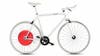
The Copenhagen Wheel:  MIT Senseable City Lab
The innovation slingers from MIT Senseable City Lab have shown up at the Copenhagen Conference, and they’ve brought an idea with them that’s actually worth talking about. The Copenhagen Wheel – named not just for the city of its unveiling but also for Copenhagen’s role in a biking renaissance over the past several years – employs regenerative braking, an electric motor and even a Bluetooth connection to your iPhone for real-time data display.

Anytime you step on the brakes, the generator collects power that it stores in an on-board battery. A sensor in the wheel’s hub can tell when your ride becomes strenuous, like when you’re heading uphill. The sensor then triggers an electric motor that boosts your forward pedaling power. The next time you hit the brakes the cycle starts all over.

The Copenhagen Wheel, Up Close:  MIT Senseable City Lab
But this next-gen bike doesn’t stop at regenerative braking and electric helper motors. A Bluetooth connection in the wheel can speak to an iPhone that fits snugly into the mount on your handlebars. From there it feeds you all kinds of information through an app, including map and traffic info, heightened pollution alerts, speed, distance, fitness data, etc.

The app then lets you share your data with friends through social networks, helping you keep track of your friends throughout the city. It also allows riders to anonymously share urban and environmental data collected by sensors in the wheel with other riders around the city, creating a centralized information hub that's constantly fed real time info by bikers spread across the landscape. It even lets you rack up “green miles” as you travel about, a system not unlike a frequent-flyer program that rewards you for logging time on your bike rather than a car, bus or train.

All of the sensors, instrumentation, batteries and motor are packed in the Copenhagen Wheel itself (which is actually just the hub), and a spoking method devised by the team allows the hub to mount on any bicycle rim, though there's no mention of how much weight it adds to your ride. The Copenhagen Wheel should hit the market within a year, retailing for between $500 and $1,000.


[CNET]

13 Comments

This is mice, but the price is a bit steep for the average person. That will come down in time though, but for now it is limited to rich people or professional cyclists.

Once again the Apple fanboys at popsci drop the main point to give props to iPhones.

The C Wheel might be a decent concept, but the iPhone would seem to be just fluff.

they should make it where it charges the phone too.

I would hope it is not stritly iPhones it works with. And for $1,000 I would hope it was not just an aftermarket product. Bike should be included, otherwise only a select few would buy this.
www.creativecompulsions.com
Knowledge is not information, it is transformation.
~ Osho ~

And yeah, it should power/charge the phone too. www.creativecompulsions.com
Knowledge is not information, it is transformation.
~ Osho ~

It's a nice idea, but it is only an idea unless we know three things:

How much does it weigh?
How much force does it provide?
How far will the battery take you?

Depending on how these questions are answered, it could be totally fabulous, or it could be an expensive piece of junk, or it could be just sort of OK.

Great. Teenagers texting while driving AND while cycling...

Does it only provide power while braking? If so, would it be too complex/large to add an miniature alternator or generator to power the devices simply while pedaling? Personally I don't use the brakes a lot on my bike. Of course the addition of stuff like that would be parasitic, but it's just a thought.

I agree that the Iphone is fluff. How much power can this thing store? Bursts, minutes, what?

Concerning regenerative braking, the article is, well, disappointing, to be gentle.

Regen. braking has been in use for many decades, for electric railroad locomotives, where it feeds power back into the electric distribution system. Hybrid cars use it; they require it to be efficient.

In regen. braking, the motor[s] that drive the vehicle become generators. The electricity that the generators create either goes to the power grid, or charges batteries (or both, in rare cases, perhaps).

The Copenhagen Wheel does not have a separate motor and generator; it has one unit that serves both purposes.

Clay should have realized, before publishing, that he didn't understand how regen. braking worked in this Wheel, and should have been in touch with somebody who knew the answers. Sorry. Pop. Sci. looks rather foolish as a result.

Given the right conditions, common types of electric motors can function as generators, even the ubiquitous squirrel-cage induction motors (as in some wind turbines). This fact needs to be better known to the semi-technical community.

It's likely that the C. Wheel has a permanent-magnet rotor (if it's geared) or a p.m. stator (if it's direct drive -- "inside-out", so to speak.) Of course, the other part of the motor-alternator contains the windings.

HTH,
[n/b]

This is simple...Considering the odds against our planet surviving, I'd say it's a no-holds-bared fight against the polluters. Next, this wheel is a very smart way of gaining positive attention, but it's some what of a hoax, and the MIT people know it. Remember, there are no more fairness rules, so I say a bunch of smoke, mirrors, and big red wheels are acceptable, just save our planet!

Here is what should have been touted as the Copenhagen wheel - it's call Active Spoke, and it actually works! see for yourself at www.activespoke.com The best part is it's a DIY solution, works with just about any wheel, and is very affordable.

That's a funny idea, and a good innovation. We really find this iphone everywhere, it's really like a game... where are we going to find an iphine next time ? ;p

www.scrabblecheat.org

Yes great idea, But it is now june 2010 and I still havent seen this thing on the market and the price is outrageously high for $100 dollars worth of parts. People if we want a better way we need to stop being greedy and start using our brains!


June 2013: American Energy Independence

Five amazing, clean technologies that will set us free, in this month's energy-focused issue. Also: how to build a better bomb detector, the robotic toys that are raising your children, a human catapult, the world's smallest arcade, and much more.


Online Content Director: Suzanne LaBarre | Email
Senior Editor: Paul Adams | Email
Associate Editor: Dan Nosowitz | Email
Assistant Editor: Colin Lecher | Email
Assistant Editor: Rose Pastore | Email

Contributing Writers:

Kelsey D. Atherton | Email
Francie Diep | Email
Shaunacy Ferro | Email

circ-top-header.gif
circ-cover.gif