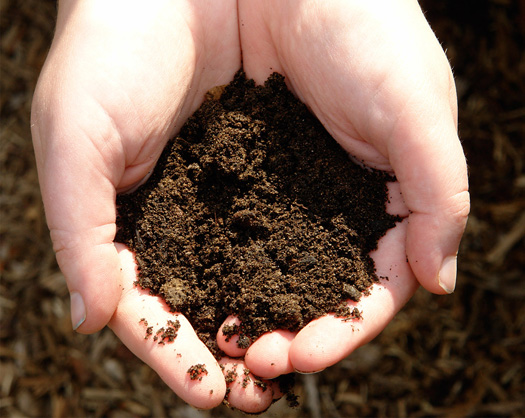
“It depends on what you mean by dirt,” says Milan Pavich, a research geologist with the U.S. Geological Survey.

“The oldest sedimentary rocks are about 3.9 billion years old—they’re in Greenland—and at one time, they were dirt. That’s pretty close to the time the Earth formed.”

But those rocks are just proof that dirt existed on the planet way back then. The stuff in your backyard is much fresher. “Most of the dirt you see today is from the past two million years,” Pavich says. About two million years ago, the planet underwent two major changes that drove the formation of new dirt. Global cooling and drying enlarged the deserts, and dust storms redistributed that dirt around the globe. Meanwhile, glaciers began extending from near the poles, grinding rocks, soil, plants and anything else into dirt as they moved over the land.

Dirt is still being produced all the time, albeit in much lesser quantities. Beneath the soil’s surface, rocks constantly react with rainwater or groundwater and slowly grind together to break down into smaller minerals. So in that respect, dirt really isn’t that old. Then again, Pavich notes, a lot of what came out of the big bang was essentially dust, which then condensed to form the stars and, later on, planets. “If you think about it,” he says, “dirt and its origin are older than the stars.”

8 Comments

Most dirt is actually earth worm dung. This is not a big revelation but I am extremly disturbed at our farmers who depend on the dirt for their crops and kill all the earth worms with their pesticides. Go to an area where there are houses mixed with farmers fields when it rains and look at the worms on the roads. The worms end right at the edge of the farmers fields. Thus no new dirt is made from leaves etc. or aireation (Sorry about the spelling.) of our fields. Something is wrong about this and we need to find a way to keep the worms in the fields before we can't raise crops any more.

Worms help (breakdown of large material to increase surface area and aereation), but it is bacteria that do the job of turning life into soil. Those pesticides are bad for the worms, frogs, and most everything else, but things still rot back into soil, because we could not kill off all the bacteria if we tried.

Oak is right, soil is made irregardless of the presents of worms. I haven't done enough research but I don't know how old soil really is, so I don't believe that it is millions of years old. If that where true we would never have fossils in rock because the rock would never have been made. But still not enough research done on my part to say for sure.

First off, soil is a form of dirt. However, they aren't interchangeable. The term soil is usually used to describe a more organic compound that's broken down plants and animals and fungi. So in that sense, Azorus, you're right because soil is relatively freshly made. Dirt however is more like a broken up form of rock and mineral so it technically can be as old as the stars, given that it could be compressed into rock and then ground back into dirt again.

if the earth were to instantly stop spinning what would happen?

Oak is right, soil is made irregardless of the presents of worms. I haven't done enough research but I don't know how old soil really is, so I don't believe that it is millions of years old.
www.promdresspicture.com
If that where true we would never have fossils in rock because the rock would never have been made. But still not enough research done on my part to say for sure.

ومع ذلك ، فهي ليست قابلة للتبديل. عادة ما يستخدم المصطلح لوصف التربة مركب أكثر العضوية التي انهارت في النباتات والحيوانات والفطريات.
www.thaicarnews.com
www.autonewstoday.net

Curious if the author is accurate, then all rocks should have the same age. Sedimentary rock is just compressed constituents of earlier smaller pieces of rock (dirt), igneous rock is simply earlier rock, melted, spewed to the surface and exposed and metamorphic rock is simply extant substance filled with constituent minerals (dirt). In other words, all forms of dirt and all forms of rock, came from rock that already existed. Thus the rock should display an age equal to the age of the constituents. Rocks are either "created" (ex nihilo - out of nothing) or are "formed" (ab initio - from the beginning). If they are formed, then they should reflect the oldest parts of which they are composed. If they are created, then they would reflect their creation date, but matter would be increasing. Since the laws of physics, in particular, the conservation of matter/energy, states that matter and energy can neither be created nor destroyed, matter cannot be increasing, at least not without a commensurate decrease in energy (which is being converted to matter).

So, if you test the age of a rock and say it was created 3.9 billion years ago, then grind it up (dust storms, plate tectonics, water erosion, whatever) you end up with a pile of dirt 3.9 billion years old. It now washes down a river, into the sea, settles to the bottom and compresses for centuries. However, shouldn't it still show 3.9 billion years old? If so, how do we ever get sedimentary rock that is anything but 3.9 billion years old. You say, fish dung! Where did that come from? Plants, animals, whatever it eats to survive. Where did that come from? On and on and on, until finally you say, it came from the constituent elements that are 3.9 billion years old. Why doesn't everything test 3.9 billion years old. In fact, the earth came from stuff 11 billion years old, why does the earth test at 3.9 billion years old when it was made from stuff that is 11 billion years old? What event changes material in some explainable way where today we are measuring it as part of the 11 billion year old universe, we light a spark and say "poof" today you are brand new and we've erased the 11 billion year old date? What does the erasing, what does the initiating, what stamps the date on the material and what are the chemical and physical changes that occur that cause 3.9 billion year old igneous rock to suddenly turn into ground up, settled, 1 day old sedimentary rock? One day it was dirt on the bottom of the ocean, the next day dirt on the bottom of the ocean, next day, next day, then Poof! it's now sedimentary rock one day old and here'e the thing that changed that we can now measure. On that day, can we say that one molecule below is two days old and one molecule above in not yet sedimentary rock? How many inches, feet, miles "change" per day?

You see where I am coming from?


June 2013: American Energy Independence

Five amazing, clean technologies that will set us free, in this month's energy-focused issue. Also: how to build a better bomb detector, the robotic toys that are raising your children, a human catapult, the world's smallest arcade, and much more.


Online Content Director: Suzanne LaBarre | Email
Senior Editor: Paul Adams | Email
Associate Editor: Dan Nosowitz | Email
Assistant Editor: Colin Lecher | Email
Assistant Editor: Rose Pastore | Email

Contributing Writers:
Rebecca Boyle | Email
Kelsey D. Atherton | Email
Francie Diep | Email
Shaunacy Ferro | Email

circ-top-header.gif
circ-cover.gif