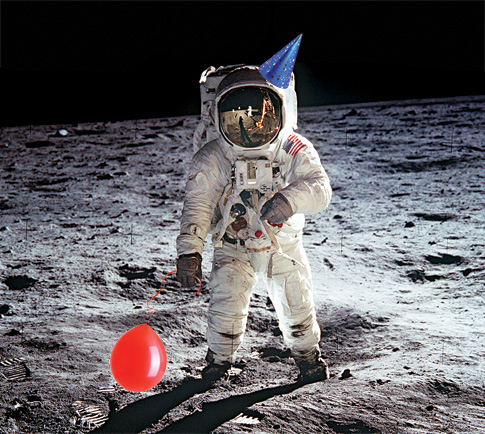
Birthday on the Moon NASA; Insets: iStock

A helium balloon on the moon might as well be made of lead. For any balloon to stay aloft in any atmosphere, the gas inside it must be lighter than the surrounding air.

Ultralight helium has no trouble climbing in Earth’s atmosphere, which consists mostly of heavy molecular nitrogen and oxygen. “But on the moon, there is no air, so there’s nothing for the helium to rise above,” says Marc Rayman, an engineer at NASA’s Jet Propulsion Laboratory. Unable to escape even lunar gravity, which is one sixth that of Earth’s, the balloon would plunge to the ground.

Try throwing a birthday party on the International Space Station, and you’ll run into the opposite conditions. Because atmospheric pressure in the station is kept the same as at sea level on Earth, a helium balloon would have the support it needs to float, but with almost no gravity on the station, there is no force to push up or down on the balloon. “It would just hang there, the same as if you let a hammer go,” Rayman says.

If you’re looking to throw an extraterrestrial fiesta for an astronaut, book a spot on Mars. The thin air on the Red Planet is still heavier than at the highest altitudes on Earth where balloons have floated. That, combined with gravity that’s about a third of Earth’s, would send a helium balloon on Mars up and away.

Have a burning science question you'd love to see answered in our FYI section? Email fyi@popsci.com

12 Comments

Yes the balloon may float if it is electrostatically charged, rub it on your head or in this case in the lunar dust. Electrostatically charged dust was suspended above the surface at the Apollo sites for hours after the astronauts kicked it up walking on the moon.

would it not be basically impossible to have a helium-filled balloon on the moon? since there is no pressure there? even if the balloon was inflated to the smallest pressure it would instantly pop i think... correct me if i am wrong

Helium floats because it has a negative mass so it would float on the moon, I think conservapedia needs some editing. LOL

Did someone actually ask this question?

Um...would a helium filled balloon float in a vacuum chamber?

From what the article suggests, it's a definite NO. Only one way to find out. Please someone submit this to Mythbusters ASAP.

thedudefromthewoods ballons can survive space, you don't need much pressure. The first satellites were balloons, Echo 1 and Echo 2 see:

www.en.wikipedia.org/wiki/Echo_1

"Following the failure of the Delta rocket carrying Echo 1 on May 13, 1960 Echo 1A (commonly referred to as just Echo 1) was successfully put in a 1,519 to 1,687 km (944 to 1,048 mi) orbit on August 12, 1960. The 30.5 meter (100 foot) diameter balloon was made of 0.127 mm (0.005 inch) thick metalized Mylar polyester film and was successfully used to redirect transcontinental and intercontinental telephone, radio, and television signals. The satellite also aided the calculation of atmospheric density and solar pressure due to its large area-to-mass ratio. As its shiny surface was also reflective in the range of visible light, Echo 1A was visible to the unaided eye over most of the Earth. Brighter than most stars, it was probably seen by more people than any other man-made object in space. Echo 1A reentered Earth's atmosphere and burned up on May 24, 1968. Of note is that both the Echo 1A and Echo 2 experienced a solar sail effect due to their large size"

Echo 1 was a passive communications satellite: it functioned as a reflector, not a transmitter. After it was placed in a low orbit of the Earth, a signal would be relayed to Echo, reflected or bounced off its surface, then returned to Earth. Echo 1 was visible to the eye because of its shiny surface, but also because of its low orbit; it would appear from below one side of the horizon, cross the sky, then disappear below the opposite horizon after crossing the sky, as happens with all LEO satellites. The spacecraft was nicknamed a 'satelloon' by those involved in the project.

wouldn't a helium-filled balloon in a vacuum simply explode?

A balloon preset to one with 1 atm., about 10^30 particles per cm^3 would explode in vacuum of space average 7 particles per cm^3 at Earth distance from the sun. However if you inflate the balloon right with over 7 particles per cm^3 in space it would be enough pressure to keep the balloon inflated.

It's important to note that even the best vacuum on earth can't preset the balloon before it enters into space at a lower pressure than is in space, so the container holding the balloon and the opening to the balloon would have to be depressurized slowly to the almost perfect vacuum of space before inflating it with a gas...

Also note that Echo 1 was 100 foot diameter, so a very small amount of gas was used to inflate it in space. I really don't know if they could even control inflating a 10 inch Mylar balloon, you're talking about a infinitesimally small amount of particles...

animemaster,

"Helium floats because it has a negative mass"

Negative mass??? You really shouldn't open your mouth in regard to things you don't understand.

On another note, the issue that must be mentioned is that the low pressure in space will cause a balloon, inflated on earth, to expand because you don't have the same external atmospheric pressure pushing in on the outside of the balloon. There are two forces at work here. The density (not mass animemaster) of helium (at sea level) is less than that of air, which causes lift. The other force at work is the equilibrium of external and internal forces on the skin of the balloon. The internal pressure needs to be great enough to equal the elastic compression force of the skin plus the atmospheric pressure of the air outside.

On a side note, under pressure helium can have a higher density than air (at sea level). The density of a gas is directly related to pressure. So if a balloon skin was thick enough (ignoring the mass of the skin) the required pressure to inflate the balloon would cause the helium to be compressed to the point that it would have a higher density than the surrounding air, and would not float.

They haven't actually done this on the moon.

I think that if a baloon was on the moon, which has no air,
it would float right off of it into space and then begin moving towards earth's orbit and eventually pop.

I don't think it would float because the moon has no atmosphere. Balloons float because the air they are floating in is heavier than the air inside the balloon. So without an atmosphere I don't see how it would be possible for a balloon to float. I don't see why you couldn't inflat a balloon on the moon and set it in an orbit of the moon.

Xspot

from neverland

There should be buoyancy on the moon, because there is some gravity. Sun and entropy probably evaporate some gasses, so that small and properly balanced balloon should feel some buoyancy, at least where vapor is present.
If we accelerate two volumes of heavy and light gasses in space, separated inside a closed envelope, balloon would have wobbling center of gravity, constantly trying to balance different weights. Nothing would float, because gravity is not strong enough, but in artificial gravity conditions, masses would separate and lighter gas would fly on top. If we could keep those two masses separated, buoyancy force between two masses can be used to accelerate the system, with today technology. Think about what we can do with gases, how energy can be added and striped away from molecules, how it can change pressure, volume, shape, temperature and so on.
If you seat in a closed room, there is a lot of air pressure all around you, equally distributed. If somebody would bring a canister of liquid helium and pure it out, nothing would happen, but if helium would expand in an instant, enormous pressure difference would knock out doors and windows at least.
In example, imagine zeppelin like a breathing capacitor, where we could compress lighter gas inside in a small space, at the back of the ship and eject heavy gas trough it, those expanding, gaining energy and slaming in the wide area of wall in front, exerting thrust on envelope in opposite direction. Before this mass could pressurize volume and create back force, we can drive it around the walls, striping heat and energy away and recompress it at the back. The trick is, to manipulate gasses inside closed reference frame, using geometry and their natural properties, transforming one aspect of EM force into another with a slight phase shift on every turn, to result in specific thrust pulse, constantly accelerating object. No need to carry LHC along, transitions between forces, can be done very fast and in gentle, controlled cycles, using natural properties of matter and energy, we know how to manipulate today.
The other part of idea, both for propulsion and protection, is the EM shield, generated as part of the flow inside a balloon ship. Perhaps whole system would look like an electron for outside space, borrowing energy from virtual particles and eject it away somewhere else.


138 years of Popular Science at your fingertips.

Innovation Challenges


Popular Science+ For iPad

Each issue has been completely reimagined for your iPad. See our amazing new vision for magazines that goes far beyond the printed page


Download Our App

Stay up to date on the latest news of the future of science and technology from your iPhone or Android phone with full articles, images and offline viewing


Follow Us On Twitter

Featuring every article from the magazine and website, plus links from around the Web. Also see our PopSci DIY feed


February 2012: The Future of Fun

Science is reinventing play, from extreme sports to gamification to ridiculous roller coasters to the playgrounds of tomorrow, and this issue is chock full of fun. Also, on a less fun note: Did global warming destroy my hometown?


circ-top-header.gif
circ-cover.gif
bmxmag-ps