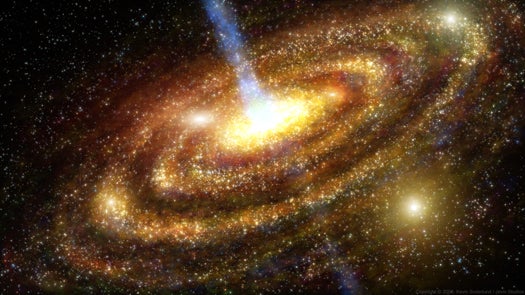
Find The Entropy In This Super Massive Black Hole via Jevin Studios

While Robert Frost famously said that he prefers the world to end in fire, physicists have long predicted the universe will end with an icy sputter known as "heat death." Heat death occurs when the universe finally uses up all its energy, with all motion stopping and all the atoms in creation grinding to a halt. And, based on new calculations from a team of Australian physicists, it looks like heat death is far closer than previously thought.

Heat death is based on the concept of entropy, which holds that disordered states are more stable than ordered states. We experience entropy in real world examples like a glass window being easier to break than to reassemble or create anew. On the scale of the universe, complex systems like stars, planets and galaxies are the glass window, and the Australian physicists have found that supermassive black holes are breaking them faster than we could have imagined.

Physicists have always known that black holes contribute to entropy in the universe by breaking down matter and energy in their gravitational maelstroms, but the calculations always measured the rate of this disorder using the destructive power of the smaller, more common black holes.

However, this new calculation takes into account the galaxy-consuming hunger of super massive black holes. And in this new calculation, the physicists discovered that the old theory vastly underestimated how much of the universe has already been eaten.

On a human scale, say a person can only reasonably expect to live 90 years. This new calculation reveals the age of the universe to be closer to 90 than 50. But don't worry. Since both estimates place heat death billions of years away, the universe still has a long time to enjoy its AARP discounts before having to face the galactic health care death panel.

[via US News and World Report]

23 Comments

i dont see how everything would stop when the extreme pressure on matter in black holes is causing heat itself.

I don't believe all the matter and energy Black Holes consume is lost, I don't think any amount of energy in universe is lost. It's just converted to another type of energy. And I don't think Universe will end by energy deprivation. I think it will just tear itself up (big shred proponent here).

This made me wonder...
We have covered the topic of preventing the world from being destroyed by an asteroid countless times in movies, sci-fi novels and in real life. What are we to do if a black-hole appears and starts munching away at our galaxy?

Q: What are we to do if a black-hole appears and starts munching away at our galaxy?

A: Short sell

What ever happened to the first law of thermodynamics? This is pretty outlandish. Good point on the high pressure/temperature of blackholes. Then again, I'm not an astrophysicist.

There's an interesting rumor circulating that when this happens, someone called god will save us.

stupid rumor

Can we at least get the science right!?!

Heat death is NOT "when the universe finally uses up all its energy, with all motion stopping and all the atoms in creation grinding to a halt."

That's not what heat death is.

Heat death is when there is no longer any difference in temperature between any mass and any other mass. It doesn't mean all the energy is used up -- it just means it is so evenly distributed that there is no longer any difference in potential. With no difference in potential you can't get any work done. Sure the average temperature of the universe is pretty cold -- but it's not zero. So there will still be motion at that point.

As long as there is one black hole and something that's not in that black hole there is going to be a difference in potential. So the universe only dies when it's all one black hole.

Of course at that point it's all a singularity and none of the laws of physics as we know them apply. (First law of thermodynamics doesn't necessarily apply at a singualrity.) Basically, anything at all could happen. (So god isn't really ruled out at that point...)

The fact that pressure in black holes causes heat doesn't help, to the contrary it increases global entropy.

First law of thermodynamics says that when a form of energy is transformed into another, the result of the transformation will be some other form of energy (e.g. work) plus thermal energy (heat), the total amount of energy being conserved. Right.

However not all forms of energy are of equal "quality", heat being the worst one in the "food chain". For example, if I convert to heat the energy stored in a battery, even if I invent the best process to re-convert this heat to electricity to charge another battery, there will be a loss. A part of the heat will be dissipated and not available. Entropy, second law of thermodynamics.

Third law tells that at some point all forms of energy will end up irreversibly transformed to heat and this heat will be dissipated (equally repartited) everywhere. As said TRK3, no difference in thermodynamic potential => no exchange and no work possible anymore.
It'll be "heat death" and it'll be damn cold!...

The way I understood it was that all of the stars will eventually exhaust their fuel and the entire universe will begin cooling. Nothing will matter after that point to us living creatures. I assume that all matter will then join back together with the parallel universe of antimatter and something like a big bang could occur again.

This a theory not yet proven to be fact, remember that.

hey i had the though that the "all black hole universe" sort of death one time, but i just had two theories, one from real scientists, and one by me (yep...minors making theories, then it's bound to be incorrect :D) the real one was the one with the universe tearing itself apart like darcon77 said, and another that i made that says that all the black holes in the universe will eventually grow and then merge with each other (that is, if they don't evaporate first...i don't know their "life expectancy", ima look it up, since i never did :P)

Thank you TRK3 and evoisard for some real science...

One law is more certain than others (like 1...3 of thermodynamics). Everything that exists "improves" on itself to continue existing which is especially true for "living" things. Living things are a very interesting edge case. Note, that their programming language never evolved, only the information stored within the proteins "improved" letting the surviving (evolved) generations adopt to current conditions. The improvements in programming mechanisms/language would be much more time consuming than simply changing the data stored in the system hence the very rapid rate of evolution (of the stored data that define the living thing) comparing to non-"living" things. The amount of data stored by this type of system is increasing but not fast enough anymore to sustain the Moore's law. Yes, we can stretch Moore's law back from when it was defined. New computing paradigms continue propelling the Moore's law as it was true in the far past (evolution that improved and increased the information stored in living organisms) and in the near past (switches, lamps, transistors, ICs, ...). In each cycle the current technology (now silicon ICs) reaches technological limits and declines as the new paradigm takes over and continues the exponential growth.

What all this has to do with singularity or entropy? An interesting observation is that this growth (Moore's law) eventually leads to transforming the energy into "knowledge". The amount of energy committed to "storing" information keeps increasing exponentially. This leads to a singularity where all the energy is transformed and organized into a form of pure knowledge (sustained by mechanisms yet unknown to us) or leading to "heat death" or "big crunch" or would that be a definition of a god?... So, is entropy really an increasing-only proposition or our current understanding of thermodynamics needs some major overhaul????? The process of organizing energy into knowledge system seems to decrease the entropy as a measure of disorder...

If there is a limited amount of energy available in the universe then singularity does not exist and/or there exists a greater paradigm than what we call "universe". Imagine you created a computer program that is capable of improving itself (rewriting itself) learning and gain more and more knowledge. Initially it would probably improve itself exponentially but very soon it would run out of resources and would stop improving. This would be true assuming it would not switch to another paradigm and started controlling resources outside of its "body". In case of the universe it could be possible that the accumulated knowledge will be able to figure out an "out-of-the-body" experience beyond the known universe. We can't possibly know if a "heat death" is yet another syndrome that "explains" what we don't really understand (which is very common in medicine).

Xspot

from neverland

I think heat death of space is also a question of volume. Entropy would encrise, if energy is

confined in tiny space, but decrese if it's spread around into infinity. It's basically a question of a shape of the universe or rather it's geometry. So if geometry is open we will freeze and if it's closed we'll burn.
Or are there another possibilities, like we will continue to grow, connected within the structure of the universe. It's also a question of objects, nobody has ever seen we call black holes. If they exist like such and can devour matter, probably nothing will stop the process of collapsing all the matter, not even evaporation of energy. If those objects are something else, their known physical properties and energies are so incredible that anything is possible and they might even contribute in adding the energy into space, as they can possibly create something from space itself. But this would be another physics.
Scinow, perhaps your computer wouldn't stop improving itself. Field of information would become so big it would stop feeling itself and it would split into two poles, dragging space behind it's lines, trying to complete information, improving the process to infinity ;)

The reason why a software singularity is impossible (a program that improves itself and learns indefinitely) is that it would simply run out of available storage (RAM, disk space). Even if it was able to hijack the external storage and computing resources (other computers on the network) it wouldn't improve significantly further (for the same reason). The required component for a real improvement is the change of the operational paradigm. So in the second step this program would have to start controlling at least the production (conversion) of energy and production of hardware but this is not software anymore (as we define today). If we extend the definition of “software” things get a little bit more interesting.

If all living things are simply parts of a computer program that was written with a similar purpose then it already reached the second stage (conversion of energy and production of hardware/tools).

If the universe is simply a computer program that was written with a similar purpose then it still needs to figure out how to reach/control the outside paradigms and/or our knowledge is still verrrrrrrrrry primitive. Looking at the exponential rate of improvements in our understanding and knowledge we can only deduce that indeed we must have very primitive understanding and knowledge (but we sure are arrogant, we even thought (or at least some of us did) that we were powerful enough to cause global warming! – this is quite an impressive and encouraging level of optimism). We’re like a teenager that thinks that s/he is smartest in the world but when you ask him/her if he thinks she is smarter than a year ago the answer certainly is “yes”. If you continue asking if it is smarter than 2 years ago the answer will be “much much smarter”. If you ask what makes you think that in a year you’ll be dumber? - you’ll see some curiosity on the face. If you follow up with: and what makes you think that in 20 some years you’ll be much much dumber? If you’ll notice a light bulb go off that’s also encouraging.

I always hypothisized that the universe would end when William Wallace would fart?

DarkFx

from Winnipeg, Manitoba

If all this matter is being fused into the purest of energy from the intense pressure of the gravity then it will eventually spew it out like a fountain and its formation into the elements and eventually into planets and gaseous bodies in the universe.

If the Universe is Not Spherical, we would Not be able to listen to the Static of the Big Bang today. That Frequency would still be going outwards, not infinitely reverberating.

When the Pressure of the Universe is Less then the Amount Mass taking up the Volume, then I see the black holes exploding out all that matter anyways, in whatever form. Nature will Always Exist, and will continue to expand. If Earth life dies off, hopefully some Organic Matter somewhere in space gets privileges to a perfect environment and grow into something intelligent over Trillions of Years

I have always thought the flaw in the Big Bang theory is that there is only one Big Bang that humans can detect. What if the Universe is so large that we can only see a tiny fraction of the Universe. What if there are Big Bangs going off every milisecond of every day in some other part of the Universe? Why do sciencetist think that we humans can see almost all of the Universe. Every time we build a bigger telescope, the more we find to see. What would we see if the human race built a telescope as wide as the football statium and as tall as the Sears Towers?

this is not the big bang theory!

It seems a lot of bad science comes out of Oz any more.

I can find a lot wrong with their prediction one super massive black holes are also tend to be self regulating the more the eat the more the radiation from the resulting quasar pushes back in falling matter.
The mass ratio of a black hole to it's host galaxy has been found to almost always be 0.1%.
Also the universe is young enough that every M class star that has ever formed is still around and will remain main sequence for another 20 to 100 billion years.
The Sun is a G class star these have a life span of around 10 billion years.

Same with white dwarfs and their theoretical cold counter part the black dwarf.
The universe is not old enough for a black dwarf to exist.

Really they need to spend more time studying telescope data then playing with theoretical numbers.

A mathematical theory that is not backed by observations is just speculation.

Our present theories could be completely wrong since they do not fit what is observed.

The flaw of the universe model is rooted in the principles of this model’s conception. Consider this. What if by some fluke of nature we were able to evolve to our current levels of intelligence without the ability to sense light (we had no eyes) and our primary sense was hearing (like bats). How would our understanding of the universe look like? (how bat’s understanding of the universe looks like?) What would our laws of physics be? Our instruments would probably measure with the speed of sound not with the speed of light. Wouldn’t our theories embed some kind of limits on the max possible speed? How could we track something that moves faster than sound especially when moving away from us? How could we measure both the velocity and the position precisely and at the same time? Heisenberg would definitely be a major issue even on the macro level…

In other words, we only know what we (and our instruments) “see” and both we and our instruments observe things with the speed of light or slower. We try to improve accuracy by using shorter wave lengths (electron microscopes, etc) but that’s not much of a progress. There is a solution to this in which in the above example we are able to “hear with the speed of light” and in reality “see with a speed of …” (later).

@HoosierDaddy. Haven't you seen star trek? We just shoot some red matter in it to make a slightly smaller black hole. Or would that make it bigger? ;)

In a closed system we'd see conversion of energy but the universe is generally considered to be an ever-expanding and therefore open system so instead of conversion of energy there is, ultimately, dissipation & loss of energy until heat death. This would be a freezing heat death as opposed to the boiling heat death a closed universe would reach at maximum entropy.

It's sad to think we're destined to have our atoms shredded in a black hole before progressing to absolute energy loss.


138 years of Popular Science at your fingertips.

Innovation Challenges


Popular Science+ For iPad

Each issue has been completely reimagined for your iPad. See our amazing new vision for magazines that goes far beyond the printed page


Download Our App

Stay up to date on the latest news of the future of science and technology from your iPhone or Android phone with full articles, images and offline viewing


Follow Us On Twitter

Featuring every article from the magazine and website, plus links from around the Web. Also see our PopSci DIY feed


February 2012: The Future of Fun

Science is reinventing play, from extreme sports to gamification to ridiculous roller coasters to the playgrounds of tomorrow, and this issue is chock full of fun. Also, on a less fun note: Did global warming destroy my hometown?


circ-top-header.gif
circ-cover.gif