Bird, Uninterrupted
The godwit sets record for non-stop flight
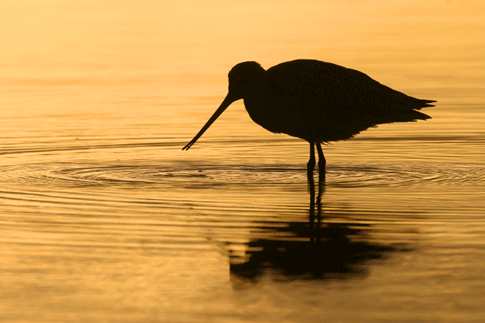
The godwit, while perhaps not as well known as some of its avian cousins–it’s no beauty queen like the swan, nor cheery like the robin redbreast–finally has its own claim to fame. One enduring female godwit recently broke a record for the longest non-stop flight by a bird ever documented, flying an entirely uninterrupted 11,680 kilometers (over 7,257 miles). She took off from a breeding ground in Alaska and her flight lasted eight days, during which she did not stop for food, water, or rest until reaching her destination half-way around the world: New Zealand. The godwit, a shorebird, possesses a long bill, long, reedy legs, and a wingspan averaging 30-40 centimeters. It winters in the Southern Hemisphere much like retired folks do in Boca, except unlike most humans on their flights south, this journey causes the godwit to lose almost half its 1.5 pound body weight.
Scientists tracked this bird marathon, called an “extreme endurance flight,” for nine bar-tailed godwits during the 2006 and 2007 migratory seasons. In a serious show of girl power, the female godwits flew longer and farther than the males. Seven females flew about 10,153 kilometers (about 6,309 miles) each over 9.4 days without stopping. Males logged slightly shorter distances and clocked in fewer days (they flew, at most, 6.6 days, uninterrupted). The previous record was held by a Far-Eastern curlew that flew a measly 6,500 kilometers (about 4,039 miles) over a mere 3-5 days en route from Australia to China. To put the godwit’s feat into perspective, flying 10,153 kilometers is like flying from Los Angeles to London. And then flying another 1,000 kilometers. They build them tough up there in Alaska.
The transoceanic flight was monitored by a team of scientists from the U.S. Geological Survey Alaska Science Center in Anchorage that had implanted minuscule satellite tracking devices inside the female subjects and attached external satellite trackers to the males. They all took off with a favorable tailwind, meaning the wind helped push them in the right direction. An Alaskan tailwind is no small boon: sometimes they can blow birds 3,000-5,000 kilometers, practically to the Hawaiian islands. Aloha! Scientists don’t know how the birds track or sense correct weather patterns, but it is clear they are in sync with favorable conditions. As climate change continues to skew once predictable weather patters, godwits and other migratory species are more likely to miss the narrow seasonal window for flight, and get trapped in freezing temperatures.
One interesting piece of data missing from the study is the godwits’ altitudes–the trackers can’t tell if the bird is skimming the ocean surface or up in the clouds. Scientists also don’t know how the birds navigate themselves. Researchers say further study is needed to fully explain the flight, but the most recent results are astounding. If only American or United flew as smoothly Avian Airlines.
The winner of the new record, godwit E7, is now enjoying summer in New Zealand after her incredible and taxing journey. You could say she, and the rest of the godwits, went around the world on nothing but a wing and a prayer.
via: [Star Tribune ](http://www.startribune.com/nation/32642349.html/ http://www.sciencenews.org/view/generic/id/37858/title/Avian_airlines_Alaska_to_New_Zealand_nonstop/)