Introducing the Lynx, a two-seat rocket built for space tourism
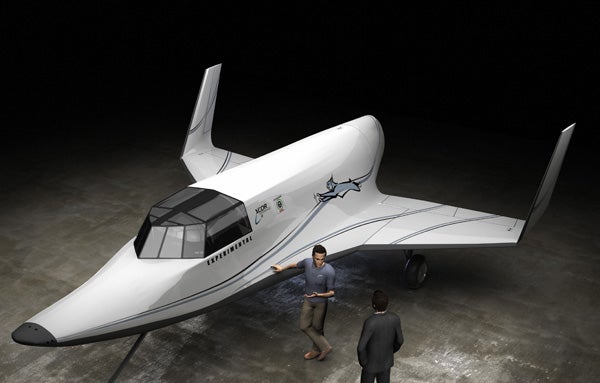
The Lynx suborbital space vehicle Mike Massee/XCOR

Today in Los Angeles, a private space company unveiled the latest entrant in the race to send paying passengers into suborbital space.

The Lynx, in development by XCOR Aerospace, is envisioned as a two-seat vehicle that will allow a paying passenger to ride up front with the pilot to experience weightlessness and see the Earth from space.


"From the beginning we worked towards a vehicle which is fully reusable, will fly often enough, economically enough and safely enough to succeed in what we expect will be a robust, competitive market place," said XCOR president Jeff Greason at a press conference today.

XCOR's been quietly working on liquid fueled rocket engines of all sizes and types in Mojave, California since 1999. The engines range from a diminutive alcohol-fueled "tea-cart" rocket suitable for showing off in hotel ballrooms (and attracting investors), to a methane-powered 7,500-pound-thrust engine completed last year for NASA.

Along the way, the company's engineers have also hotrodded a homebuilt Long-EZ airplane with an alcohol-fueled rocket engine, picked up contracts from the Department of Defense to build novel rocket fuel pumps for cheaper operation of high powered rockets, and teamed with the Rocket Racing League to build the X Racer, a rocket-powered raceplane that XCOR chief test pilot and former Space Shuttle commander Rick Searfoss is now flight testing.

"As a test pilot and former astronaut, I'm absolutely enthralled to be having the prospect of flying this Lynx up through the development and test phase to the point where we are confident we can safely fly the paying public," said Searfoss at the press conference.

Space is defined by an imaginary boundary at 62 miles altitude, and suborbital spaceships built by private companies aim to just sail past that mark for four or five minutes of weightless flight before falling back to Earth. That's far short of the 200 miles or so reached by the Space Shuttle at orbital speeds topping 25 times the speed of sound.

Still, suborbital flight is a big challenge for any private company, and only one, Scaled Composites of Mojave, California has actually pulled it off. To get there, a ship has to crack three times the speed of sound using rocket power, keep its passengers alive with onboard life support, use maneuvering thrusters to orient itself in space, and somehow survive reentering the atmosphere, still going Mach 3, to make a safe landing.

Scaled's SpaceShipOne, did all that in 2004 to win the $10 million Ansari X PRIZE, inspiring British airline tycoon Richard Branson to invest in SpaceShipTwo for his newly formed
Virgin Galactic. Branson's plans hit a snag last summer, however, when a test stand explosion claimed the lives of three Scaled employees and set back the company's rocket development for the new ships.

XCOR plans to launch the Lynx by 2010, the same year called for in Virgin's revised schedule for SpaceShipTwo. The private space race is definitely heating up.

5 Comments

Skillfully rendered animations aside, XCOR is promising an awful lot in a very short time.

.

probably (but not 100% sure) the Virgin's SpaceShipTwo will fly first, but the single-vehicle suborbital planes, like the EADS-Astrium and Xcor Lynx, will be ways BETTER since they costs less to build, need less maintenance time and costs, may take off from hundreds airports around the world, have no "exotic" solid+liquid hypergolics propellents and are (both EADS and Xcor) VERY MUCH SAFER since they have jet or rocket engine(s) for several landing's attempts/changes/abort while the SS2 will fall like a meteorite

cut the flights' altitude to 60 km. and the tickets' price to $100,000 is a great idea since each flight woill go the "enough Space" with less risks and a price that can be affordable for a larger market

more info and opinions about Space and Spacecrafts on http://www.ghostnasa.com/

.

DarkFx

from Winnipeg, Manitoba

I want one, 1000X Larger that can take me and my ENTIRE Family away, must include a - Everything fabricator, including food, b- Star Fleet to run it C- Be able to run in space, Forever. To go where no human has gone before.

Or at least put StarFox on the side instead of Linx

They should serously like make it so that you can stay longer in space. And how in the world can that company make money off of a $100,000 dollar ticket? or even a million? Wouldn't it like cost a lot more than that to put that craft into space. What would be really awsome is if you were up there for like a day or two and like take a space walk. DarkFx has the right idea i think when he says that they should make the thing bigger. not 1000x by any means but big enough so that maybe 20 people could go at a time. I'll bet it would actually make the per person ticket price go down.

Swilverback

from hamilton, on

I would love to see this happen, but other than well done animatics there have been no test flights(that I'm aware of)!At least the Virgin's Space Ship One has a proven flight record,even though I support the liquid fuel propulsion system over the solid fuel alternative!We have seen too many disasters from such technology, that it would be a delight to see the Lynx's system function at an optimal rate.I wish both of them the best, but I believe commercial space travel has to have the clients best interests(safety)in mind.After all, there's no point in going somewhere if you cant enjoy it!


138 years of Popular Science at your fingertips.

Innovation Challenges


Popular Science+ For iPad

Each issue has been completely reimagined for your iPad. See our amazing new vision for magazines that goes far beyond the printed page


Download Our App

Stay up to date on the latest news of the future of science and technology from your iPhone or Android phone with full articles, images and offline viewing


Follow Us On Twitter

Featuring every article from the magazine and website, plus links from around the Web. Also see our PopSci DIY feed


February 2012: The Future of Fun

Science is reinventing play, from extreme sports to gamification to ridiculous roller coasters to the playgrounds of tomorrow, and this issue is chock full of fun. Also, on a less fun note: Did global warming destroy my hometown?


circ-top-header.gif
circ-cover.gif
bmxmag-ps