Solar Sail Experiment Fails to Reach Orbit
Cosmos 1, the first mission to test if spacecraft can sail to distant stars on beams of sunlight, was lost shortly after launch on Tuesday
The Cosmos 1 solar sail experiment was lost on Tuesday when the Russian Volna rocket carrying it to orbit failed, according to the Russian Space Agency. Had the launch been successful, the experiment would have tested whether sunlight could have pushed the spacecraft into a higher orbit. Explore the mission that was to be with our exclusive slideshow, pulled from the pages of Popular Science.
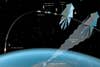
On June 21, the California-based nonprofit Planetary Society will attempt for the fourth time to launch its privately funded Cosmos 1 solar sail. A Russian ballistic missile will deliver the 30-meter-wide sail, which is made of Mylar and looks like a giant pinwheel, into an 825-kilometer near-polar orbit. Like a sailboat coasting with the wind, the craft won’t need an engine: Pressure from the sun’s photons, striking the sail’s surface at various angles, will boost its orbital velocity. If the concept is successful, more-developed solar sails might one day cruise among the planets of the inner solar system. And they’ll never need to refuel.
To get out of Earth’s orbit quickly, however, a solar sail would require more than a gust of sunlight. Physicist and science-fiction author Gregory Benford thinks he has a solution. When the Planetary Society gives them the go-ahead, he and his brother James, the CEO of Microwave Sciences, will use a 70-meter antenna in Goldstone, California, to fire a 500-kilowatt beam of microwave energy at Cosmos 1. The influx of high-energy photons will produce at best a tiny change in the sail’s velocity–not enough to kick it
out of orbit, but enough to measure–and it will
stand as an important test. “We know the physics will work,” James Benford says. “We’re now trying to find the best approach to get us out of the solar system.”
Click here for our exclusive slideshow.
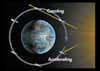
Facing the Sun
by John MacNeill
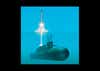
Launch