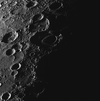
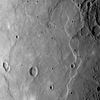
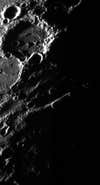
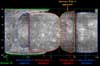
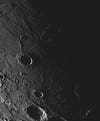
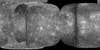
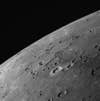
NASA’s Messenger spacecraft recently made its third flyby of Mercury, in order to get a gravity boost that will enable it to enter into orbit around Mercury in 2011. Scientists used the close encounter to capture images of Mercury’s surface that had never been seen before.
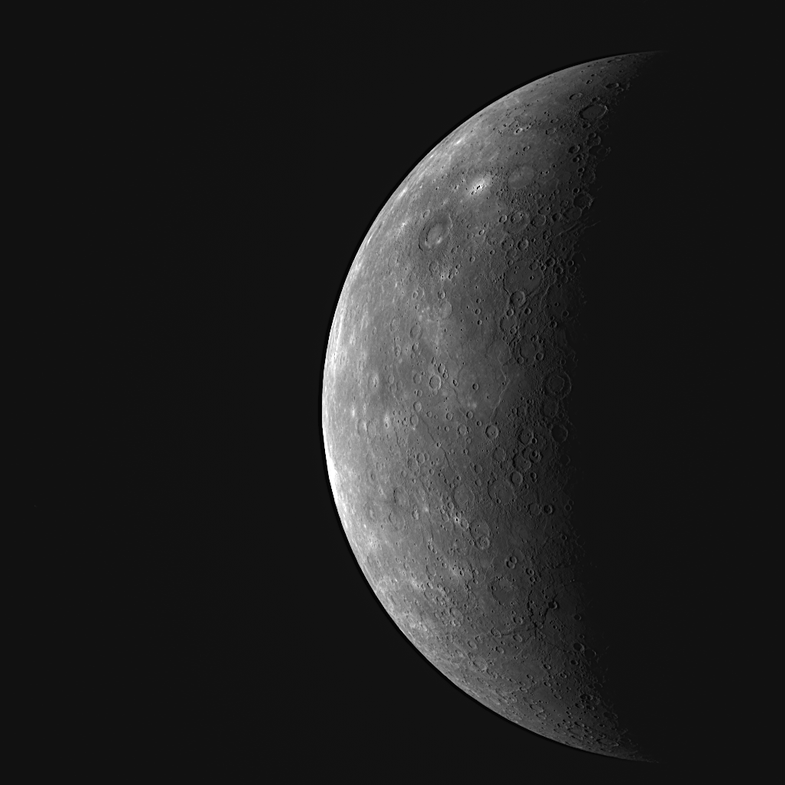
Messenger‘s cameras revealed an additional five percent of Mercury previously unseen by spacecraft even after the three flybys by Mariner 10 in 1974-75 and Messenger‘s two previous flybys in 2008. The new images show many interesting surface features, including impact craters, smooth plains, and an intriguing double-ring basin.
NASA
A Never-before-seen Portion of Mercury
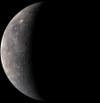
This striking view of Mercury shows portions of its surface that had remained unseen by spacecraft even after the three flybys by Mariner 10 in 1974-75 and Messenger‘s two earlier flybys in 2008. The newly imaged terrain is located in a wide vertical strip on the left side of Mercury’s partially sunlit disk.
Outlining Messenger’s new coverage
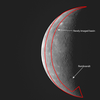
Messenger imaged Mercury’s partially sunlit surface on its approach to the planet. The area of this image outlined in red reveals the portion of Mercury’s surface that had been previously unseen by spacecraft. Also shown are a newly-imaged double-ring basin, and the Rembrandt basin.
A Newly Imaged Double-Ringed Basin
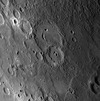
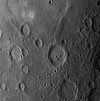
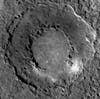
This unnamed impact basin was seen for the first time during Messenger‘s third flyby of Mercury. The outer diameter of the basin is approximately 160 miles. This basin has a double-ring structure common to basins with diameters larger than 125 miles. The floor of the basin consists of a smooth plain. Concentric troughs, formed by surface extension, are visible on the basin floor. Such troughs are rare on Mercury, and the discovery of such features is of great interest to Messenger‘s science team.
A High-resolution Look over Mercury’s Northern Horizon
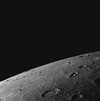
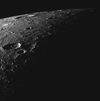
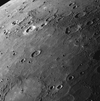
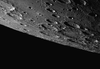
A high-resolution look at a previously unseen portion of Mercury’s northern horizon. Visible in the lower right corner of the image is Mercury’s terminator, the line between the light day side and dark night side of the planet. Smooth plains extend for large distances towards the horizon.
A Newly Pictured Pit-Floor Crater
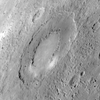
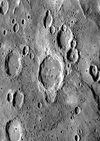
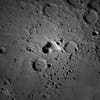
The unnamed crater in the center of the image was viewed at close range for the first time during Messenger‘s third flyby of Mercury. It displays an arc-shaped depression known as a pit crater on its floor. Impact craters on Mercury that host pit craters in their interiors have been named pit-floor craters. The discovery of multiple pit-floor craters adds to the growing evidence for the presence of volcanic activity during the evolution of Mercury’s crust.
Seeing Double?
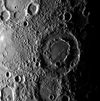
This image shows a double-ring impact basin, with another large impact crater on its south-southwestern side. Comparatively fresh craters are visible aross the entire surface, and are caused by smaller, more recent impacts. Double-ring basins are formed when a large meteoroid strikes the surface of a rocky planet.
A Bright Spot in the Latest Imaging
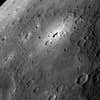
Messenger‘s third fly-by has provided the best view so far of the bright area shown near the top center of this image. It allows us to see the feature and its surroundings in greater detail, including the smooth plains in the foreground and the rim of a newly discovered impact basin at its lower left. At the center of the bright halo is an irregular depression, which may have formed through volcanic processes. This area will be of particular interest for further observation during Messenger’s orbital operations starting in 2011.
Crater chains
This newly observed flat-floored crater was viewed at an oblique angle as Messenger approached Mercury for its third flyby. The distinctive halo of small secondary craters that radiate outward from the central structure shows that this crater is younger than nearby craters of similar size. Many of these secondaries are aligned in chain-like formations and some show characteristic “herringbone” features pointing back to the crater of origin. This unnamed crater is partially superposed on an older and smaller crater to the south.
Mercury’s Cratered Surface and the “Paw Print”
Mercury’s surface is covered with craters in many sizes and arrangements, the result of impacts that have occurred over billions of years. In the top center of the image, outlined in a white box and shown in the enlargement at upper right, is a cluster of impact craters on Mercury that appears coincidentally to resemble a giant paw print. In the “heel” are overlapping craters, made by a series of impacts occurring on top of each other over time. The four “toes” are single craters arranged in an arc northward of the “heel.” The “toes” don’t overlap so it isn’t possible to tell their ages relative to each other. The newly identified pit-floor crater can be seen in the center of the main image as the crater containing a depression shaped like a backward and upside-down comma.
Evening Shadows
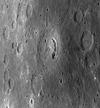
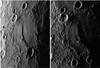
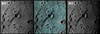
The above Messenger images were taken during the spacecraft’s second (left) and third (right) flybys. The two images cover very nearly the same terrain, but for the right image the Sun’s illumination is more nearly grazing (local time is almost sunset) and the viewing perspective of the spacecraft is more nearly vertical. The large impact crater bisected with a prominent scarp or cliff is the same feature in both images. Because of Mercury’s rotation between the two encounters, the position of the crater in the right image is nearly at the terminator (the division between the day side and night side of the planet), and thus the shadows are longer. To the west of the crater, the shadows and viewing angle show that the terrain is far more rugged than it appeared from the previous flyby.
Capturing Mercury through Messenger’s Dual Cameras
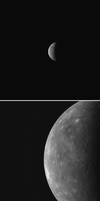
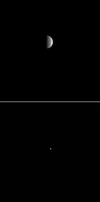
Messenger captured these two images of an approaching Mercury. The top image was taken by its Wide-Angle-Camera (WAC), while the bottom image was acquired by the Narrow-Angle-Camera (NAC). The dual cameras provide complementary images, both valuable for understanding the nature of Mercury’s surface. The NAC is higher in resolution than the WAC and is used to see the details of geologic features. The WAC can be used to create enhanced-color images that highlight differences in the composition of rocks on Mercury’s surface. Enhanced-color images from the first two flybys have been used to map Mercury’s crust.
A Terminator Shot
The terminator, the division between the dark night side and light dayside, runs through the middle of this image. Shadows are elongated as the craters catch the rays of an evening Sun. At the terminator, only the highest points of crater rims and inner peak rings are illuminated by sunlight. Such lighting conditions can provide important information about the heights of geologic features on the surface.
Young and Wrinkled
This image shows a large expanse of smooth plains material. The density of impact craters on the smooth plains is less than on the heavily cratered terrain visible in the upper right and lower right corners of the image. The presence of fewer impact craters means that the plains are young compared with the older, battered terrain. Despite their relative youth, tectonic forces in Mercury’s crust have produced the curving scarps (cliffs) and “wrinkle ridges” that run mostly from top to bottom in the image.
Strange Neighbors
The Sun casts deep shadows in this image, emphasizing the texture and topography of the terrain along the terminator (day/night boundary). The large crater at upper left has a rough rim and walls, and the floor of this crater has a sunken inner circular area containing an irregular depression (or pit) that is entirely in shadow. Just to the south-southwest is the right half of another large crater of about the same diameter, but which has been filled nearly to its rim with smooth material likely of volcanic origin. These two close neighbors, one empty and one full, attest to Mercury’s surprisingly complicated geological history.
A Global Map of Mercury’s Surface
One of the main science imaging goals of Messenger‘s third Mercury flyby was to obtain the first images of a portion of Mercury’s surface that had never before been seen by spacecraft. The new images (outlined in yellow) filled a gap in the map that existed prior to the encounter. Combining the new Mercury coverage with photos obtained from Mariner 10’s three flybys in 1974-75 (outlined in green) and images from Messenger‘s first (outlined in blue) and second (outlined in red) Mercury encounters in 2008 now yields nearly total coverage of Mercury’s surface. Along with revealing intriguing geologic features in this previously unseen terrain, having a complete global map of Mercury’s surface will be valuable for planning Messenger‘s orbital operations, which will begin in March 2011.
Rembrandt in 3D!
The central graphic shows a three-dimensional (3D) image of a portion of Rembrandt basin. Standard 3D glasses (which can be assembled at home), with a red filter in front of the left eye and a blue filter in front of the right, can be used to view this picture. This image was made by overlaying two mosaics of the same area of Mercury taken from different angles. Here, an image from Messenger‘s second flyby was superposed on an image from its third flyby to create the 3D image. The images acquired by Messenger during its orbital mission phase beginning in March 2011 will allow most of the surface to be represented in 3D!
It’s Just a Phase that Mercury’s Going Through
Shown here are nine of the 1,177 images planned with the goal of characterizing how the measured brightness of Mercury’s surface is controlled by changing lighting conditions. During Messenger‘s third Mercury flyby, the angle–called the phase angle–between the Sun, Mercury’s surface, and the spacecraft was continually changing.By collecting images that show the full planet over a large range of phase angles, the effect of the phase angle on Mercury’s apparent brightness can be determined. Such information is very important when trying to compare and interpret images of Mercury’s surface that were collected under different lighting conditions.
Evidence of Volcanism on Mercury: It’s the Pits
Craters on Mercury with non-circular, irregularly shaped depressions or pits on their floors have been termed pit-floor craters. The pits could be evidence of volcanic processes. This image shows a good view of a pit-floor crater. The large crater near the center of the image contains an elongated bean-shaped depression on its floor and is a pit-floor crater. The slightly smaller crater to the south also contains a pair of depressions on its floor, though it is unclear from this image if the depressions are pits or overlapping impact craters.
Look Back – Look Ahead
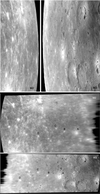
The two top images cover some of the same parts of Mercury. The top left image labeled “M2” was captured after Messenger‘s second flyby as the spacecraft looked back at Mercury.The top right image labeled “M3” was captured by Messenger as it approached Mercury for its third flyby. The differences in perspectives, foreshortening, and illumination conditions make it difficult to find features visible in one image that also appear in the other. However,placing the images into the same map projection can remove most of the geometric distortion. The two lower images are both in simple cylindrical projection, and common features are recognizable. A few bright craters are labeled with letters to guide the eye. Images in map projection can be mosaicked together to produce a global image model of a planet’s surface.
Tip of the Crescent
As Messenger was nearing its closest approach to Mercury, one of its cameras captured this image of the northernmost region of Mercury’s surface illuminated by sunlight. The brightly lit northeastern walls of large impact craters can be seen near the horizon. The Sun’s angle also accentuates wrinkle ridges winding across the smooth plains. In the foreground, the terminator separates day from night.
Mercury’s Geology: A Story with Many Chapters
This image captures examples of the multiple processes that have played important roles in shaping the geology of Mercury’s surface. Impact cratering has clearly been an influential process, and both old degraded craters and relatively young fresh craters can be spotted in this image. Near the center of the image is found a large, fresh crater with a smooth floor, central peak structures, terraced walls, and many associated small secondary craters. At the top of the image, smooth plains extend over a large area. There is evidence that many of the smooth plains are volcanic in origin. Wrinkle ridges are visible on the plains. In the lower left of this image, a scarp (cliff) cuts through a deformed impact crater.Such scarps are thought to be the surface expressions of large faults that formed in Mercury’s past as the planet’s interior cooled and the surface contracted slightly as a result.
The Rim of Rembrandt and Neighboring Scarps
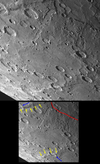
The large Rembrandt impact basin was discovered during Messenger‘s second Mercury flyby. A portion of the rim of that basin (outlined in red) is visible at top right in this high-resolution image from the third flyby. Two scarps (cliffs) can also be identified in this image (yellow arrows). Both scarps cut across craters that have been deformed by the faulting that produced the scarps (blue arrows). Because this area of Mercury’s surface was imaged during both Messenger‘s second and third flybys, there is now stereo coverage that enables a three-dimensional visualization of the surface to be constructed.
Flooding Mercury’s Surface
Messenger‘s high-resolution images have revealed large areas of Mercury’s surface that appear to have been flooded by lava, forming wide expanses of smooth plains. This image shows some of these smooth plains toward the horizon in the upper left corner. A large crater in the lower left has been filled with lava until only portions of its circular rim are visible. Other examples of flooded craters can be spotted throughout the image, along with wrinkle ridges snaking across the plains.
Approach Mosaic from Mercury Flyby 3
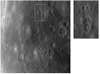
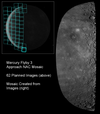
Messenger acquired 62 high-resolution images during its third flyby, prior to the spacecraft’s closest approach to Mercury. As shown in the inset, the 62 images (blue squares) covered the entire sunlit surface of the planet, including terrain not previously imaged by spacecraft and depicted as a featureless gray strip in the inset. On the basis of information about the location of the spacecraft and the pointing of the camera, the 62 images have been fit together to create the mosaic image shown, which fills a gap that existed in the global map of Mercury prior to the flyby.
Mercury from Nearly Two Million Miles
These two images of Mercury were acquired at a distance of nearly two million miles from the planet. Just 10 days earlier the spacecraft passed a mere 140 miles above Mercury’s surface during the mission’s third Mercury flyby. Taking images of Mercury from such a large distance can still provide valuable data. The top image was taken to support a passive scan of Mercury by the Mercury Laser Altimeter (MLA). In a passive scan, the MLA laser is turned off and the field of view of the instrument’s sensors is swept back and forth across a swath of space that includes Mercury. Such a scan provides information about the pointing of MLA with respect to other instruments. The bottom image was acquired as part of a large imaging campaign to characterize how the measured brightness of Mercury’s surface is controlled by changing lighting conditions.
Mercury’s Surface Has More Iron + Titanium Than Previously Thought
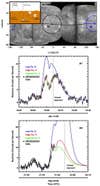
In the figure at the top, the areas on Mercury’s surface measured with the Messenger Neutron Spectrometer (NS) during the first and third Mercury flybys (M1 and M3, respectively) are shown as circles. The spacecraft ground tracks for M1 and M3 are indicated by the black and blue lines, respectively. A mosaic of Mercury’s surface in cylindrical projection is shown as background. The inset is a schematic illustration of how thermal neutrons are used to probe the iron (Fe) and titanium (Ti) content of Mercury’s surface. Fe and Ti capture thermal neutrons very efficiently, so low fluxes of thermal neutrons indicate high abundances of these elements. The middle graph shows the modeled and measured neutron counting rates for M1. The solid lines show predicted neutron counting rates for three different composition models: low Fe and Ti (blue), high Fe and Ti (red), and highest Fe and Ti (green). The low Fe and Ti model is similar in composition to the lunar highlands. The high and highest Fe and Ti models are similar in composition to lunar basalts from Mare Fecunditatis (Luna 16) and Mare Tranquillitatis (Apollo 11), respectively. The NS data (black circles) show that Mercury’s surface fits the model with high Fe and Ti abundances, in contrast to previous ideas that Mercury’s surface is low in Fe and Ti. The bottom graph shows new modeled and measured neutron counts just obtained during M3. While the data stop prior to 21:50 UTC because of the spacecraft safing event that shut off all data collection, enough NS data were returned to again show that Mercury’s surface fits the model with high abundances of Fe and Ti. These results from both M1 and M3 demonstrate that Mercury’s surface has a significantly higher Fe+Ti content than was previously appreciated.
Evidence of Volcanic Activity on Mercury
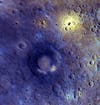
This enhanced-color view was created with a statistical technique that highlights subtle color variations often related to composition. Merged with images from the higher-resolution camera, the two sets of observations tell the story of the geology of the area and the compositional differences of the features observed. This region, viewed in detail for the first time during the third flyby, appears to have experienced a high level of volcanic activity. The bright yellow area near the top right is centered on a rimless depression that is a candidate site for an explosive volcanic vent. The double-ring basin in the center of the image has a smooth interior that may be the result of effusive volcanism. Smooth plains, thought to be a result of earlier episodes of volcanic activity, cover much of the surrounding area.
Mercury Flyby 3 Reveals a Highly Diminished Sodium Tail
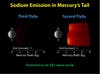
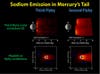
These figures show comparisons of the neutral sodium observed during Messenger‘s second and third Mercury flybys. The left panel shows that emission from neutral sodium in Mercury’s tail, which extends away from the planet in the anti-sunward direction, was a factor of 10-20 less than during the second flyby, shown in the right panel. This difference is due to variations in the pressure that solar radiation exerts on the sodium as Mercury moves in its orbit. During the third flyby, the net effect of radiation pressure was small, and the sodium atoms released from Mercury’s surface were not accelerated anti-sunward as they were during the first two flybys, resulting in a diminished sodium tail. These predictable changes lead to what are effectively “seasonal” effects on the distribution of elements in the outermost layer of the atmosphere.
A Color View of the Solar System’s Innermost Planet
As Messenger approached Mercury, one of its camera’s 1000, 700, and 430 nanometer filters were combined in red, green, and blue to create this color image, the last close-up color view that will be acquired until Messenger goes into orbit around Mercury in March of 2011. Only 6% of Mercury’s surface in this image had not been viewed previously by spacecraft, and most of the measurements made by Messenger‘s other instruments during this flyby were made prior to closest approach.
Calcium and Magnesium in Mercury’s Exosphere
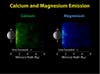
These figures show observations of calcium and magnesium in Mercury’s neutral tail during Messenger‘s third Mercury flyby. The distribution of neutral calcium in the tail appears to be centered near the equatorial plane and the emission rapidly decreases to the north and south as well as in the anti-sunward direction. In contrast, the distribution of magnesium in the tail exhibits several strong peaks in emission and a slower decrease in the north, south, and anti-sunward directions. These distributions are similar to those seen during the second flyby, but the densities were higher during the third flyby, a different “seasonal” variation than for sodium. Studying the changes of the “seasons” for a range of chemical species during Messenger‘s orbital mission phase will be key to quantifying the processes that generate and maintain the exosphere–the outermost layer of the atmosphere–and transport volatile material within the Mercury environment.
Modeling the “Seasons” of Mercury’s Tail
Comparisons of the neutral sodium observed during the second and third Mercury flybys to models are shown in this figure. As in previous flybys, the distinct north and south enhancements in the emission that result from material being sputtered from the surface at high latitudes on the dayside are seen. The lower two panels show Monte Carlo models of the sodium abundance in Mercury’s exosphere–the outermost layer of the atmosphere–for conditions similar to those during the two flybys. These models illustrate that the “disappearance” of Mercury’s neutral sodium tail is consistent with the change in conditions. Observations of the sodium exosphere and tail throughout Mercury’s orbit during Messenger‘s orbital mission phase will enable such “seasonal” effects to be studied. Refinement of models similar to these will lead to an improved understanding of the source and loss processes and their variations among Mercury’s different exospheric “seasons.”
Looking in Detail at a Spectacular Double-Ring Basin
This spectacular 290-kilometer-diameter double-ring basin seen in detail for the first time during Messenger‘s third flyby of Mercury bears a striking resemblance to Raditladi basin, observed during the first flyby. This still-unnamed basin is remarkably well preserved and appears to have formed relatively recently, compared with most basins on Mercury. The low numbers of superposed impact craters and marked differences in color across the basin suggest that the smooth area within the innermost ring may be the site of some of the most recent volcanism on Mercury.
The First Simultaneous Observations of Neutral and Ionized Calcium
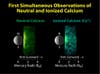
Shown here are the first simultaneous observations of the emissions from neutral and ionized calcium in Mercury’s tail region. Neutral calcium is rapidly converted to ionized calcium by sunlight, explaining the generally rapid decrease of neutral calcium away from the planet. The high degree of correlation between the two observed distributions reflects the rapid conversion of neutrals to ions and demonstrates that ionized calcium represents a significant fraction of the overall calcium abundance. Simultaneous measurement of the abundances of calcium neutrals and ions is therefore necessary to determine accurately the total calcium abundance in Mercury’s exosphere. This situation is in contrast to that for sodium and magnesium, which are ionized much more slowly. The significantly longer lifetime for neutral magnesium may explain why its abundance is more widely distributed in the tail region than calcium.
A Newly Identified Candidate for an Explosive Volcanic Vent on Mercury
This image shows a detailed view of the irregular depression seen in the enhanced color image released earlier. This region of high reflectance was just barely seen on the limb during Messenger‘s second flyby, but without enough detail to characterize it as anything other than a bright spot. A more favorable viewing angle reveals this bright spot to be an irregular rimless depression approximately 30 kilometers across surrounded by highly reflective material. Its features are distinctly different from those of impact craters and, though its origin remains ambiguous, it is suspected to be volcanic, possibly the site of an explosive volcanic vent.
Mercury in True and Enhanced Color
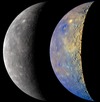
Messenger‘s Wide-Angle-Camera (WAC) used its 11 filters to capture images during the third Mercury fly-by. The image on the left is not black and white but rather was produced by using three of the WAC’s filters (centered at 480, 560, and 630 nanometer wavelengths) to create an approximation of how Mercury’s true color might appear to a human eye. In contrast, the brightly colored view of Mercury on the right was created by utilizing the information gathered by all 11 of the WAC filters and applying statistical methods that accentuate the subtle color differences on Mercury’s surface.
A Southern Horizon as Seen during Mercury Flyby 3
This dramatic view of Mercury was captured by the NAC as the Messenger spacecraft approached the planet for the mission’s third flyby. The image shown here includes a large area of Mercury’s surface in the southern hemisphere that had not been imaged at high-resolution prior to the third Mercury flyby, and thus this image provides important coverage for a new global Mercury map.
The Sun Sets on Rembrandt
This image acquired during Messenger‘s third flyby of Mercury shows a view of the interior of Rembrandt basin that emphasizes landforms. Rembrandt was discovered during the mission’s second Mercury flyby in October 2008. During Mercury flyby 3, Rembrandt was closer to the terminator, the line between the sunlit dayside and dark nightside of the planet, and the different viewing geometries between the two flybys enabled a three-dimensional view of this unusual basin. The grazing angle of the light from the setting Sun in this particular image accentuates the topography of the features on the Rembrandt’s floor, including the set of unusual radiating fractures.
Full global map of mercury released
This image shows the full global map of Mercury at a greatly reduced scale, but you can access the publicly available high-resolution Mercury map here. Members of the Messenger team and experts from the U. S. Geological Survey (USGS) used images from Messenger‘s three Mercury flybys and from the Mariner 10 mission in 1974-75 to create a global mosaic that covers 97.7% of Mercury’s surface at a resolution of 500 meters/pixel (0.31 miles/pixel).
Extensive Smooth Plains on Mercury
This image is of an area just to the north of a previously released image acquired during Messenger‘s third flyby of Mercury. Both that previously released image and this one show large areas of Mercury’s surface that appear to have been flooded by lava. In this view, craters are visible that have been nearly filled with lava, leaving only traces of their circular rims. After the Mariner 10 mission, there was some controversy concerning the extent to which volcanism had modified Mercury’s surface. Now Messenger results, including color composite images, evidence for pyroclastic eruptions, and images of vast lava plains (such as shown here) have demonstrated that Mercury was indeed volcanically active in the past.