Caches of H2O could serve as fuel depots for future lunar bases
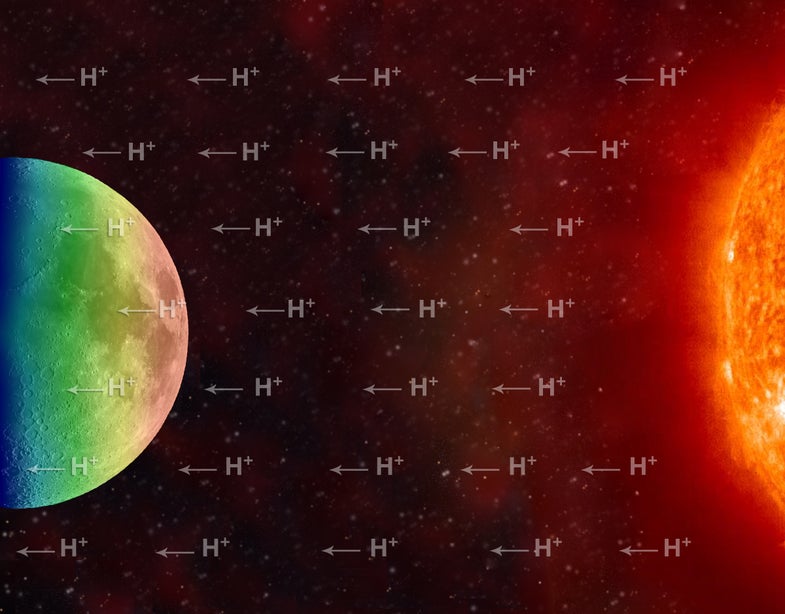
Moon + Sun = Water? Where the moon's water comes from is still up for debate. One hypothesis is that charged hydrogen particles spit out by the sun react with oxygen-containing minerals on the moon's surface to form water. Image courtesy of University of Maryland/F. Merlin/McREL

Although science news is often muddied by qualifiers, the news today is clear. After decades of believing that the moon was a dry, dusty wasteland, we now know that there is water on the moon's surface. This discovery means that colonizing the moon could be a bit easier, since water could be used to produce oxygen and fuel, not to mention a delicious glass of refreshment.

Three separate papers based on different spacecraft missions present evidence of water on the surface of the moon. One mission found evidence for water itself; the others spotted the hydroxyl (O-H) bond, which is a bond found in water (H2O). The papers were published online today by the journal Science.

"These new observations . . . prompt a critical reexamination of the notion that the Moon is dry. It is not," says University of Hawaii planetary scientist Paul G. Lucey in an accompanying commentary.

For a long time, scientists had viewed any traces of water found on moon rocks as mere contamination. Then, there was some data suggesting water deep within the center of the moon, but nothing convincing from the surface.

Although the measurements published today suggest that the most of the moon is still quite dry (only about a quart of water in a ton of soil), one of the papers determined that the water is more concentrated at the colder lunar poles, where it could get trapped as ice. There, future moon settlers might find water in sufficient quantities to power fuel cells.

Some think that the water might be from hydrogen spit out by the sun reacting with minerals on the moon. Scientists might find more clues early next month when NASA's LCROSS mission will crash a satellite into one of the poles to jostle up some moon dust for inspection.

[Science, LA Times]

Want to read more articles on the military, aviation, and space? Subscribe to Popular Science today, for less than $1 per issue!

15 Comments

So, we have a hard enough time even coming up with an idea that would actually get us to the moon and back, but now we're mining water and using it as fuel at such a rate that we could have, potentially, a permanent base there? NASA may want to re-think this plan.

Actually - the only thing the three spacecraft agree on is that there is hydroxyl on the moon.

This article even contradicts its own headline which is ridiculous.

1 quart per ton of soil. They want to mine and refine that? It would be cheaper to send the water to the moon from earth.

IF you will excuse my language, I think all of this is BS, and is just a way to get funding for another trip to the moon.

Wow these comments! Thank GOD these people aren't running NASA. At least someone here (me) understands what they're doing this for, and why they're doing it this way. For example Oakspar77777, if you had finished reading the article you would see right after that they explain how it could be more concentrated in the poles and accumulate as ice. And yes i_rakov this is a good excuse to send LCROSS there just to be sure, we really are risking lives every time they go up. Grow up.

What is with everyone criticizing every article posted on PopSci? It seems every person is trying to out smart the next while trying to bring down an article. This is research people. Things are not done in a day. This could take years! Decades! Give them a break. Research takes time and optimism. If you are in the science field I would assume you understand this or simple embrace the thought of new ideas.

In the future we better not destroy the moon like we did the Earth.

I would go right now! I am someone who has grown up with the promise of SPACE!! We shouldn't have to "get funding for the Moon." I would bet that PopSci has enough readers with the engineering experience that we could design a workable first-draft Moon colony. Say about 14 people in the first wave (my idea- if it ever works I claim 2 seats). Given that we could only receive packages from Earth every 6 months (of anything we need like food or water or whatever we need) and that would be limited to what the best estimate of rockets today. I don't want to see any speculative technology proposed.

Just think of things that exist today that can be used cheaply to make a Lunar colony feasible.

...(We need a bunch of air to begin with. We need to live far enough underground that the extra radiation won't be too deadly. We need to bring enough plants and animals to set up an ecosystem we can use. We need to have enough scientific facilities so that we could bring in a profit for expansion.We need to make this happen SOON!!!)...

Come on, if enough people can respond to this in constructive ways then maybe PopSci will focus on this.

John Holzman
Medford, Oregon, USA, Earth

Make your one water and generate 100 kilowatts of electricity at the same time.

Oxygen makes up approximately 48 percent by volume of the moons soil and rocks as a result there's plenty of oxygen on the moon you just have to mine it. To make water all you need is hydrogen. A way to make water economically is to carry hydrogen to the moon in place of water. Liquid hydrogen is 14 times lighter than water as a result one liter of liquid hydrogen weighs only 70 grams on earth. How to make water is to extract out the oxygen from the lunar soil using advance mining techniques similar to the one recently published in a Nature paper as reported here.

www.popsci.com/military-aviation-amp-space/article/2009-08/new-reactor-make-breathable-air-out-moon-rocks#comment-39520

By using the hydrogen in fuel cell's and mixing it with oxygen similar to fuel cells in some experimental cars that produce 100 kilowatts of power then condensing it down from vapor to water we can get an average of 0.32 pounds of water per minute of operations from the exhaust resulting in over 2 gallons of water per hour. This way of producing water may be cheaper than trying to mine it directly on the moon.

The added benefit from the process of making water from the reaction of the fuel cells hydrogen with oxygen is that we are producing 100 Kilowatts of electricity.

Great rlb2, but the excitement of water on the moon is harvesting hydrogen OUT of it, to get fuel.

To all the naysayers...

Exploration of space is Humanity's future. Expansion to the reaches of our solar system and beyond is essential to humanity's survival. Research and development is only going to take us so far on this planet. Out beyond the reaches of this atmosphere contains a vast wealth of knowledge and wonders that we couldn't begin to understand. If we as a race (humanity) could find a way to attain these things, wouldn't it be more than worth the funding to get us there?

Colonizing on the moon would be the first step towards exploring the outer reaches of our solar system and beyond. Yes we have probes to do this for us, but nothing... NOTHING can take the place of Humans experiencing these things on their own.

Yes, NASA has been plagued with setbacks and tragedies, but none of this could even come close to compare to the utter waste that would befall us should start trying to colonize other regions of our solar system and beyond. All that the men and women of NASA sacrificed, all the lives lost, would have been for nothing. What is that saying to the people who gave their lives for the betterment of humanity? It would all be for nothing!

No, space exploration is essential to our survival. It is essential to humanity's survival. We MUST go back to the moon and we MUST send explore the reaches of the solar on our own, without probes.

At first, in the proposed colony, seems like the first order of business after setting up housekeeping is create a larger hab, using the mining of relatively denser areas to set up the next colonists. The construction of successive mining camps would be great work for a few years anyway, and with all those people, someone would get the itch real quick to try for Mars orbit. Keep the shuttles for emergency ops only. Don't forget lots of solar panels for start up power and redundancy later. Best of all worlds has the Navy pitching in for a custom reactor using the best of what they know now. Get Greenpeace or somebody to get us borderline extinct plant species to grow after we are up and running. Wonder if a specie of worm could live on the moon..anyway, get a diverse biomass and general organics base and use something like a worm or possibly animals as quickly as possible, and yeah, it could make a start in a 10-20 yr scenario.

Sorry, jaydub, it's going to take a bit more than some "inspirational poetry" to get this thing going. :)

Then you're a fool, Flu17, to not realize the imporantce of space exploration to humanity.

Hydroge in not a fuel by itself. You also need the Oxygen. To produce fuel on the moon, you need water and electricity to break it down. Solar panels will provide the electricity. Refuel your rocket with the resulting Hydrogen and Oxygen.

That is also how we will get the folks back from Mars as well since we can't ship the fuel all the way there. They have two years (next transfer window) to convert enough water into Hydrogen and Oxygen to get off the surface, refuel the mother ship and get back to earth orbit. Once there, we can send up a ship to bring them back to the planet as they will not have enough fuel left to land on their own.


June 2013: American Energy Independence

Five amazing, clean technologies that will set us free, in this month's energy-focused issue. Also: how to build a better bomb detector, the robotic toys that are raising your children, a human catapult, the world's smallest arcade, and much more.


Online Content Director: Suzanne LaBarre | Email
Senior Editor: Paul Adams | Email
Associate Editor: Dan Nosowitz | Email
Assistant Editor: Colin Lecher | Email
Assistant Editor: Rose Pastore | Email

Contributing Writers:
Rebecca Boyle | Email
Kelsey D. Atherton | Email
Francie Diep | Email
Shaunacy Ferro | Email

circ-top-header.gif
circ-cover.gif