The National Research Council bemoans a lack of funding for NASA to detect asteroids which could threaten Earth
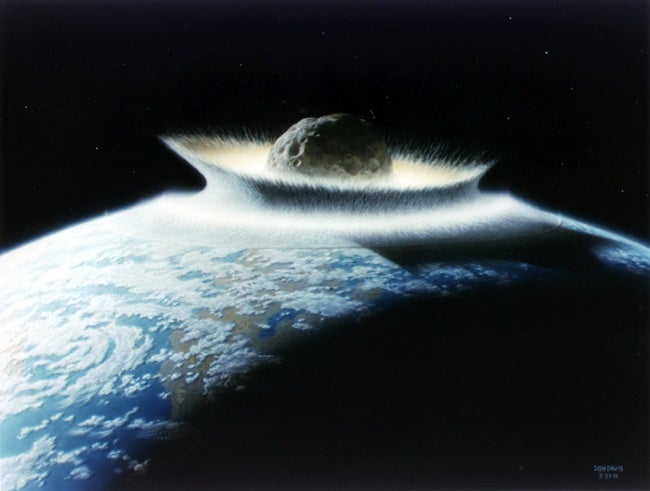
Welcome to Earth Efforts to detect asteroids and other near-Earth object threats remain underfunded. NASA

Congress charged NASA with finding 90 percent of nearby space rocks greater than 140 meters (460 ft) by 2020. Now the National Research Council warns that the space agency will fall short of that goal without more funding.

The National Research Council's interim report points out the familiar situation where the government assigns NASA goals without the necessary funding to carry out its mandate. Even so, NASA has funded more than 97 percent of NEO discoveries over the past decade. Scientists have cobbled together some surveys of possible space-based threats, and also rely on volunteer or amateur efforts from a loose worldwide network of ground-based telescopes and observers.

Some good news comes from NASA having detected and tracked close to 90 percent of near-Earth objects (NEOs) greater than 1 km. But even objects as small as 20 meters (66 ft) could pose regional threats to cities, and there are also other gaping holes in current NEO detection capabilities.

Satellites and space telescopes could continue to play a growing role in detecting asteroids. Future projects such as Germany's AsteroidFinder or Canada's suitcase-sized NEOSSat would also help spot space rocks on a possible collision course with Earth.

Better detection would give scientists earlier warning and allows for a wide range of responses that could nudge asteroids out of the way. However, existing space surveys cannot detect "imminent impacts" from objects that would pass close to Earth with short warning times of hours or weeks. Such objects end up being discovered through sheer chance by telescopes or observers conducting other tasks.

Space missions may shed additional light on NEOs by flying out to examine passing space rocks. A NASA panel even recently suggested the possibility of a manned mission to an asteroid.

A final NRC report is due out by the end of 2009. Until then, let's hope that altruistic band of stargazers keeps watching the skis … I mean, skies.

Want to read more articles on the military, aviation, and space? Subscribe to Popular Science and enter to win $5,000!

6 Comments

wouldn't it be cheaper to just hire Bruce Willis an an all-star mining team for a few weeks?

too easy

I think a manned mission to an asteroid would be pretty sweet, if we could pull it off. Maybe bring them in far earth orbit and mine them while we mine the moon?

Has NASA really done anything revolutionary/significant since the moon landing?

If NASA played poker then every time they made a bet on something then i will go all in bc they are always wrong.

For all the astronomy and aviation fans/techies, i ran across this site which has ton of interesting information.

maggwire.com/articles/index/popular-science/published:week/category:science

lol nice treehouse of horror reference

Has NASA really done anything revolutionary/significant since the moon landing?

Well- I would think most would consider landing a unmanned robot on the surface of Mars to be a significant achievement, let alone on three different occasions. I mean who has ever heard of sucess without failure? But seriously if you have that much money to bet on NASA's quote "failures" you should just start your own Air and Space organization. Sounds like something a business major would say lol

PeteDSL Chula Vista
NASA is a government agency with a long line of budget induced, politically motivated failures dubbed "accidents"
Their governmental modus operendi is to contract out the science and construction of projects to corporations that specialize in government contracts. Their projects reek of cost overruns, and coverups for management lapses.
Real space science is done by small labs run by genius such as the skunk works or composite engineering. Kelly Johnson and Burt Rutan provide the out of the box thinking and vision that make things fly.
Entrusting earth safety to NASA will work just as well as everything else that they have done. Which means that one day we will all have to bend over and kiss our **selves** goodbye.
It is not enough to find the asteroids 6 months before the collision, the necessity is having the men and machines in place to do something about it a year in advance.
Today, if we found an asteroid 2 years away from collision we could not establish that it was on a definite collision course nor get men and machines out there to divert it within 2 years.
We need functioning spacestations with space factories capable of building space tow trucks in place 2 years before impact and the government is not capable of doing that, and as long as it is more important to feed starving people who are dying through lack of proper infrastructure than it is to change local infrastructure or build adequate emergency services then nothing will be done in time.
If humanity is still around maybe the government will do something to stop asteroid collision number three (3)

When we are not able to stop one rock, we are not deserve to live!!!
And WHEN the rich peoples understand that their money are not able to safe their lives...
...Maybe will stop to control the world and share these space with peoples with ideas, to understand the "Capital" from inside and for what must to surv...


Download Our iPhone App

Stay up to date on the latest news of the future of science and technology from your iPhone with full articles, images and offline viewing


Follow Us On Twitter

Featuring every article from the magazine and website, plus links from around the Web. Also see our PopSci DIY feed


Become a Fan On Facebook

Share links with friends, comment on stories and more


December 2009: Best of What's New

In our December issue, Popular Science names the 100 best innovations of the year: bombproof wallpaper, self-parking cars, the fastest helicopter, and 97 more. Plus inventor profiles and videos.

Check out the best of what's new here.

Popular Science Photo Pool


Share your photos in the Pop Sci pool at www.flickr.com!
tags_sprite.png
POP_embeddedForm_cover_May09.jpg