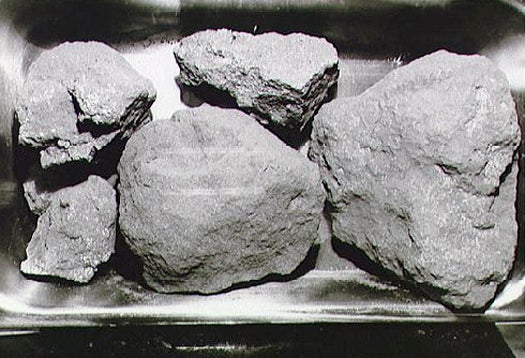
Moon Rocks (PerriAir?) courtesy of NASA

One the major differences between visiting the moon and staying on the moon involves resupply. In fact, the prospect of constantly hauling water and oxygen to the moon is so daunting that NASA offered a million dollars to the first lab that could extract 11 pounds of oxygen from a simulated pile of moon rocks.

Well, it seems like scientists at the University of Cambridge may want to start thinking about how they're going to spend their million.

Adapting a chemical process they originally created to extract metal, the Cambridge team has designed a reactor that strips the oxygen from the metal oxides found in moon rocks. Essentially a giant electrode sitting in a vat of melted salt, the reactor creates an electric current that chemically breaks the oxygen off of the metal, and frees it into the atmosphere.

According to the scientists, three ten foot tall reactors working on three tons of moon rocks could produce a cubic ton of oxygen over the course of a year. Additionally, the reactor doesn't require much more electricity than a hot water heater, so it won't eat up the limited energy of the potential moon base.

Of course, the astronauts could forgo the reactors and just steal the air from from Druidia, but then they'd have to deal with Lonestar.

[via Nature News]

Want to read more articles on the military, aviation, and space? Subscribe to Popular Science and enter to win $5,000!

20 Comments

could they possibly apply that same tech to mars for a terraformation?

Tons can't be cubic, so maybe it's one cubic meter?

Even a cubic meter is meaningless, since this is dependent on the pressure.
But 3 tons of rock could produce 1 ton of oxygen. But I doubt it needs to be any where near this efficient. It would make more sense to just strip the easiest portion of the oxygen. However, the more efficient the oxygen removal, the more efficient the metal extraction.

Once they start trying to extract He3, they are going to need pretty efficient volatile extraction.

I'm not sure why the article claims the energy is limited. This only needs to be working during the lunar daytime, plenty of energy around then.

This sounds pretty cool. If we perfect this technology on the moon, then we can probably use it on Mars too.

ajohnson1986

from Sioux Falls, South Dakota

We don't wanna make this information too public. If the spaceballs find out they'll come with their super-maid and vacuum up all our moon rocks and then we'll be back to square one.

One human lung consumes about 5-6 ml oxygen per minute at an esophageal temperature of 28 degrees C. This is the minimum amount needed for the body to function normally, in other words non-recoverable oxygen, most all other oxygen and CO2 exhaled can be recovered. That don't sound like much but over an entire year if my calculations is right that will be about 2.3 cubic tons.

Approximately 2.3 cubic tons of oxygen is enough for 1 human's basic needs if all the rest of the exhaled oxygen and CO2 can be recycled back to Oxygen completely, as a result a minimum of 7 ten foot reactors would be needed just for one human.

What about the oxygen burned to maintain the system and gather the rocks even in 1/6th G there will be some exertion, robots can do most of the heavy lifting, but there will be some human oxygen penalty to pay to keep the supply of moon rocks flowing and the system working the way it should.

I did a quick calculation so I strongly advise you to do your own math to confirm or deny this.

and once all the moon rocks are gone what do u use next?

Then they can start in on asteroids next. They would need to bast them to smaller chunks though, so we need to find good pilots for that job by re-releasing Asteroids.

Uncle Sam told me that human respiration produces about 1 kg of CO2 a day 365.25 kilograms = 805.238413 lbs of CO2 per annum. http://cdiac.ornl.gov/pns/faq.html CO2 is 2 oxygens with atomic mas of 16 each and one carbon with a atomic mass of 12 so CO2 8/11 oxygen by mass. 805 * 8/11 = 586 lbs of O2 needed per year. So if the O2 were utilized fully and not wasted one tonne should support 3 people for a year.

But maybe O2 changes its mass when you put it in a cube for no reason... Wikipedia failed to inform me why in the world cubic tonne the unit would be used on a gas, it only mentioned stuff like how many cubic feet of rocks would be a ton... Why not give us like the mass of gas collected or pressure & volume @ a temperature, or number of moles or the volume of liquid O2.

My other complainant is why tell us the number of lbs of O2 collected but not the mass of the simulated regolith. We want to know the efficiency of there process for all we know it was 200 lbs of rocks.

Since this technique involves stripping oxygen from metal oxides, it could very well be conceivably used on mars, since mars rock contains a large degree of iron oxide. Depending on the process, you would be able to have a beneficial biproduct, iron.

The unit in the article is tonnes or metric tons, not cubic tons, so that should make more sense. Don't feel like doing the math but I saw somewhere that a person would need about a coffee mug of regolith per day to be converted to oxygen.

"According to the scientists, three ten foot tall reactors working on three tons of moon rocks could produce a cubic ton of oxygen over the course of a year."

The metric tons is from the weight of the rocks, which is confusing because are they talking about the moons metric tons or earths??? The cubic ton is from the resulting volume of the oxygen.

1 cubic ton (40 cubic feet) = 1.133 cubic metres

1 cm3 = 0.000001 m3 = 1 mL

One human lung consumes about 5-6 ml oxygen per minute at an esophageal temperature of 28 degrees C.

Thats what I used to do my math above.

I think keep collecting literally tons of rocks to provide oxygen on Moon or Mars would be really really impractical. What is needed is a machine that can collect CO2 from the air around and split it to oxygen and solid carbon using only electricity. It would help greatly in all kinds of human activities in space.
I think NASA better focus its efforts on that.

Go to the original article on nature.com
The unit of measure is a metric ton (tonne), not cubic ton.
The word "cubic" is not mentioned anywhere in the article.

Thanks zhenya76, JRS ONE, I knew there had to be more than what was stated above to make this work, I should have read the original article. It's easier to compare apples to apples instead of apples to Oranges.

They also claimed in the Nature article: "three reactors, each a metre high, would be enough to generate a tonne of oxygen per year on the Moon." a metre is 3.28 feet high not "three ten foot tall reactors" as stated above.

Industry has been using salt baths to Quench metals with temperature mentioned above for many, many, years so it sounds like it could easily be made from standard materials reducing the cost by using mostly off the shelf parts.

Now for the bigger challenge, how are they going to squeeze Nitrogen out of the rocks that virtually don't have any , approximately 100 ppm ??? We require 78 percent nitrogen and 21 percent oxygen to breath. The Apollo 1 explosion that killed three astronauts was caused by using 100 percent-oxygen, they never used 100 percent oxygen again....

"Now for the bigger challenge, how are they going to squeeze Nitrogen out of the rocks that virtually don't have any , approximately 100 ppm ??? We require 78 percent nitrogen and 21 percent oxygen to breath."

We don't need 78° nitrogen that's just what we use here. There are other inert gasses that work just fine like argon or heleum.

HUMANS NEED OXYGEN AND JUST OXYGEN WHAT DO YOU THINK GOES IN THOSE PURE OXYGEN TANKS FOR SCUBA DIVERS! NOT NITROGEN OR HELEUM JUST THE GOO OLD O2

GOOD :P

...although the rest of us live just fine without
GOOD OLD 02! The only way is conservation, it isnt like the humans will be doing quality exersise done by the divers. Obviously there will be training sessions to keep the astronauts fit...so low quality "air" with fillers such as nitrogen as a standard sit-at-a-control-panel job and normal or higher quality "air" added into the training rooms.

Besides if you want to go "GOOD OLD" style, then has NASA tossed out the idea of robot tended hydrponic plants...?
Surely it takes far less energy than breaking apart rocks. ALTHOGH it would take more time and money to develop, and we all know how NASA screws up, just as bad as the government itself!! It could be done in less than a decade of private initiatives.

Andrew;
A 1-mi. diameter rocky asteroid nudged into near-Earth orbit would provide easy access (the components are mostly separated and layered already) to more precious (and probably base) metals than have been mined in history from the planet's crust. Worth about $1,000,000 per capita. For the whole planet. Makes even Obamugabe's deficits look puny! :) It would pay for all the space exploration and development expenses of all nations ever for the past and for a century to come. Easy.

As for power, solar is really easy on the moon. Also, I have big hopes for the focusfusion.org project, which will produce generators making 5 MW in a reactor-plus-service-housing the size of a small garage, using about 5 kg. boron per year. They'll transform the Moon, not to mention the Earth!


Download Our iPhone App

Stay up to date on the latest news of the future of science and technology from your iPhone with full articles, images and offline viewing


Follow Us On Twitter

Featuring every article from the magazine and website, plus links from around the Web. Also see our PopSci DIY feed


Become a Fan On Facebook

Share links with friends, comment on stories and more


December 2009: Best of What's New

In our December issue, Popular Science names the 100 best innovations of the year: bombproof wallpaper, self-parking cars, the fastest helicopter, and 97 more. Plus inventor profiles and videos.

Check out the best of what's new here.

Popular Science Photo Pool


Share your photos in the Pop Sci pool at www.flickr.com!
tags_sprite.png
POP_embeddedForm_cover_May09.jpg