Powerful, Simple Rocket Fuel Made from Water and Aluminum
A new rocket propellant consisting of aluminum powder and water ice could point toward the future of space exploration
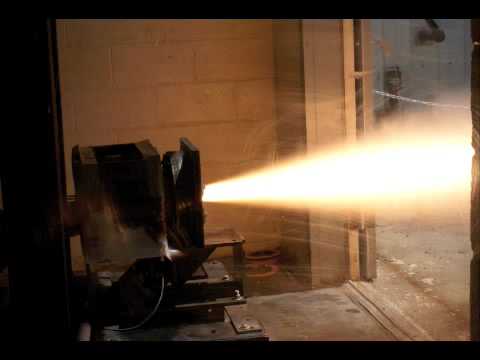
Spacecraft might one day refuel on the moon or Mars using plain old ice. A small rocket flew earlier this month on an environmentally-friendly propellant consisting of aluminum powder and water ice.
The “ALICE” fuel mixture being developed by Purdue University and Pennsylvania State University could someday replace liquid or solid rocket propellants, and possibly enable higher performance as well. The implications for space exploration could also mean accessible fuel reserves at future lunar or Martian outposts, which naturally attract the interest of NASA and the Air Force Office of Scientific Research.
“ALICE can be improved, with the addition of oxidizers, and become a potential solid rocket propellant on Earth,” said Steven Son, a Purdue researcher. “Theoretically, ALICE can be manufactured in distant places like the moon or Mars, instead of being transported to distant locations at high cost.”
The nine-foot rocket reached a height of 1,300 feet, based on the propellant’s high burn rate and maximum thrust of 650 pounds during the latest flight test. ALICE reportedly has a toothpaste-like consistency, and is cooled to -30° C (-22° F) 24 hours before flight.
The key to ALICE’s efficacy comes from the nanoscale aluminum powder, whose fine texture provides more surface area for reacting with the water. But researchers also noted that the nano-aluminum remains somewhat expensive.
Such propellant may not in fact prove more environmentally friendly than the liquid hydrogen-oxygen rockets used by the space shuttle, which leave an exhaust of water vapor, as The Register points out. But ALICE could prove a promising alternative to solid propellants.