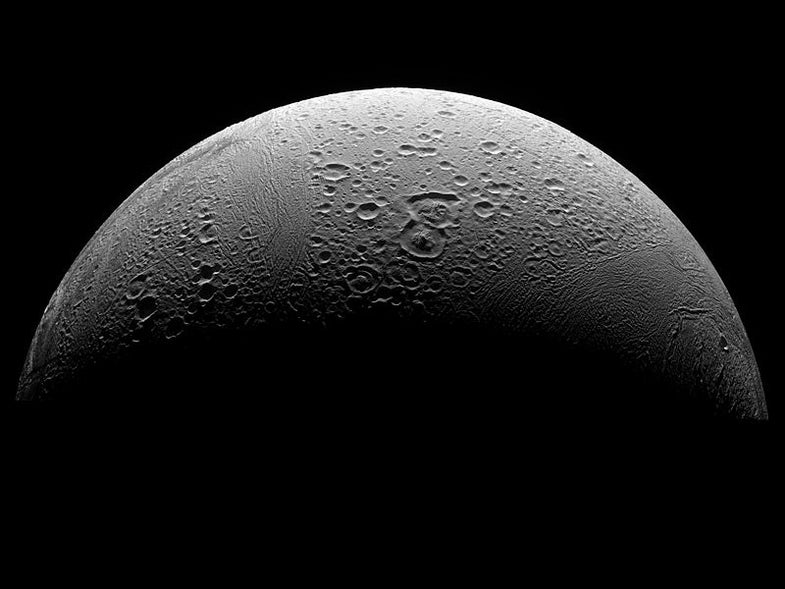
This week, new photos of our moon taken by NASA's Lunar Reconnaissance Orbiter showed what we already know: the orbiting rock has a lot of craters, but no signs of life. But scientists at the Max Planck Institute for Nuclear Physics in Heidelberg, Germany have revealed new findings that there is another moon worthy of intensive exploration -- and perhaps even a visit at some future date.
In 2005, scientists found the first signs that Saturn's moon Enceladus might have a salty ocean beneath its icy outer shell. New evidence -- based on analysis by the NASA Cassini spacecraft, currently passing near Saturn -- reveals a high level of a sodium compound that could indicate the presence of water.
There are other indications of water on Saturn's moon as well. Jet streams that shoot into space from the moon create plumes that only an underground reservoir, or pockets of ice on the planet surface, could create. The Cassini craft will make another pass this fall for a closer look at the 300-mile surface of the moon. If there are more signs of water, scientists could upgrade Enceladus to a status on par with the moons orbiting Jupiter, several of which may house water reservoirs.Stay up to date on the latest news of the future of science and technology from your iPhone with full articles, images and offline viewing
Featuring every article from the magazine and website, plus links from around the Web. Also see our PopSci DIY feed
Share links with friends, comment on stories and more
Inside NASA's astronaut bootcamp and the grueling new training regimen for deep space. Plus, ten young geniuses shaking up science today, one writer's quest to analyze every man-made chemical in her body and more.
Check out the issue's full contents online here
That’s very good news that builds on previous observational findings. We are currently looking for Extra-Solar planets that are similar to Earth for life forms several light years away in a region called the habitable zone that are currently out of our range to send probes. It is far easier to look into our back yard for life and look even in some of the coldest places in our solar system which are way outside what we would consider the habitable zone.
Next test for these scientists is build on what was learned about Enceladus and check out Triton, a moon of Neptune’s, that is bigger than Pluto that is made up of over 40 percent water ice. Triton has Cryovolcanism as observed by Voyager 2 and discovered over 20 years before the water jets on Enceladus. Internal heating from tidal forces with the natural radioactive decay of its interior may be enough to support oceans buried below an icy crust as theorized in Europa, a Jovian moon, and now found to have occurred in Saturns Enceladus.
As a result the classification of the boundaries of a habitable zone should extend all the way into interstellar space as this newly written paper suggests which exponentially increases the odds of finding life outside this island world we call Earth...
www.shineinnovations.com/19312.html