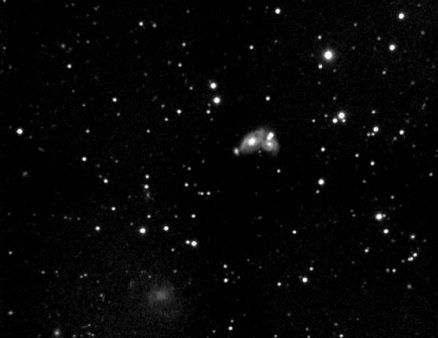
Voting just closed on NASA's version of American Idol. For the past month, people have been able to vote online for the next research subject for the Hubble Telescope. Now the results are in.
The winner, by an overwhelming majority, is Arp 274: two spiral galaxies that are getting closer and closer to each other. According to NASA, as the galaxies entwine and their gas clouds change shape, many new stars could be born. Hubble will train its view on these canoodling galaxies between April 2nd and 5th, giving researchers a picture that's many times more detailed than existing images -- and giving us some high-quality astro-porn.
140 years of Popular Science at your fingertips.
Each issue has been completely reimagined for your iPad. See our amazing new vision for magazines that goes far beyond the printed page
Stay up to date on the latest news of the future of science and technology from your iPhone or Android phone with full articles, images and offline viewing
Featuring every article from the magazine and website, plus links from around the Web. Also see our PopSci DIY feed
The 6th annual Invention Awards are here, from an inflatable tourniquet to a better lobster trap to spring-loaded hocket skates. This issue is all about the celebration of invention.
Plus: Making synthetic biology breakthroughs in a garage, building a constantly-moving ping-pong table, and a ridiculously overpowered barbecue.
LOL! "Astro porn". Hilarious. Cant wait.
from Kent, WA
Star formation is now thought to be at least as incredibly intricate and involved as sexual reproduction in mammals. Our miracle planet Earth exhibits at least trace samples of all the naturally-occuring elements, which is remarkable because those elements had to be formed in unique and exclusive processes, then all the consequent star-products had to be brought together and mixed.
Andromeda is on a collision course with the Milky Way. I suppose you could view the galaxies as being horny, so if you feel that way I would suggest that you never go out star-gazing alone.
I have a Question. What If the Hubble telescope was able with other telescopes capture light off every star, in its view, then take that light and intensify it to create energy.
what if all telescopes on earth had the same function, then what can u do if u had capture the light from a billions stars all at the same time and combine them all together then intensify the light to create energy, how much energy can we get?