If you roll out of bed and see the headline "Life on Mars," is it because: a) it's a hoax, b) NASA got lucky, c) scientific genius won out, or d) it is written in a British tabloid?
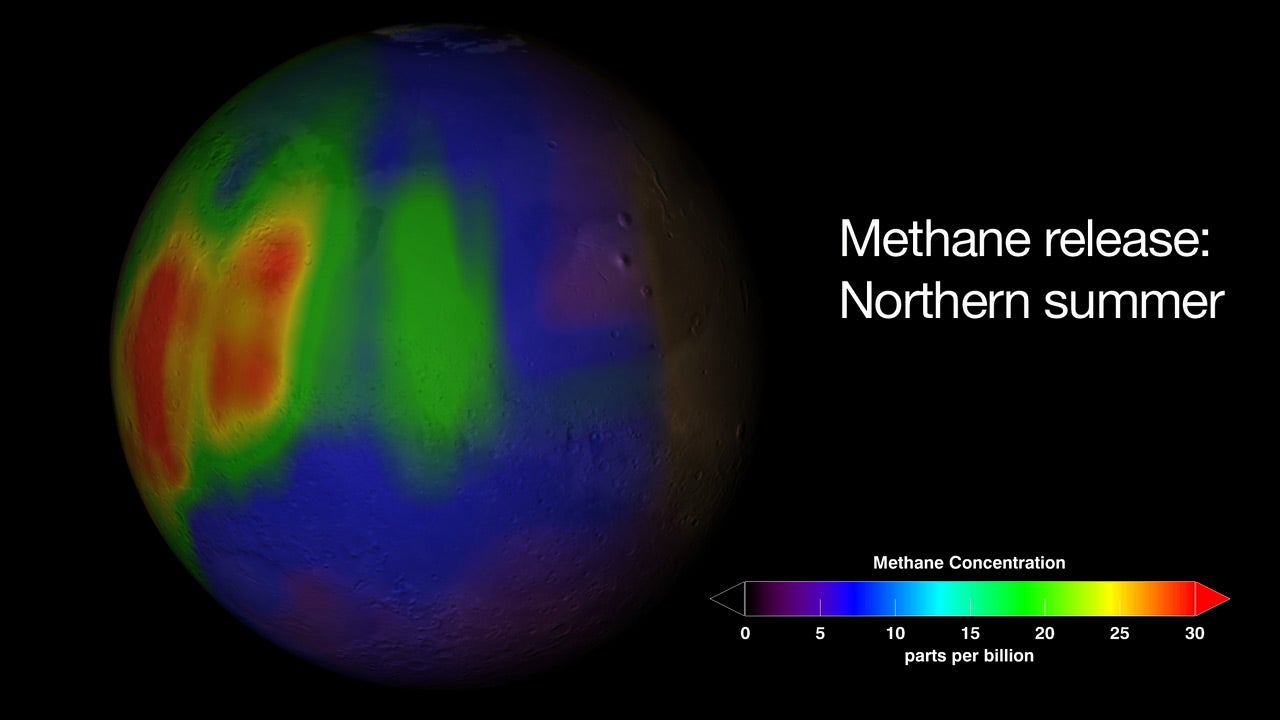
The British Sun received a slap on the wrist from the journal Science, but news sites buzzed cautiously over a new NASA study about methane gas detected on Mars in 2003. Methane plumes traced to three specific regions could signal active geological processes—or possibly even gas-emitting microbes, said scientists during yesterday's press conference.
The methane puffs appears linked to heating that occurred during the northern Martian hemisphere's summer, SPACE.com explained. Such methane must have marked a recent release, because the gas molecules rapidly fall apart when struck by sunlight's ultraviolet rays in the Martian atmosphere.
Even methane produced by active geology could prove intriguing, because scientists generally view Mars as a dormant planet. Sushil Atreya, a space scientist from the University of Michigan at Ann Arbor, examined this methane mystery for Scientific American in 2007.
Wired noted the possible impact of these findings on future Mars missions, such as the Mars Science Laboratory (MSL) that has been delayed by two years. One methane hot spot appeared near the Nili Fossae region, which may now get a second look on the list of MSL landing sites.
MSL has the equipment to sniff out traces of methane after landing, if the SUV-size rover does end up near a methane-emitting region. Such close study could prove as scientifically intriguing as the discovery of water ice on Mars by NASA's Phoenix Mars Lander last summer.
But regardless of any offbeat proposals or serious long-term planning, no humans will likely set foot on the Red Planet until travelers can avoid the problem of deep space radiation. In the meantime, geologists hankering for an up-close-and-personal look will have to bide their time.
Five amazing, clean technologies that will set us free, in this month's energy-focused issue. Also: how to build a better bomb detector, the robotic toys that are raising your children, a human catapult, the world's smallest arcade, and much more.


Online Content Director: Suzanne LaBarre | Email
Senior Editor: Paul Adams | Email
Associate Editor: Dan Nosowitz | Email
Assistant Editor: Colin Lecher | Email
Assistant Editor: Rose Pastore | Email
Contributing Writers:
Rebecca Boyle | Email
Kelsey D. Atherton | Email
Francie Diep | Email
Shaunacy Ferro | Email
I just have one question... What is deep space radiation
Deep space radiation, I believe, is the radiation left over from the big bang or from stars and galaxies.
Deep Space Radiation is not radiation left over from the Big Bang. It is radiation left over from distant Supernovas, Black Hole formations etc.
deep space radiation is an old greek ship they used in the 50's
Actually, there is a bit more to the radiation that astronauts would be exposed to. There are Gamma Rays from black holes and supernovae, X-rays from a whole manner of energetic objects, and constant exposure to the solar winds(radiation from our own sun). Not to mention the risk of being exposed to powerful jets of energy from Gamma-Ray Bursters,increased solar radiation,and super-hot plasma caused by solar flares, and micro-meteors. Space is not a friendly place my friends. As of yet, we don't have any real protection from these threats, so only the very lucky could make the trip unharmed.
When is NASA going to wake up and do something useful with their technology? Who gives a flying fujucki if there is anything on Mars? NASA should be concentrating on technologies that can benefit us here on earth: creating a useful heavy-lift shuttle to take solar panels into space, designing the "space elevator" to lower the cost of getting equipment into orbit, building re-usable booster systems and redeveloping liquid oxygen/hydrogen powered launch boosters. As it stands now, NASA is a bunch of space geeks using tax dollars to peer into space and rant in conjecture about what's out there. They need to focus on what is happening here on earth - not what happened 50,000 years ago in a galaxy far away....
If space radiation is such a problem, then how were we able to land on the moon?????
NASA is imho, a government scam to generate money. NASA has generated Hundreds of Billions of dollars over the last 45 some years and what do we have to show for it? An alleged landing on the moon (which incidentally we can't seem to duplicate now despite having literally light-years of advancements in Material Science, Computational ability, and design of shuttle suits and equipment).
NASA is one of the biggest wastes of money that this country has spent over the years.
It's a giant ball of Public Relations, and a cosmic waste of money. For the amount of money we have spent fiscally in the last half century, we could have solved the more immediate problem of insurance for every American Citizen plus foreigners and still had change left over to not be in the financial hell-hole we're in now. Our Space programs are a major reason why that National Deficit started that has manifested itself into a proverbial Texas sized snowball just waiting to wipe out this country.
The only reason NASA (and Regan for that matter) spent so much money on the space program was just for bragging rights against the Soviet Union. The only reason we'd bother continuing to fund NASA is because China is now pushing their country into the Space Program.