The best home office printers of 2024
Get quality printing done efficiently without leaving the house with the best home office printer.
We may earn revenue from the products available on this page and participate in affiliate programs. Learn more ›
The ideal home office printer offers the same features as the premium ones you’d use at work in a more compact, budget-friendly package. They should be efficient with their ink usage, so you’ll never run out of ink, even if you print long reports, photo prints, or your kids’ homework. Many of the best home office printers are all-in-one models, which means they can also scan, copy, and even fax documents and photos. Modern conveniences, like the ability to print wirelessly rather than rooting around for the right cable, should also be top of mind. The best home office printers will offer all of these features (and more) while sitting comfortably on the side of a desk or on a shelf.
- Best overall: Brother MFCJ 1170DW
- Best inkjet: Epson EcoTank ET-2800
- Best laser printer: Xerox Laser Printer
- Best all-in-one printer: HP Smart-Tank 7602
- Best compact printer: Canon PIXMA TR150
- Best Alexa-enabled printer: Canon PIXMA G6020
- Best budget: Brother MFC-J1010DW
How we chose the best home office printers
Our home office printer recommendations are based on a mix of hands-on testing and research. We considered both inkjet and laser printers, assessing the benefits and tradeoffs with both printer styles. Because home offices have different constraints than a traditional workspace—you’ll likely have less space but won’t need documents to print quite as quickly—those were considered, too. Types of work also factored into our decision of which printers to feature since photographers checking prints for color accuracy and students printing reports require different tools.
The best home office printers: Reviews & Recommendations
There are an overwhelming number of home printer options available, but we’ve made an effort to ensure you’ll find one that fits your work needs, space, and budget. We’re here to ensure you don’t waste your time or valuable desk space with the wrong choice for your laptop and lifestyle.
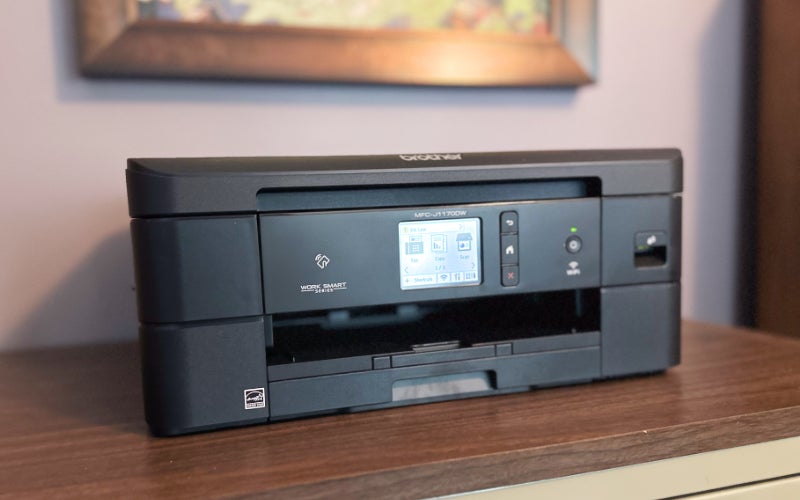
Best overall: Brother MFCJ 1170DW
Brandt Ranj / Popular Science
Specs
- Printer style: Inkjet
- Printing speed: Up to 17 pages per minute
- All-in-one: Yes
- Price: $139.98
Pros
- Reliable
- Solid performance with text and photos
- Reasonable paper tray capacity
Cons
- Small display
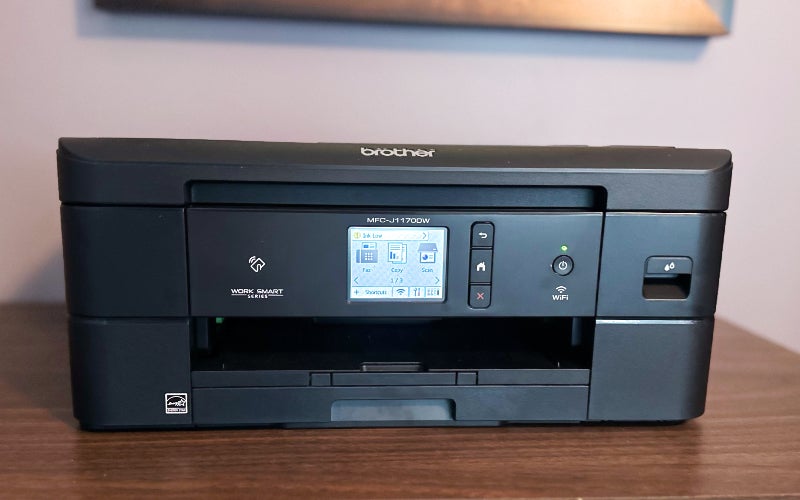
The biggest compliment we can pay to Brother’s MFC-J1170DW is that it continues to work so well after months of regular use that we’ve forgotten it’s there. That’s the mark of the ideal home office printer. Setting it up didn’t require us to download a mobile application, and we were up and running in just a few minutes. Punching in a long WiFi password on the printer’s relatively small screen was tedious but not particularly annoying.
During our tests, we connected the printer to a variety of smartphones, tablets, and computers, and none of them had any trouble connecting or sending print jobs to this machine. Inkjet printers can’t match the raw printing speed of a laserjet, but the MFC-J1170DW is still respectable in this department. We never felt like we were waiting on a print for very long and accepted that double-sided print jobs would take an extra half a minute or so per page.
The MFC-J1170DW isn’t a photo printer, but we found it turned out good-looking pictures when using photo paper. Colors were never washed out, and plenty of clarity (assuming the picture was taken well and with a high-resolution camera) was present. Scanning and copying worked just as reliably as printing did, though you should be mindful of the fact that wireless scanning takes longer than connecting a device directly to the printer with a cable.
What we’ve found remarkable about the Brother MFC-J1170DW is that it just works. We never had to troubleshoot connectivity issues and even found the process of replacing ink cartridges to be pretty straightforward. If you’re building your first home office and need a simple, reliable printer for day-to-day needs, it’s hard to argue with the performance of Brother’s MFC-J1170DW.
Best inkjet: Epson EcoTank ET-2800
Epson
Specs
- Printer style: Inkjet
- Printing speed: Up to 10 pages per minute
- All-in-one: Yes
- Price: $199.99
Pros
- Print up to 7,500 without an ink refill
- Less wasteful
- Heat-free printing
Cons
- Slow
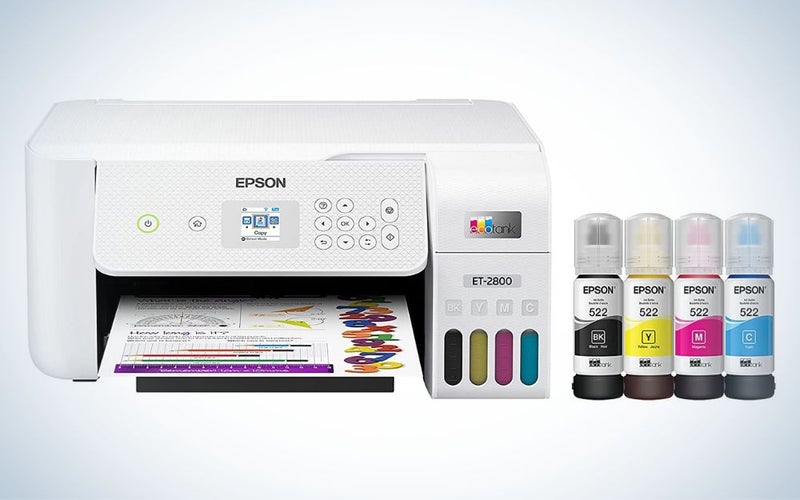
Inkjet printers have a reputation (earned rightfully) for having a low up-front cost but very costly ink cartridges. Epson’s EcoTank ET-2800 upends that trend by using ink from bottles. Epson says this printer holds enough ink for roughly two years of prints (4,500 monochrome sheets or 7,500 color sheets) before you need to pick up another set. This ink system will not only save you money; it’ll keep plastic cartridges out of landfills. You’ll need to wait a little longer for print jobs to complete, given the EcoTank ET-2800’s relatively slow speed, but that’s a small price to pay given its ink efficiency. Additionally, waiting for this printer to finish the job will be well worth the wait because of its “Micro Piezo Heat-Free Technology,” which Epson says produces sharp results when printing text and photos alike.
Best laser printer: Xerox Laser Printer
Amazon
Specs
- Printer style: Laser
- Printing speed: Up to 31 pages per minute
- All-in-one: No
- Price: $698
Pros
- Incredible print speeds
- Capable of 4,000-page print volume per month
- 250 sheet paper tray
Cons
- Cost
- Monochrome only
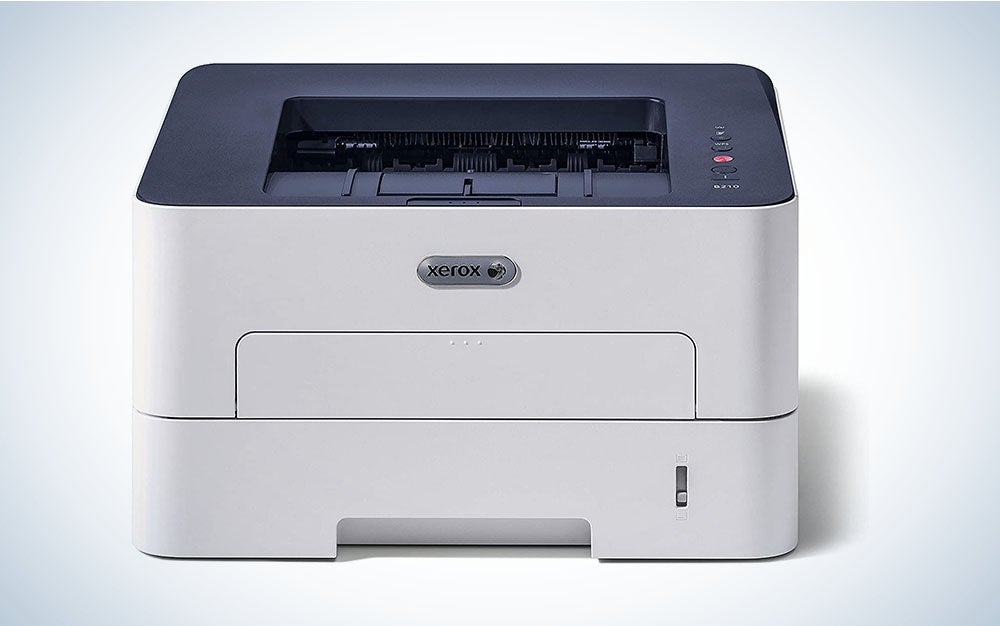
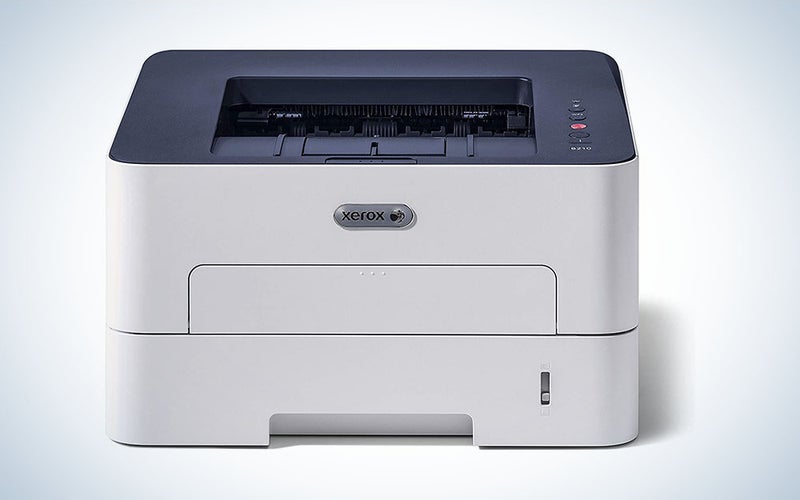
If you have a need for (printing) speed, you can’t do better than Xerox’s B210DNI, a laser printer capable of spitting out over 30 pages per minute. It has some limitations: you can’t print in color, for instance, or scan and copy documents or photos, but they’re a small price to pay for this performance. Speaking of price, the B210DNI is roughly triple the price of our best overall pick for home office printers. You’ll need a very heavy regular print load to justify this printer’s cost, but you won’t be able to argue with its results. Xerox says you can use this printer to print up to 4,000 sheets per month, which would bring other printers to their knees. If you run a small business or rely on printouts to get your job done, the B210DNI is a worthwhile investment. Those with more modest needs should consider our other recommendations.
Best all-in-one printer: HP Smart-Tank 7602
HP
Specs
- Printer style: Inkjet
- Printing speed: Up to 15 pages per minute
- All-in-one: Yes
- Price: $449.99
Pros
- Uses ink bottles instead of cartridges
- Automatic document feeder
- Made from recycled materials
Cons
- Price
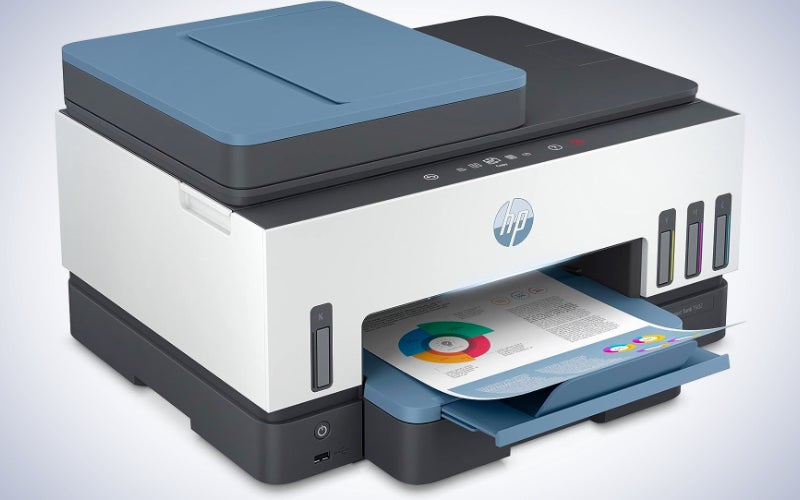
An all-in-one printer is arguably the best option when setting up a home office because you never know when you’ll need to copy or scan a document or photo. HP’s Smart-Tank 7602 carries many of the same features we liked about Epson’s EcoTank ET-2800, namely its use of ink bottles over cartridges. HP says you should get roughly two years of regular use out of the printer before replacing them, but clarifies it means roughly 6,000 monochrome or 8,000 color pages. Either way, even frequent printers shouldn’t have to think about ink for a long time. Similarly, HP says this printer is made from 25 percent recycled materials, which is more Earth-friendly than most printers.
The EcoTank ET-2800 can print at a rate of up to 15 pages per minute, which is faster than the majority of our other home office printer recommendations. The additional efficiency will be helpful whether you need to print documents quickly for a client or want to make quick copies. It’s bulkier and more expensive than most home office printers, but if you don’t mind paying for the additional performance, you’ll be rewarded each time you use HP’s EcoTank ET-2800.
Best compact printer: Canon PIXMA TR150
Amazon
Specs
- Printer style: Inkjet
- Printing speed: Up to 9 pages per minute
- All-in-one: No
- Price: $219.99
Pros
- Ultra-compact
- Can run on battery power
- 50 sheet capacity.
Cons
- Slow speed
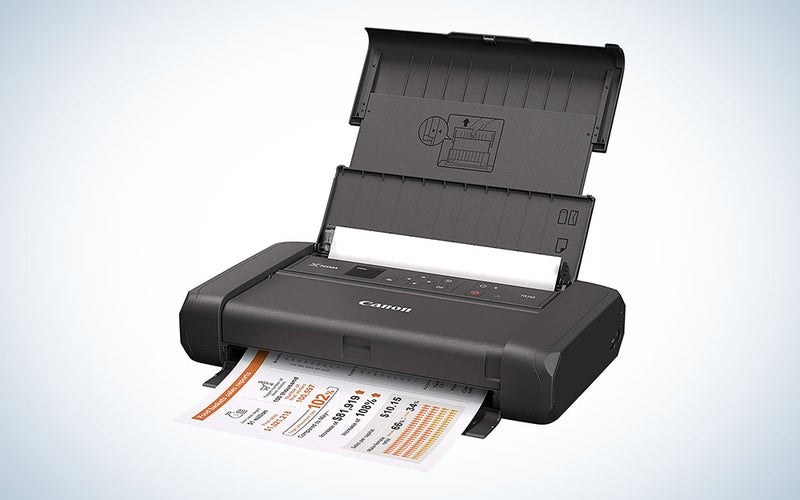
Canon’s PIXMA TR150 is a great space-saving printer, but you won’t need to worry about a decrease in quality with this unit’s minimal size. It may have a slower print speed than our other recommendations, but the fact that you can easily carry this printer in a backpack, on a plane, and even optionally run it on battery power all help it stand out. We laud Canon for engineering the TR150 with a flip-out design, wherein the rear paper tray pops up when necessary but flips down when you’re not using the printer. When the TR150 is fully bundled up, it measures just 12.7 inches wide by 7.3 inches deep by 2.6 inches tall, yet Canon still managed to fit a paper tray with a 50-sheet capacity into this printer. If you’re fully remote and have a home office that needs to move around as much as you do, make Canon’s PIXMA TR150 part of your setup.
Best Alexa-enabled printer: Canon PIXMA G6020
Canon
Specs
- Printer style: Inkjet
- Printing speed: Up to 13 pages per minute
- All-in-one: Yes
- Price: $199
Pros
- Can be integrated into your smart home
- Prints up to 7,700 pages per ink bottle set
- Comes with two additional Black ink bottles
Cons
- Limited Alexa functionality/
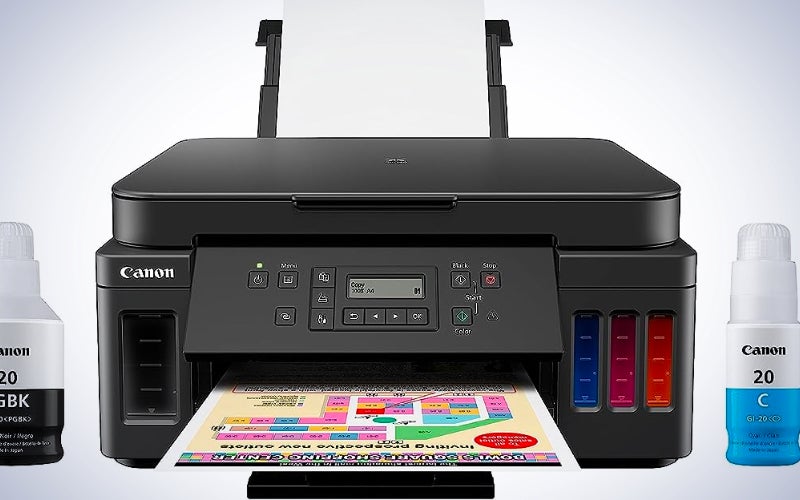
If you’ve gone all-in on Amazon’s smart-home ecosystem, add Canon’s PIXMA G6020 to your list of must-have tech accessories. You can interact with the all-in-one printer using Alexa, Amazon’s smart home assistant, which can be accessed through smart speakers like the Echo. Unfortunately, the only function this serves is allowing you to set up smart reorders, a system wherein you get sent ink as your printer is getting low. This is helpful in as much as you’ll never run out of ink at an inconvenient time—or ideally ever—but this level of Alexa functionality is very limited. Thankfully, the PIXMA G6020 is a solid all-in-one printer, even if you disregard its compatibility with Amazon’s smart home platform.
The inkjet printer offers respectable speeds but really impresses when it comes to ink efficiency. The PIXMA G6020 uses liquid ink from bottles, stored in tanks rather than cartridges. The upshot is that this printer can hold a lot more ink, which needs to be replenished less frequently. Canon says the printer holds enough ink to print up to 6,000 monochrome pages or 7,700 color pages per bottle. The company bundles three bottles of Blank ink with this printer, so it’s possible you won’t run out for several years if your printing needs are modest. If the thought of running out of ink frustrates you, and you don’t want to remember when to order more, Canon’s PIXMA G6020 makes a lot of sense.
Best budget: Brother MFC-J1010DW
Brother
Specs
- Printer style: Inkjet
- Printing speed: Up to 17 pages per minute
- All-in-one: Yes
- Price: $79.99
Pros
- Price
- Relatively compact
- Page gauge feature is genuinely useful
Cons
- Just the basics for features
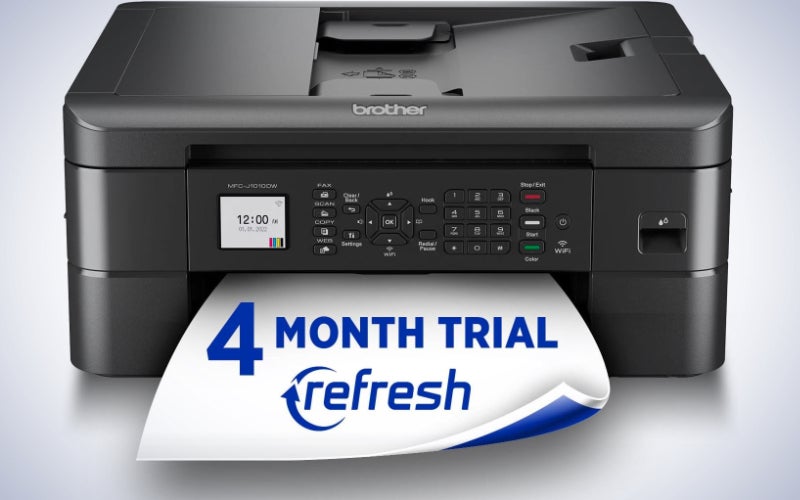
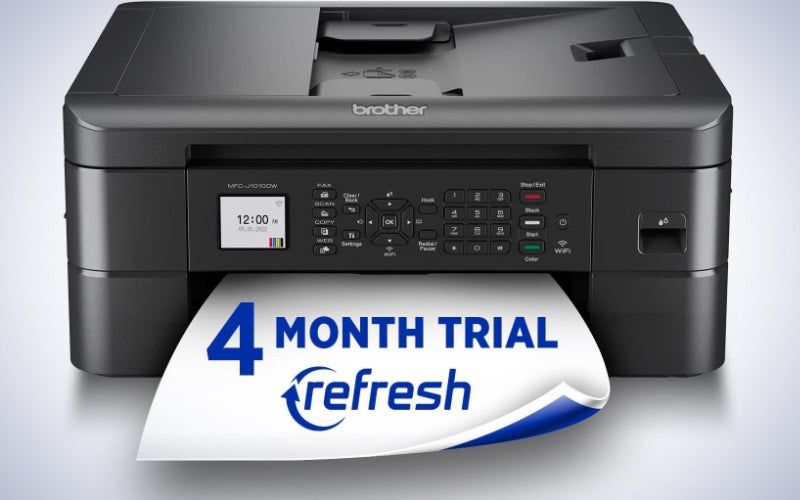
Brother’s all-in-one MFC-J1010DW inkjet printer has many of the same features found in our best overall pick but at a lower price. This model features the same 150-sheet tray, a similarly compact frame, and an all-in-one design. It even has a cool feature called a “page gauge,” displaying how many pages you can print based on how much ink is left on the printer’s cartridges. If you’re frequently annoyed at trying to determine how much magenta ink is available based on a pixelated bar graph on a small screen, this feature alone is worth picking up the MFC-J1010DW. The fact that it can also be used as a copier and scanner is a bonus, given this printer’s $80 price tag. It doesn’t have any fancy extras, but it could be all you’ll need if you don’t have any niche printer requirements.
What to consider when shopping for the best home office printer
When selecting the best home office printer, you must consider what tasks you’ll use it for. If the quality of the prints is most important, you may be thinking of a laser printer. For a cheap and easy solution that will cover your most basic jobs, a compact inkjet is more suitable. Printers you’d typically find in an office environment are expensive and made to withstand your and hundreds of colleagues’ needs. This is not so for home printers. Your home printer is tailor-made for individual use and won’t cost nearly as much. The best home printers are reliable and deliver quality prints.
The benefits of an inkjet printer
To create an optimal home office, a quality printer is an essential item. While these days we work mainly in the digital domain, printing reports, visualizing charts, or scanning documents is still an important part of the workday. A solid inkjet printer will cover your visual printing needs, as it is designed to provide accurate details and colors. An inkjet printer will typically be cheaper upfront, but the ink can get fairly expensive if you’re printing a lot.
The benefits of a laser printer
While laser printers tend to be more expensive out of the box, you may find that you save cost in the long term. Laser printers are so efficient that they can handle hundreds of pages of documents in a much quicker amount of time than an inkjet printer. This is a great option for someone who has lots of demand for their printer. The laser look also makes things glossy, which is a plus for your next presentation handout.
Laser printers will be slightly larger due to the technology packed inside that makes the lasers so efficient. If you’re tight on space, you may want to consider inkjet. If, however, your high-volume printing needs are essential for your work, a laser printer may be just what you need.
The benefits of all-in-one printers
Printing isn’t the sole office function many of us have. A good scanner with quality bulbs ensures documents are scanned digitally and are perfectly legible on your screen. Similarly, a copy function allows you to pop open the hood of the printer and make color or black-and-white copies of documents. These handy functions will make this printer an all-in-one solution for your home office. The best home office printer needs to be able to handle all these jobs reliably and with high quality.
Space
Space in your house is precious, so home offices are typically not the grandest of rooms. If you don’t have the room to spare, a compact printer is a clutch purchase, especially if your family or roommates don’t have intense printing needs. Whether you’re printing a few hundred pages a week for work or getting your kid’s homework printed for school, a smaller printer will get the job done without crowding you out of your office space.
Extra features
Some printers do way more than just print. We’re not talking about just a plain all-in-one printer, but printers that include advanced features like voice control. A home office printer with voice-enabled capabilities means you can tell Alexa to get your printing done. Don’t worry about the best positioning of your printer, since you’ll be able to get it working wherever you are able to speak to Alexa.
Budget
Those on a tight budget can still find a printer that can get the job done. Printing isn’t a new technology, so even cheaper devices will get work well. For under $100, you can find inkjet options that will produce solid prints at a reasonable speed. As mentioned above, inkjet printers will run out of ink quicker than other options, so your initial investment can become costly down the road.
More expensive printers will be able to print colors with a stronger vivid look and at quicker speeds. That said—if you’re looking to simply get a few pages printed out at a time, a budget printer will be just what you need.
FAQs
Q: How do I choose a printer for my home office?
It’s important to know what you want out of your printer for your home office. Do you need hundreds of pages done at warp speed, or do you need colorful high-quality prints ready to hang on your wall? Think of it as the speed of a laser printer versus the color vibrancy of an inkjet printer.
Q: Which printer brand is most reliable?
Some of the very best home office printers are made by companies like HP, Canon, and Xerox who have a long history of not only making quality printers but offering convenient ink replacement cartridges.
Q: Which home printers last the longest?
In terms of durability, the pricier laser printers will offer you an extended lifetime. Ink cartridges can add up over time, so you may end up saving money in the long term with a laser printer for your home office.
Q: How much does a home office printer cost?
This will depend on its set of features, but our recommendations range in price from $90 to $689.
Final thoughts on choosing the best home office printer for you
- Best overall: Brother MFCJ 1170DW
- Best inkjet: Epson EcoTank ET-2800
- Best laser printer: Xerox Laser Printer
- Best all-in-one printer: HP Smart-Tank 7602
- Best compact printer: Canon PIXMA TR150
- Best Alexa-enabled printer: Canon PIXMA G6020
- Best budget: Brother MFC-J1010DW
When picking the best home office printer, you will need to decide the printing features you like the most. The convenience of small, portable, and Alexa-enabled printers is just right for some. In contrast, bulkier but speedier printers will save loads of valuable time for those who need to print long documents.
Why trust us
Popular Science started writing about technology more than 150 years ago. There was no such thing as “gadget writing” when we published our first issue in 1872, but if there was, our mission to demystify the world of innovation for everyday readers means we would have been all over it. Here in the present, PopSci is fully committed to helping readers navigate the increasingly intimidating array of devices on the market right now.
Our writers and editors have combined decades of experience covering and reviewing consumer electronics. We each have our own obsessive specialties—from high-end audio to video games to cameras and beyond—but when we’re reviewing devices outside of our immediate wheelhouses, we do our best to seek out trustworthy voices and opinions to help guide people to the very best recommendations. We know we don’t know everything, but we’re excited to live through the analysis paralysis that internet shopping can spur so readers don’t have to.