CES 2011
Why scan when you can snap?

Lexmark Genesis The Lexmark Genesis costs $400 at lexmark.com Greg Neumaier

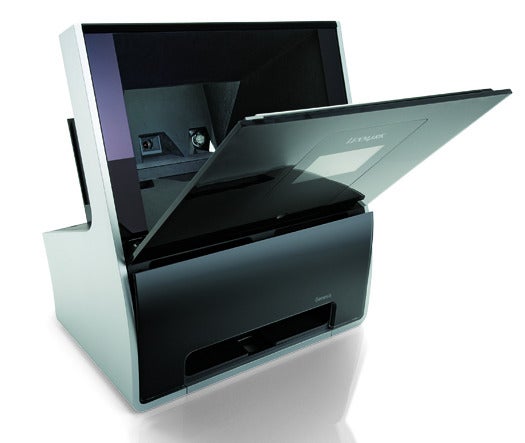
For more than 20 years, flatbed scanners have used slow-moving sensor bars to copy an image by scrolling over documents a little at a time. In replacing that bar with a retooled camera sensor, the Lexmark Genesis captures the entire image in a flash. It can do in three seconds what other scanners take upward of 10 seconds to accomplish.

The Genesis has more in common with a digital camera than with a conventional scanner. A 10-megapixel sensor shoots documents through a lens made of six reflective elements, which grab more light to help take clear images even at close range. The sensor grabs six exposures in rapid succession—one each for the scanner’s pairs of red, blue and green flash bulbs—and combines them into a single picture. The image processor on the Genesis corrects the image warping caused by using a wide lens up close.

The process seems nearly instantaneous. Less than a second after the scanner door closes, a preview pops up on the 4.3-inch touchscreen. Within three seconds of hitting the scan button, a full image is ready to print, e-mail, or upload directly to Flickr, Picasa or PhotoBucket over Wi-Fi.

The Genesis isn't the only scanner to use Wi-Fi, though: A new crop of scanners is making good use of wireless to send docs directly to the Web, sans computer. The business-minded Fujitsu ScanSnap S1100 ($200 (est.)) beams receipts, business cards and more to Google Docs or Evernote. The HP PhotoSmart eStation ($400, hp.com) talks to the Web with apps, such as one that links directly to a Yahoo account. The Doxie portable scanner ($150, getdoxie.com) can be programmed to create a 20-character URL for each item.

8 Comments

Brilliant! Years ago I pondered aloud why digital scanners didn't operate more like a camera and a co-worker just stared at me like a cow looks at an oncoming train. I could have invented this. :(

This this screams. Truly is a big advance for scanners. I hope that Lexmark integrates direct to PDF scanning with the option that resulting PDFs get pushed to the cloud (Google Docs - in a folder called "Incoming Scans" would be fine.)

Lexmark could eat Fujitsu's lunch by entering the huge Scansnap market with a better desk-side solution because they are leaders in paper handling.

Simple desktop software to tag, organize and save these documents is also important.

I would love to see Lexmark (or Fujitsu) add a small inkjet component that will optionally spray "SCANNED" in the corner of a document after scanning is completed.

Why did this take 20 years again?

Why did this take 20 years again?
-----
Computer cpu's, high resolution cameras and lenses were too expensive. Remember when a Radio Shack computer cost $3,000.?

Funny how certain Things that come around go around... Back in late 80s/early 90s I had a "digitizer" to scan pictures to my computer (Amiga at the time).

It was a camera attached to a arm at a set distance from a white board. The camera would snap a picture of the sheet on the board and send it to the computer... exactly what this unit is doing, but probably at a much better resolution! (back then it was color too!)

@zomg_zombies,

Nice Yankovic-Albuquerque reference. ;-) I laughed 27 times! hehe

I wonder how this technique attempts to achieve an equal optical resolution across the picture, surely the image will have an optical resolution "sweetspot", becoming increasingly blurry the further the image is from the camera sensor. Improving resolution through post-scanning digital techniques isn't as good as capturing the data optically at source - I suspect that this type of scanner will be best suited for scans where detail is unimportant (i.e. office document scanning) but won't replace flatbead scanners where a high quality consistent optical resolution is required.

The Post Office uses a machine with a camera that reads the address on envelopes of different sizes so they can be automatically sorted with human assistance. It works in a way similar to this. The technology has been improved considerably for this machine.

Popular Tags

Regular Features


June 2013: American Energy Independence

Five amazing, clean technologies that will set us free, in this month's energy-focused issue. Also: how to build a better bomb detector, the robotic toys that are raising your children, a human catapult, the world's smallest arcade, and much more.


Online Content Director: Suzanne LaBarre | Email
Senior Editor: Paul Adams | Email
Associate Editor: Dan Nosowitz | Email
Assistant Editor: Colin Lecher | Email
Assistant Editor: Rose Pastore | Email

Contributing Writers:
Rebecca Boyle | Email
Kelsey D. Atherton | Email
Francie Diep | Email
Shaunacy Ferro | Email

circ-top-header.gif
circ-cover.gif
bmxmag-ps