Pixel Qi: The LCD Screen That Could Finally Kill Paper For Good
Mary Lou Jepsen has created massive holograms and cheap laptops for the developing world. Now she’s rethinking the LCD screen, leading the way to the next great gadget: an e-reader to replace your laptop
We may earn revenue from the products available on this page and participate in affiliate programs. Learn more ›
Pixel Qi
For Mary Lou Jepsen, getting an MRI is not unlike getting a massage—a relaxing ritual, a rare slice of time when no work can possibly be done. I’m accompanying Jepsen to her doctor’s appointment at Massachusetts General Hospital because it’s the only few hours she can fit me in. She’s in Boston for three days, in between trips to her Sausalito, California, houseboat and her apartment in Taipei, Taiwan, and she’s booked back-to-back with appointments. Yesterday she had a meeting with the team at One Laptop Per Child, the nonprofit she helped create and with which she still collaborates on new computer designs. Today she’s talking with her doctor about the medicine she needs to take to stay alive, after a tumor nearly killed her 10 years ago. Tomorrow she will appear at the Boston Book Festival in a debate about the future of reading, along with top executives from Sony and Google.
While Jepsen gets her brain scanned, I sit in the waiting room and guard the tote bag that contains the reason her life is so frenzied: a 10-inch slab of glass that, she says, merges the best of computers and e-readers into a single screen.
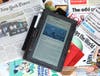
Turn on the store-bought tablet PC that Jepsen’s prototype screen sits in—she removed the old screen with a screwdriver and swapped hers in—and it looks and acts like any LCD screen, because it is an LCD, only better. LCDs display color and video, but they kill battery life. Electronic ink is more energy-efficient and paper-like, but it’s black and white and is frustratingly slow to load a new page. Jepsen’s screen combines the best of both technologies. Flick a switch, and the bulb that makes the screen glow will dim. But instead of going dark, only the colors will fade. That’s because in Jepsen’s screen, ambient light can substitute for backlight, bouncing off the mirror-like material that Jepsen has added to each pixel to reflect shades of black and white. With the lamp completely off, the screen, called 3Qi (pronounced “three chee,” as in qi, the Chinese word for “spirit,” and a geeky pun on the 3G wireless network), displays letters as crisp and readable as those on Amazon’s Kindle. In this mode, 3Qi uses about one fifth the power of a normal computer screen, Jepsen says. And unlike the E Ink–based Kindle or any other widely available e-reader, it still does everything a regular LCD does, including play videos.
As Jepsen will say in her talk tomorrow, “The future of reading is screens.” She puts it to me more bluntly: “Books are toast.” She’s not talking about reading, just dead-tree delivery, and there’s evidence to back her up. Between January and September of last year, $112.5 million worth of digital, downloadable books were sold, up from $7.2 million during the same period five years earlier. Since the introduction of the Sony Reader Digital Book in 2006 and the Kindle in 2007, the number of e-readers sold in the U.S. has more than doubled every year—an estimated one million in 2008, three million in 2009, and a projected six million this year. According to one forecast, that number could rise to 77 million worldwide by 2018.
That may be hard to believe given the single-task capability of current e-readers. But once a screen arrives that combines the best of laptops and e-readers into a single, affordable package—once a flip of a switch can transform your high-definition-movie-playing color laptop screen into an e-book with enough battery life to last a trans-Pacific flight—then things get more interesting. Laptops could become simple flat touchscreens, and e-readers as we know them could eventually become obsolete. If the future of gadgets is in the screens, Jepsen is trying to write that future.
So are plenty of others, of course. And this could be the year the leaders in the display race pull away from the pack. The cellphone-chip giant Qualcomm; the current e-reader display leader, E Ink; and at least one other major player are set to release next-generation e-reader screens by 2011. But Jepsen’s hybrid screen is likely to be the first and the least expensive of the bunch. Her company, Pixel Qi, which is based in both Silicon Valley and Taipei, will, by the time you read this, have started a run of millions of screens. Although Jepsen won’t name brands, she says these will soon appear in netbooks, tablet computers and dedicated e-readers.
The Pixel Qi screen I’m guarding in the hospital waiting room is one of a few thousand that currently exist. Jepsen had shown it to me earlier in the day, so I restrain the impulse to pull it out of her bag to do my reading. I knew that in the black-and-white mode, the screen makes reading the newspaper as easy on my eyes as, well, the paper itself. Because the black-and-white portion of each pixel is so large (and because parts of that little pixel-portion can be turned on and off individually), the resolution in black and white is nearly 200 dots per inch. It’s remarkable, and I understand why despite being an underdog in this race—a woman doing business in Asia, competing with some of the giants of the electronics business, all the while managing a life-threatening medical condition—Jepsen is on the cusp of something big. And why she’s so busy fielding interest that she can step out of an MRI visibly relaxed. “That’s the most time off I’ve had in a long time,” she says as she steps out of the imaging room.
How It Works
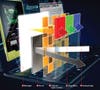
3Qi combines two kinds of displays—an ordinary color LCD and a low-power, high-resolution black-and-white version—into one package. Here’s how it pulls it off:
Pixel Qi: How It Works
Creating Color
Part of each pixel acts like one in a normal LCD screen: A backlight [A] shines through a layer of liquid crystals [B]. The crystals control how much light gets through, depending on how they shift their orientation when zapped with electricity. The light that makes it past the crystals passes through red, green and blue filters [C], which tint and combine the light to create the colors on your screen.
Bouncing Black and White
Turn the energy-sucking backlight down, and the pixel reflects light instead of producing it. Ambient light [D], whether from a lamp or the sun, enters the display and hits a large part of the pixel that’s covered in a mirror [E]. The beams bounce back out through the liquid crystals, which change the brightness of the light that escapes, just like in the color mode. But instead of shuttling through color filters, which absorb and dim rays, that light exits through an empty space—so you see it as white, black or one of 254 shades of gray in between.
Holograms and Hormones
Even when she’s not fresh from a rejuvenating medical procedure, Jepsen is simultaneously placid and upbeat, particularly for a woman on the verge of breaking into a multibillion-dollar industry. She meets the constant demands for her time matter-of-factly, without any apparent stress, and for someone who spends so much of her time in front of conference crowds, she’s surprisingly un-self-conscious. She once filmed a series of Web videos on her work while wearing a pirate-like eye patch to cover a parasitic infection. And today she seems perfectly comfortable being interviewed in her hospital gown.

Lengthy Reading
At 44, Jepsen has found a way to bring together the strands of a long and unusual career in art and engineering, 20-plus years of manipulating light for fun and profit. As a kid in a farmhouse in Windsor, Connecticut, she loved the 3-D pictures in her Thumbelina storybook so much that she scratched her way through the ridged plastic pages, in the process learning how bending light can trick the eyes. She stayed up all night dismantling radios, writing short stories, and making charcoal drawings. By sixth grade, she was teaching herself calculus.
Her parents struggled financially—her father repaired car engines until his business burned down, and then ran for political office and lost—so they pushed the teenage Jepsen in a pragmatic direction. “I didn’t want to be an electrical engineer,” she says. “But I did want to go to college. And they said they’d help me pay for it if I’d major in electrical engineering.”
During her freshman year at Brown University, she figured out a way to meld science and art: In a physics class, she learned how to create holograms. “You make this emulsion, spread it on glass, and at the end of this whole complicated process, you have this magical 3-D thing,” she says. “I was hooked.”
She decided to spend her life making holograms. She went on to earn a master’s at the Massachusetts Institute of Technology’s Media Lab, where she helped develop a groundbreaking 3-D video system (which, incidentally, earned a mention in this magazine in 1991). Then she took her artistic engineering around the world. Sometimes she put it to practical ends, as when she helped the Australian government fix the security hologram on their dollar bill. Other times, it was purely art, as when she splashed a 66-foot hologram of Roman baths across an entire city block in Cologne, Germany. In the ’90s, she even came up with the idea of using solar-mirror arrays in California to project a movie onto the moon (a plan she later shelved after deciding that it would be culturally disastrous to deface something revered by many religions).
While in Germany in her mid-20s, she began to suffer mysterious health problems: scrapes that didn’t heal, kidney ailments usually contracted only by AIDS patients. As a freelance art-holographer, she lacked health insurance, so she felt she had to switch to steadier work. She went back to Brown to get a Ph.D. in optics, thinking an advanced degree might help her compete in the male-dominated electronics industry. Partway through her studies, though, she found herself nearly incapacitated. “I was going blind, and I was in a wheelchair,” she says. “I thought I was going to spend the rest of my life living with my parents.” Finally, doctors unearthed a hormone-wrecking mass on her pituitary gland—this after years of telling her that her illness was all in her head. “In fact, it was,” she says. “They sucked it out of my nose.”
Removing part of her pituitary gave Jepsen back her health. It also gave her a strict lifelong course of pills, needed to replace the lost gland’s hormones, and a strong sense of urgency. “If I don’t take my pills every 12 hours, I can die,” she says. “So how do I want to use my time?”
Rethinking the Screen
In 2005, after nine years at display companies, Jepsen applied for a professorship at MIT. As part of her interview, she spoke with professor Nicholas Negroponte, who had just returned from proposing his “$100 laptop” idea—building low-cost laptops for kids in developing countries—at the World Economic Forum. Jepsen and Negroponte hit it off immediately. Within hours, the two had hatched the One Laptop Per Child (OLPC) initiative, and Negroponte immediately dispatched her to Europe to talk with technology leaders. Working as OLPC’s screen guru, she made the project happen, says Media Lab researcher V. Michael Bove, a technical adviser to OLPC who has known Jepsen since her grad-student days. “She was the one who had the big fights with Taiwanese LCD makers and engineers who didn’t think it”—making an inexpensive laptop—”could be done.”
The true humanitarian worth of spreading cheap laptops across the developing world is up for debate, but OLPC had one undeniable effect: It led directly to the advent of the small, stripped-down, inexpensive “netbook,” a sector that now makes up about 20 percent of all laptop sales. Once the nonprofit showed that it could build a compact, functional laptop for less than $200, nearly every other computer maker followed suit, and the gadget-buying public snatched them up. Since its debut in 2007, OLPC has delivered more than a million computers; Acer, Asus, HP and other consumer-electronics companies now ship approximately 40 million netbooks a year.
Jepsen left OLPC at the beginning of 2008 to take her display technology further. She started Pixel Qi with her own money and the half a million frequent-flier miles she had racked up traveling to Africa. For the OLPC computer, she had designed a new low-power display that could have maximum battery life in villages where the electricity was spotty at best. Instead of always using the power-hungry LCD backlamp, the screen could be illuminated by reflecting sunlight (a variation on the outdoor-readable screens found in some cellphones and rugged laptops). 3Qi is designed to bring the battery-saving benefits of reflective pixels to the rest of us.
She hashed out ideas over the dinner table with her husband, John Ryan, a telecom consultant, and when he became more interested in her project than his own job, she hired him as chief operating officer. After securing venture-capital funding, she rented offices across the street from YouTube in San Bruno, California, set up a lab for playing with liquid crystals in the office kitchen, and began experimenting with ways to get more light through the screen. By the time she and her growing team finished, they had changed nearly every layer inside the LCD, so that all that remains from the original OLPC screen, Jepsen says, is the basic idea of the black-and-white mode. “It doesn’t sound as cool as giving poor kids laptops, but it’s one and the same,” she says. As Pixel Qi scales up, the cost of the screens (which are going into the next OLPC computer) should come down, making Jepsen’s technology ever more accessible.
Jepsen is still involved in Pixel Qi’s technical work, but most of the rest of the time she’s in the air, on her way to supervise manufacturing in Taipei or to meet with a company about using her screen. She logs nearly 300,000 air miles a year in service of these missions. And despite the seemingly obvious benefits of her screen designs, it’s never an easy sell. “To a certain degree, she’s selling ice to Eskimos,” says John Jacobs, a laptop analyst at DisplaySearch who used to evaluate new screens for Apple. “No matter how great the ice is, they’ve already got some.”
Yet Jepsen has an “ace in the hole,” Jacobs says: “She’s a phenomenal evangelist for the technology.” Since she started Pixel Qi, she has effectively completed a world tour every month, trying to convince computer manufacturers from China to Texas to use her screens. When a CEO dismisses Pixel Qi as just another here-today, gone-tomorrow screen technology, she pulls out her OLPC credentials: “Which one has shipped a million products within a year of starting mass production? Which one? There are none,” she tells them. “There are none at all. Which one has even shipped 1,000 products within a year of mass production? OK, 100? We’ve got a million. That’s why you should believe me.”
Taking On the E-Giant
When she’s at the LCD factory in Taipei that’s gearing up to produce her new screen, Jepsen is on constant call, sometimes napping on the floor after pulling an all-nighter. It takes more than 100 different machines to assemble the layers of an LCD screen, and as Pixel Qi moves into mass production, problems can occur at every step: a few specks of dust in the workroom taint the materials, a batch of the liquid crystals doesn’t precisely match the batch that came before. This is when Jepsen is most content. “Time disappears, coffee appears, and it’s just work at high pressure to debug the problem. Those days are actually some of my happiest. The speed is fast, and the insights gained are tremendous.”
Part of her ability to sustain that nonstop rhythm may come from the quiet force—the qi?—of Jepsen’s personality. But part of it, serendipitously, comes from her illness. Thanks to the destruction of her pituitary gland, her body no longer makes the cortisol that usually regulates a person’s internal clock, so she doesn’t get jet lag; she feels awake as soon as she takes her pills. “My health used to limit me, but now it’s sort of an advantage,” she says. “I think business executives may consider it”—pituitary-gland removal—”an optional surgery at some time in the future.”
The frantic pace is necessary because, as young as the e-reader industry may be, trying to break into it is like trying to launch a new operating system after Microsoft. She’s up against a company that pretty much started the business: E Ink, which today controls some 90 percent of the market. Spun out of MIT’s Media Lab in 1997, E Ink makes the screens for most of today’s e-readers, including the Kindle. The E Ink screen mimics the look of ink on paper because it’s filled with floating particles of actual ink pigment. A zap of current sends oppositely charged black or white particles to the surface, forming images that stay put until zapped again. That means the screen draws power only when changing pages—ideal for a book, with which you can stare at a sheet for minutes. But again: no color, and no video.
Soon Jepsen and her competitors will take E Ink (and one another) on. At least one other manufacturer says that it will ship an e-reader screen this year with color and video and that, unlike 3Qi, the screen will remain full-color in low-power mode. Made by Qualcomm, the Mirasol display creates pixels with tiny moving metal pieces, just a few micro-meters across, that move up and down to reflect light of different wavelengths and colors. Like E Ink’s screen, it doesn’t need a backlight and uses energy only when changing images.
There are more contenders in the pipeline, too, all boasting some variation of color, video or both. A Philips spin-off called Liquavista plans to produce low-power, video-playing black-and-white screens at the end of this year, and full-color versions by the end of next. They rely on a technique called electrowetting, which replaces the liquid crystals inside an LCD with drops of oil in water that require less electricity to move. The old guard E Ink plans to release a color version late this year, and the company has displays running videos in its labs that it hopes to produce in a few years.
But, as Jepsen reminds me (with uncharacteristic brusqueness) when I mention that there are other fast, colorful reflective displays around: “not that are ready to ship.” Hers is also likely to be cheaper. The 3Qi screen, as a tweak on existing LCDs, is manufactured on the same machinery and from most of the same materials as the 1.5 billion displays shipped every year. As a result, a netbook with a 10-inch Pixel Qi screen should cost little more than one with
an ordinary LCD.
Readability Is in the Eye of the Beholder
Whether 3Qi succeeds will ultimately depend on the subjective experience of millions of sets of eyes. The circumstances in which people feel comfortable reading turn out to be somewhat unpredictable. For instance, it’s as much a myth that LCDs cause eyestrain because their backlights shine into your eyes like a flashlight as it is that reflective screens like E Ink’s are easier on the eyes just because they reflect light. “Light is light,” says VCD Sciences display consultant Lou Silverstein, a fellow of the Society for Information Display. “Your eyeball can’t tell whether it’s reflected or transmitted.” LCDs and E Ink look different because of the way E Ink reflects light. Its pigments sit at the surface and scatter light in many directions, just as paper does. LCDs and even other reflective screens direct light only at certain angles, so the look isn’t quite as uniform as paper. Jepsen says her team has employed a number of tricks to improve the angle of reflection on the 3Qi, but because it’s still an LCD, it will never look quite as much like print as E Ink.
But it may not have to. The real goal of Pixel Qi, Ryan says, is to “try to ask and answer a big question: What is the device of the future? The idea that people would actually carry three devices—phone, netbook, e-reader—doesn’t seem right.”
So the Kindle-style e-reader may be a transitory gadget, a step toward super-thin tablets that support modern computing just as well as old-fashioned reading. Pixel Qi may help catalyze that change, although it too may find itself a bridge technology, superseded once people cross to the all-color, all-the-time side. By that time, though, Jepsen may have moved on. She has near-term plans to improve Pixel Qi’s current display, making it more efficient and offering it in different sizes. And then it may be back to the developing world, this time to spread the influence of television. “People, primarily in India, are coming to me saying, you know, make us a 10-watt TV,” she says. A battery-powered HDTV may sound frivolous but, Jepsen explains, India’s musical movies are a cultural institution that many people get left out of because of a lack of electricity. “We want to see our Bollywood,” they tell her.
Jepsen’s motivation now, as an entrepreneur, is the same as it was during her days of projecting art-project holograms onto German cities: “My reward for all the technical work is to get this image I can enjoy at the end.”
Senior Associate Editor Lauren Aaronson runs PopSci’s_ What’s New section and the Best of What’s New Awards._