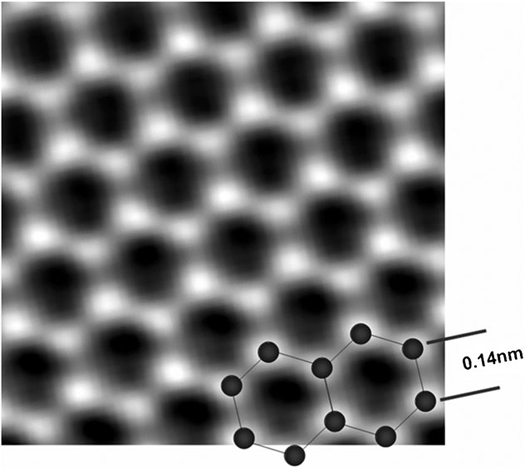
Graphene, Captured by a Transmission Electron Microscope National Center for Electron Microscopy

Moore's Law provides the axiom that the number of transistors that can be placed on a circuit will double every two years, but as we reach for smaller and smaller tech, silicon and other transistor materials are reaching their physical limits. Lucky for Moore, a European research group has produced graphene of a size and quality that can be practically developed for eventual commercial use.

Graphene has been bandied about as a replacement semiconductor material for a while now, but until now, no one has been able to make a decent batch of the stuff that is both large and of sufficient quality -- generally it's been one or the other. At its core, it's simply carbon arranged in a honeycomb-like layer just a single atom thick. But despite its thinness it's very conductive and very strong, making it a great candidate material with which to build the next generation of smaller, more powerful electronics.

The researchers were able to create high-quality, high-quantity graphene epitaxially -- by growing one crystal layer atop another. By this method, they were able to create a set of graphene layers about 50 square millimeters in area. With this (relatively) large sample, they were able to measure the electrical characteristics of graphene with greater precision than ever before, proving that it indeed has the physical potential to replace conventional semiconductors as the primary building block of future electronics.

Graphene won't replace normal semiconductors overnight, but the creation of sizeable, high-quality graphene is a significant breakthrough in materials science. Transistors made of graphene should run at higher temps, at faster speeds, and in smaller packages than their semiconductor predecessors, meaning they could maintain the relevance of Moore's Law for many years to come.

[Science Daily]

10 Comments

Just when you thought Moore's Law was dead, it comes kicking back to life.

Is graphene similar to diamond (in its molecular structure)?

So are you actually comparing scientists to a religious cult, or was that just a poor joke?

I would like an 8"x11" screen computer/telephone that you can fold up like a sheet of paper and put in your pocket.

@svb

What does your insane rambling have to do with anything in the article ?

Please go elsewhere if you want to spew unrelated nonsense.

If you wish to discus the ramifications of smaller faster organic electronic devices please feel free to post here.

@JamesDavis

Organic thin film transistors are what you'd need for that sort of device.
Unfortunately there aren't many ways to fabricate OTFT's (pentacene based OTFT's are the closest to viable) in a commercial environment as of now, but there is a LOT of research into creating an inexpensive fab process. Specifically, patterned pentacene proves to be somewhat viable, as crosstalk can be reduced, as well as optical properties optimized, for use in flexible backlit OLED screens. (Crosstalk between transistors is a downside of some organic electronics). Even with a viable production method, however, transistor size is dramatically increased from silicon.
Overall, organic technologies are not terribly far from fruition, but will probably be analogous to handheld gaming devices (in terms of far worse performance than contemporary consoles in exchange for mobility).

And it's very cute that svb wants to play, too.

@ JamesDavis

Would you like fries with that ? :)

@rpenri, graphene and diamond are both made solely of carbon, however they have extremely different molecular structures.

Graphene is a planar 6 sided ring, which means it can be deposited in thin layers.

Diamond, however, is a 3-dimensional complex crystal structure (actually the same 3D structure as silicon)

@mitEj - you ain't the boss of him, so shut your officious yob :)

k thanks!

Brian P.

Nice! Maybe one day I can have that Dick Tracy Videophone watch I've always wanted!

@JamesDavis, 8"x11" screen computer/telephone that you can fold up like a sheet of paper and put in your pocket is so totally 2009 and uncool nowadays! What we want is a supercomputer nanochip with built in whole lifespan batteries that you could insert under your skin, allow neuron connections to make, and experience realistic hallucinogenic sceneries just the way we want it communicating with others in a telepathic-like manner. Is that too much to ask for?

Come to Budapest: www.hungriabonita.com/budapeste

Popular Tags

Regular Features


June 2013: American Energy Independence

Five amazing, clean technologies that will set us free, in this month's energy-focused issue. Also: how to build a better bomb detector, the robotic toys that are raising your children, a human catapult, the world's smallest arcade, and much more.


Online Content Director: Suzanne LaBarre | Email
Senior Editor: Paul Adams | Email
Associate Editor: Dan Nosowitz | Email
Assistant Editor: Colin Lecher | Email
Assistant Editor: Rose Pastore | Email

Contributing Writers:
Rebecca Boyle | Email
Kelsey D. Atherton | Email
Francie Diep | Email
Shaunacy Ferro | Email

circ-top-header.gif
circ-cover.gif