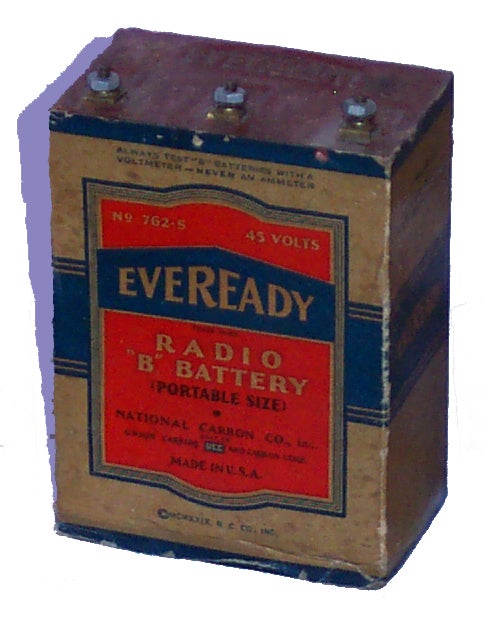
PopSci reader VectorAKA2004 raises a good question: "I wonder why batteries are lagging behind portable technologies. We advance cell phones and all kinds of things so far and still barely have the power to run them. We have yet to create batteries that can efficiently store solar energy, or other renewable energy sources."
What do you think? Discuss in the comments.
Submit your science and technology questions to fyi@popsci.com.
Five amazing, clean technologies that will set us free, in this month's energy-focused issue. Also: how to build a better bomb detector, the robotic toys that are raising your children, a human catapult, the world's smallest arcade, and much more.


Online Content Director: Suzanne LaBarre | Email
Senior Editor: Paul Adams | Email
Associate Editor: Dan Nosowitz | Email
Assistant Editor: Colin Lecher | Email
Assistant Editor: Rose Pastore | Email
Contributing Writers:
Rebecca Boyle | Email
Kelsey D. Atherton | Email
Francie Diep | Email
Shaunacy Ferro | Email
Fundamentally a battery is two different metals immersed in a corrosive fluid. Since elements tend toward their natural state these two metals exchange electrons through the fluid causing corrosion and the exchange of electrons is where we get electricity.
I am not certain but I think the reason we have trouble making a more efficient battery is because we haven't discovered or created any new metals to try to implement into a battery system. I think the next step in creating a more efficient battery would be the use of superdense metals because in order for a normal battery to last longer it needs to be larger.
Mind you I am no chemist, but I have toyed around with a few different ideas about how to configure a battery that would be longer lasting and more efficient simply out of curiosity, an Idea I had come up with is using series metals where at the top you have a metal that doesn't corrode well which is followed by a metal that has limited corrosion potential on through to a metal that is easily corroded.
This way once the first metal has surrendered electrons to the second, the second metal begins shedding electrons to the third and so on down the chain. Sort of a built in reserve for the battery, but without a mechanism to efficiently test my suspicion, it is unknown what the result might be.
what about them viral batteries they have been playing with?
The question in this case implies a false fact.
There have been many innovations to batteries. The problem is, these innovations cost $$$. They use many exotic materials that in many cases can only be found in specific areas of the world (that is if we are talking about the typical mobile phone or flashlight battery). Just 10 years ago, my Nokia mobile phone had a 1 hour talk time and was the size of a water bottle. We have moved away from the NiCad batteries, through the NiMH, and now use Lithium ion. The battery is smaller than the palm of my hand and it powers what is essentially a portable computer that plays music, sends and receives email, plays games, browses the internet, takes pictures, oh and makes phone calls.
To make batteries cheaper, there needs to be "innovations" in nickel mining, or lithium, or any of the other exotic materials used (which of course is nearly impossible considering the price is derived from its scarcity).
Part of the problem is that we are tied to the idea that batteries must work by putting two metals in an acid.
This really isn't much different than being tied to the idea that a car must run on gasoline.
We need to start looking at alternative ways to store power. The Hydrogen fuel cell is an example of an alternative method of storing power. Perhaps there are others.
That is sort of by definition what a battery is, now fuel cell's and ultra-capacitors are seeing a lot of work these days.
I think its because Chemists cant keep up with Physicists! Physics has produced revolution after revolution in energy.
The real question this article should ask is: "where have Biologists been in this energy arena?" They have the most efficient example of energy transfer on earth to use as an model (the body's digestion of organic food) and yet they have not ever produced anything that can imitate or replicate that process!
A real breakthrough would be a car that runs on Grass by imitating the stomach of a grasshopper or a cow!
Talk about renewable energy!
But on this topic, I think the MIT discovery advancing the usefulness of fuelcells will be a much more efficient way of storing energy for our future. I think our cellphones will have fuelcells in the future.
Making and selling batteries is a business. Current batteries are probably making producers top dollar right now so why keep upgrading and spending money on little improvements when demand is so high for what is available.
Even worse for manufacturers is what will they do if they develop batteries that are 10 times more efficient and use solar energy to recharge or maybe they sap energy from our movement? What happens is they make less money.
So I think we have the science to backup new and improved batteries.. I don't think we have manufacturers thinking the same untill they come up with a way to maximize money in their pockets.
Nanotube Batteries AKA "Super Battery"
I don't know why you all think batteries haven't improved? Take your cell phone battery for instance. Compared to 5 years ago, we now have much smaller batteries that power a cell phone that requires much more power than your own phone from 5 years ago. On the contrary, I'm continually surprised that my iPhone can be so slim and still have the power to do so much for so long.
This being said, i read an article not so long ago about scientists using bacteria somehow to dramatically increase battery power. The preliminary results would dramatically increase battery power -- the example they gave was a laptop that would be powered for 1 month on one charge with the same size battery you have now.
Also, you probably recall that no so long ago some MIT guys figured out out to transfer energy wirelessly. How sweet is that? That means that as you walk around your city, your phone/laptop/whatever will charge in your pocket. If we could figure out solar power or some similar alternative energy we could all just have cars that have batteries and charge as you drive along the road. I read once that if you can trap 100% of the solar energy that hits the earth in 1 day it would power the world for 200 years (even given dramatic increases in energy consumption in the future). Not bad, huh?
Just had another thought. Obviously you can't cover the world in solar panels, but if you built a huge array in space, or a collection of smaller ones, you could just transfer this energy wireless to earth. So maybe in a hundred or two hundred years if we haven't figured out fusion or killed each other that might be viable.
nebyorel said:
Also, you probably recall that no so long ago some MIT guys figured out out to transfer energy wirelessly. How sweet is that
Tesla invented what you speak of, not some one at MIT..
Look it up..
--------------------------------------
NuclearGenie said:
To make batteries cheaper, there needs to be "innovations" in nickel mining, or lithium, or any of the other exotic materials used (which of course is nearly impossible considering the price is derived from its scarcity).
Lithium Batteries dont use nickel, they use lithium as anode and manganese dioxide as cathode
NO Nickel...
Also some newer batteries are using nano carben cells as the cathode and are getting some good results
that's true, but the MIT guys are making the wireless transfer of energy efficient. If we did it Tesla's way, we'd lose a huge percentage of the energy and it just wouldn't make sense to implement from an economic POV. Interestingly, Tesla was Croatian and so is the MIT guy who's now enhancing what Tesla first demonstrated :-)
Advances in portable power is a war on many front first the batteries themselves, second the power consumption of the devices. with tinier processors and miniaturization, companies have come a long way. we would probably be way further by now if the Electric car of 1839 had pick up instead of the gas car.
but to go the way of infinite power we need to bring in more technologies together, solar charger embedded in the device etc.
one thing I don't get thou is why things like cell phone don't have some kind of shaking recharging system, to help keep the charge .
Some Japanese dudes invented wearable fabric that generates electricity with body movement. Couple that with a low cost super capacitor(I'm assuming it is much more rechargeable and longer lasting than a typical rechargeable cell phone battery), and you have all the juice you need. If you are a total desk jockey, just fidget as you talk.
what about the theory of using crystals (quartz comes to mind) to store or amplify energy? just thought i'd toos it out there.
also thought i'd state that batteries that wear out will always keep you coming back for more. even if they figure out a battery with a long life, it will be manufactured to fail at some point to keep consumers coming for more.
also there are so many super battery shopping online web on the google search.
www.okeybattery.com
i always though a nuclear-powered battery would be cool but it really wouldn't be safe distrubuting those to the public. if people could be trusted to not be stupid and break them open to use the nuclear fuel as a weapon (or on accident LOL) then i think it would be a good idea... but people are ALWAYS going to be stupid so never mind....