Future Human
Not even close, says a new psych study on plasma screen “windows”
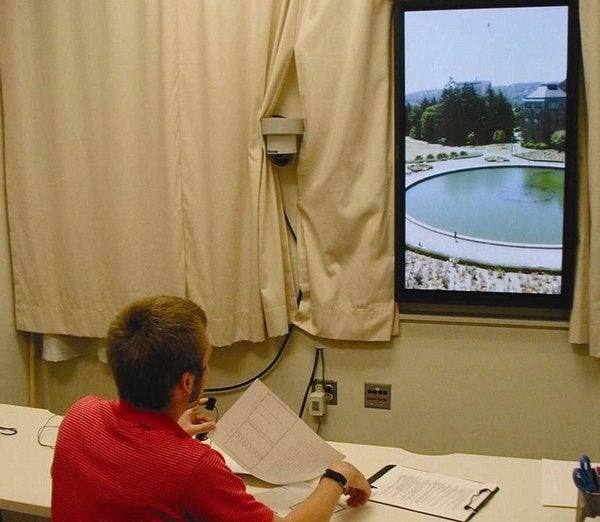
Is it live or is it Memorex? Psychologically speaking, nature on screen can’t beat the real deal. University of Washington

Discovery Channel addicts, get outside! HDTV may offer a vivid window on the natural world, but it won’t substitute for the real thing. That’s the implication from a new psychological study from the University of Washington’s Human Interaction with Nature and Technological Systems (HINTS) Lab, which found, in fact, that nature on a plasma screen is no more soothing than a blank wall.

The researchers set up participants in three office settings: one with a glass window on a natural vista, one with a 50-inch plasma screen playing a live HD video feed of the same scene, and a third with a blank wall. They noted how quickly the settings brought down participants’ heart rates after a stressful set of social interactions and cognitive tests.

The real window, as you might imagine, was the most restorative. The researchers expected the plasma screen’s ability to score somewhere between that of the window and the wall, but it ended up being no different than the latter. Furthermore, the longer the window-gazers looked outside, the more they recovered. The plasma screen had no such effect.

The medium, it appears, is the message. As digital technologies increasingly filter our environment, research groups like HINTS are investigating how direct and indirect experiences with nature can affect body and mind. “Humans will continue to adapt to an increasingly technological world,” say the authors in the paper, which appears in the current issue of the Journal of Environmental Psychology. “But are there costs to such adaptations in terms of human well being?”

Intuitively, we know that connecting with nature feels good. And a growing body of scientific evidence suggests that it really can make people healthier and more emotionally balanced. (Just read Richard Louv’s book Last Child in the Woods, an earnest look at the “nature deficit disorder” of today’s gadget-happy kids.)

One factor at play, say the HINTS researchers, is a process called “shifting baselines.” Simply, it means that due to ecosystem degradation, people today have a different perception of “nature” from people a generation ago, and a very different perception from the generation before that. The very idea of what is natural is subjective and changing over time as we adapt. As Jill Fredston writes in Rowing to Latitude, her chronicle of an epic Arctic paddling adventure, “When we do not miss what is absent because we have never known it to be there, we will have lost our baseline for recognizing what is truly wild.” Nature on screen is not wild, but will the next generation consider it so?

Technology is inseparable from the human experience. As we progress, studies like this will be increasingly useful to gauge how the tools—or more accurately, how we use them—can impact the toolmaker.

4 Comments

Last Child in the Woods ––
Saving Our Children from Nature-Deficit Disorder,
by Richard Louv
Michael J. Vandeman, Ph.D.
November 16, 2006

In this eloquent and comprehensive work, Louv makes a convincing case for ensuring that children (and adults) maintain access to pristine natural areas, and even, when those are not available, any bit of nature that we can preserve, such as vacant lots. I agree with him 100%. Just as we never really outgrow our need for our parents (and grandparents, brothers, sisters, uncles, aunts, cousins, etc.), humanity has never outgrown, and can never outgrow, our need for the companionship and mutual benefits of other species.

But what strikes me most about this book is how Louv is able, in spite of 310 pages of text, to completely ignore the two most obvious problems with his thesis: (1) We want and need to have contact with other species, but neither we nor Louv bother to ask whether they want to have contact with us! In fact, most species of wildlife obviously do not like having humans around, and can thrive only if we leave them alone! Or they are able tolerate our presence, but only within certain limits. (2) We and Louv never ask what type of contact is appropriate! He includes fishing, hunting, building "forts", farming, ranching, and all other manner of recreation. Clearly, not all contact with nature leads to someone becoming an advocate and protector of wildlife. While one kid may see a beautiful area and decide to protect it, what's to stop another from seeing it and thinking of it as a great place to build a house or create a ski resort? Developers and industrialists must come from somewhere, and they no doubt played in the woods with the future environmentalists!

It is obvious, and not a particularly new idea, that we must experience wilderness in order to appreciate it. But it is equally true, though ("conveniently") never mentioned, that we need to stay out of nature, if the wildlife that live there are to survive. I discuss this issue thoroughly in the essay, "Wildlife Need Habitat Off-Limits to Humans!", at http://home.pacbell.net/mjvande/india3.

It should also be obvious (but apparently isn't) that how we interact with nature determines how we think about it and how we learn to treat it. Remember, children don't learn so much what we tell them, but they learn very well what they see us do. Fishing, building "forts", mountain biking, and even berry-picking teach us that nature exists for us to exploit. Luckily, my fort-building career was cut short by a bee-sting! As I was about to cut down a tree to lay a third layer of logs on my little log cabin in the woods, I took one swing at the trunk with my axe, and immediately got a painful sting (there must have been a bee-hive in the tree) and ran away as fast as I could.

On page 144 Louv quotes Rasheed Salahuddin: "Nature has been taken over by thugs who care absolutely nothing about it. We need to take nature back." Then he titles his next chapter "Where Will Future Stewards of Nature Come From?" Where indeed? While fishing may bring one into contact with natural beauty, that message can be eclipsed by the more salient one that the fish exist to pleasure and feed humans (even if we release them after we catch them). (My fishing career was also short-lived, perhaps because I spent most of the time either waiting for fish that never came, or untangling fishing line.) Mountain bikers claim that they are "nature-lovers" and are "just hikers on wheels". But if you watch one of their helmet-camera videos, it is easy to see that 99.44% of their attention must be devoted to controlling their bike, or they will crash. Children initiated into mountain biking may learn to identify a plant or two, but by far the strongest message they will receive is that the rough treatment of nature is acceptable. It's not!

On page 184 Louv recommends that kids carry cell phones. First of all, cell phones transmit on essentially the same frequency as a microwave oven, and are therefore hazardous to one's health –- especially for children, whose skulls are still relatively thin. Second, there is nothing that will spoil one's experience of nature faster than something that reminds one of the city and the "civilized" world. The last thing one wants while enjoying nature is to be reminded of the world outside. Nothing will ruin a hike or a picnic faster than hearing a radio or the ring of a cell phone, or seeing a headset, cell phone, or mountain bike. I've been enjoying nature for over 60 years, and can't remember a single time when I felt a need for any of these items.

It's clear that we humans need to reduce our impacts on wildlife, if they, and hence we, are to survive. But it is repugnant and arguably inhumane to restrict human access to nature. Therefore, we need to practice minimal-impact recreation (i.e., hiking only), and leave our technology (if we need it at all!) at home. In other words, we need to decrease the quantity of contact with nature, and increase the quality.

References:

Ehrlich, Paul R. and Ehrlich, Anne H., Extinction: The Causes and Consequences of the Disappearances of Species. New York: Random House, 1981.

Errington, Paul L., A Question of Values. Ames, Iowa: Iowa State University Press, 1987.

Flannery, Tim, The Eternal Frontier -- An Ecological History of North America and Its Peoples. New York: Grove Press, 2001.

Foreman, Dave, Confessions of an Eco-Warrior. New York: Harmony Books, 1991.

Knight, Richard L. and Kevin J. Gutzwiller, eds. Wildlife and Recreationists. Covelo, California: Island Press, 1995.

Louv, Richard, Last Child in the Woods -- Saving Our Children from Nature-Deficit Disorder. Chapel Hill, N.C.: Algonquin Books of Chapel Hill, 2005.

Noss, Reed F. and Allen Y. Cooperrider, Saving Nature's Legacy: Protecting and Restoring Biodiversity. Island Press, Covelo, California, 1994.

Stone, Christopher D., Should Trees Have Standing? Toward Legal Rights for Natural Objects. Los Altos, California: William Kaufmann, Inc., 1973.

Vandeman, Michael J., http://home.pacbell.net/mjvande, especially http://home.pacbell.net/mjvande/ecocity3, http://home.pacbell.net/mjvande/india3, http://home.pacbell.net/mjvande/sc8, and http://home.pacbell.net/mjvande/goodall.

Ward, Peter Douglas, The End of Evolution: On Mass Extinctions and the Preservation of Biodiversity. New York: Bantam Books, 1994.

"The Wildlands Project", Wild Earth. Richmond, Vermont: The Cenozoic Society, 1994.

Wilson, Edward O., The Future of Life. New York: Alfred A. Knopf, 2002.

http://home.pacbell.net/mjvande

we're doing it wrong; current technology has yet to provide complete sensory feedback that we find in nature, such as heat, 3D sound, stereo imagery, smell, touch, and possibly taste.

another problem with nature "windows" is that viewers are too aware that they are looking at a flat surface, which triggers thoughts that would supposedly be associated with staring at a blank wall, although the detail of the nature scenes would still be soothing, depending on the person's taste.

I love my HDTV, but also know that it's no window! We need to master stereoscopic television before I'd buy into the whole window replacement idea.


June 2013: American Energy Independence

Five amazing, clean technologies that will set us free, in this month's energy-focused issue. Also: how to build a better bomb detector, the robotic toys that are raising your children, a human catapult, the world's smallest arcade, and much more.


Online Content Director: Suzanne LaBarre | Email
Senior Editor: Paul Adams | Email
Associate Editor: Dan Nosowitz | Email
Assistant Editor: Colin Lecher | Email
Assistant Editor: Rose Pastore | Email

Contributing Writers:

Kelsey D. Atherton | Email
Francie Diep | Email
Shaunacy Ferro | Email

circ-top-header.gif
circ-cover.gif
bmxmag-ps