Green Dream
Pre-fab panels instead of a wood frame save cash and energy
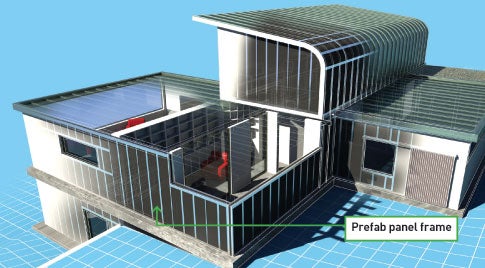
Green Dream Step one: build the box Peter Bollinger

John B. Carnett, PopSci's staff photographer, is using the latest green technology to build his dream home. Follow his progress in his monthly magazine column (the first of which you're reading now) and on the Green Dream blog.

In the past 20 years, I've lived in some pretty weird places —
 a leaky loft, a sailboat, an old carriage house that I rehabbed myself. Makeshift bachelor pads were fine until I found myself with a wife and two small boys.

Stage #1: Build the Box

Now I'm building a real home on three acres of land with river views and plenty of room for the kids to explore. And I'm going as green as I can, as cheaply as I can, starting with the prefab panels that I'm using instead of lumber to build the basic frame.
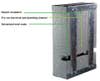
Inside Sustainable Prefab Panels:  John B. Carnett

These aren't your conventional structural insulating panels. Instead of foam and strand board, Kama Energy Efficient Building Systems in Las Vegas custom-makes the rigid panels out of light-gauge metal studs and a special type of expanded polystyrene called Neopor that's non-toxic, fully recyclable and blended with graphite to lock out heat, moisture and mold. My home is the first in the U.S. to incorporate Kama's new panels. They cost me about 5 percent less than a stick frame would have, but they're 60 percent more energy-efficient and can cut heating and cooling bills in
half.
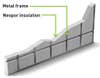
The Secret to Energy Savings: A special insulating material called Neopor encases the metal studs and eliminates thermal bridging, which occurs when two heat-conducting materials like wood and metal abut, forming a bridge over which heat escapes  Kevin Hand

The walls arrive on site pre-cut and ready to install, no special tools or hired help required. With a few buddies, I simply tilted the panels in place and secured them to a steel track on the foundation, building the whole box in less than eight days. A lumber frame would have taken me weeks to measure, cut, fit, and nail everything in place. Other types of insulating panels can require extra labor and a crane to install — in other words, more time and money.


Now that I have the frame and my insulation taken care of in one step, I'm looking at a passive solar hot-water system. That's next month's project.

The Specs

House: 3,500-square-foot, four-bedroom contemporary
Location: Greenwich, N.Y.
Project: Install a prefab panel box
Cost: $7.04 per square foot
Time to install: Approx. 8 days
Materials: Metal frame filled with expanded polystyrene and graphite
Eco advantages: Fully recyclable; no off-gassing, heat loss or mold

For more Green Dream, see Carnett's PopSci.com blog.

Want to learn more about the environment, solar energy, sustainability, and more? Subscribe to Popular Science and enter to win $5,000!

30 Comments

Is the cost relative to location? He is in N.Y. and I am in Ga. will it be cheaper for me to build here in the south?

Cant wait to see the video's of the construction . If anyone has any links our further information about designing a project please post.

It should be interesting to see all the tradeoffs. It is easy to see how the costs could be close to stick since it appears to be a simple form with metal exoframing. How does this construction hold up in a high wind situation I wonder. I did see a sheet metal exterior on one picture. Fill it and you have concrete foam construction. And that is high wind tolerant.

This is a great post. However I think it would be a little better with at least some pictures of what was done. Also this seems to pick up after the foundation was poured, was there anything special that needed to be done there. Is there a basement or does this need a slab.

Sorry one more thing..Is that $7.04 per square foot of the house or per square foot of the walls.

Fascinating article. Would like to know more about the walls and how they hold up with longevity/maintenance vs. lumber or steel construction. Also, there is no mention of fire resistance...same as lumber?

I am really looking forward to this project playing out, more details on the foundation and what type of roofing panels are available, pitch, slope, and all the necessary structural info would be great to get one's design cap on to create the new greener homes of the future. Also some contact info for direct contact with the Kama Building Systems Co. would be a real plus! What about local building codes and possible multi family units...more...more ...more!

More information on Kama Building systems can be found at www.lightshipgroup.com. This product is energy efficient and can be used for residential and commercial applications.

is this type of construction approved by most regions and administration authorities? or is it going to be scrutinized for months before permits are issued? i'm very interesed.

I'd like to see more detail on utilites races thru the material: how do you move electrical wiring vertically, how do you install plumbing piping or pex for plumbing fixtures?

Was this supposed to be an article or a teaser?
There was no significant information!
It looks interesting, but 'where is the beef'?
I would expect better from PopSci.

I live in GA am in LV now. Went to kama headquarters here and saw production facility. The guys on the east coast makes panels for new england area. Kama owner was great to visit with. I am a builder and came away with lots of material. Saw panels being made. Worth it if you visit vegas. I think the web site is www.kama-eebs.com. Jon

i agree with caste & uglib MORE! & QUICKLY!! please start from the foundation up for those who would like to follow in the author's footsteps. i would think that if it is too expensive for the print version PopScicould get more details here.

$7.04 a square foot for the panels WOW. I can't afford it now but eventually plan to build my own house on 31/2 acres I will inherit one day. Just think how affordable grren housing might be in five to ten years when I'm ready. This has inspired a new direction in my ideas of what my house would be like. I plan to do all I can to make it self efficient and completely off the grid except for communications of course (gotta have my net)! MORE PLEASE!!

The construction cost for "just the panels" will be related to the trucking distance from fabrication to site and then your local labor rates. The cost of the rest of your house (electrical, roof, etc.) will be regional.

Staff Photographer
Popular Science Magazine

"uglib" ASKED about the foundation?

I am building into a bit of a hill so I used typical footings and then an ICF foundation and first floor wall that went to the first 10'. I did not have to bring the ICF to 10' but wanted to experiment with the material. I installed radiant heating in the first floor slab.

Staff Photographer
Popular Science Magazine

"Stephen Fields" Asked about pex/electrical runs in the material...

The material comes from the factory with a pre cut horiz run on the interior of the material- You would typically not be running plumbing on an exterior wall so the pre cut area is perfect for wire-but you could run so Pex- The factory supplies you with a heated cutter to go vert- or make a last minute drop in the field.

Staff Photographer
Popular Science Magazine

"caste" asks for MORE...

The project is early in it's construction- Every system and subsystem is under review every day-please follow the blog as I find my way thru the options...

Staff Photographer
Popular Science Magazine

What keeps the walls from biodegrading in place? My first home was a 236 year old pier and beam in Mystic Conn. No bidegrading goin on round there

I'm glad to see more and more people looking at energy efficient construction. I would like to introduce you to a green building product that has been around since the 70's called ThermaSteel. (www.thermasteelcorp.com) We have buildings in all 50 states and 27 countries with national and iternational building code approvals. The more companies entering the green buildng market will allow more people to become aware of alternative building systems, which is great for the enviroment. I am very interested in seeing how this project progresses, please include additional photos in your next article.

Hey JC, hope you're pleased with the updated construction schedule. All of us here at The Lightship Group http://lightshipgoesgreen.blogspot.com are thrilled to have aided with the homes design and engineering. Thanks for choosing our firm as you Construction Mangers as well. Together we are really creating something special, thanks in large part to your vision. See you onsite.

Thank you John, incredibly inspiring. Most educated people understand the possibilities of living "greener," in every aspect of life yet are unaware of the steps needed to take in order to make it a reality. Great to see some articles and facts with steps and progress in turning a home no-less into an eco-friendly entity. Will be following all your posts. . .Keep them coming and keep the masses updated and educated.

-Verblist

-Verblist.net

Wow, this is seriously cool. My goal in life is to have a house made out of 100% recycled material.

-----------------------------------------------------------
Help control pointless waste | Fight Global Warming

WWW.1800RECYCLING.COM

JC - In the '80s, I used a Nascor SIP 1st floor and raised the existing building (now 2nd floor). Fastfoot has an interesting, continuous pour, footing and ICF wall. Legalett has a pad foundation and radiant floor heating (air) system (one 'piece'). Warmboard has a simpler subfloor, radiant heat (water) system. I am looking for ideas, to build a 24' x40' heated work shed, in a water access location. My thinking now, is to use Fastfoot footings; PT wood foundation; SIP floors, walls and ceiling; black, perforated steel panel skin (for passive solar heat); oriented, 60^ sun facing (at 45^ latitude) steel roof panel (for future, cheaper, membrane, solar heat and power) - and all of the efficient doors, windows, etc. I also want a glass, patio/garage door, with at least a 9' wide opening - to store a trailered boat in winter; and ??hard?? floor covering - to handle snowmobile studs and carbides. The water access is a limiting factor for weight and machinery.

I never have much to add to these blogs, but thought I would concur with those who would like to see more pictures of the actual project.

Mr. Carnett- Put the Earth to Work- great article. I am in the GEO Thermal energy field. I did some quick calculations for your 3500 SF home and with a total of 1300 LF of loop pipe will provide about 39000 BTU's of energy source or 3.25 tons. This amount

Mr. Carnett- Put the Earth to Work- great article. I am in the GEO Thermal energy field. I did some quick calculations for your 3500 SF home and with a total of 1300 LF of loop pipe will provide about 39000 BTU's of energy source or 3.25 tons. This amount of loop piping seems a little short for the size of the house, unless the building envelope has a high R factor. The standard for loop piping is 30 BTU's per LF Example a 200'verticle well with a soil conductivity of .85 equates to approximately 12,000 BTU's.

bemethompson: www.kama-eebs.com. Also info@kama-eebs.com. 702-451-7155. I am going in for training on their product this week in Las Vegas. KAMA has a new eco system for existing structures which I am very interested in. Wraps the building without any deconstruction to the existing structure at all.

Neopor? Steel? If you truly want to build an eco-friendly, efficient and sustainable structure, why not use earth bag construction. Earth is free (once you purchase the land) and nothing is more efficient than 3 foot thick earth insulated walls. Google it.


Download Our iPhone App

Stay up to date on the latest news of the future of science and technology from your iPhone with full articles, images and offline viewing


Follow Us On Twitter

Featuring every article from the magazine and website, plus links from around the Web. Also see our PopSci DIY feed


Become a Fan On Facebook

Share links with friends, comment on stories and more


December 2009: Best of What's New

In our December issue, Popular Science names the 100 best innovations of the year: bombproof wallpaper, self-parking cars, the fastest helicopter, and 97 more. Plus inventor profiles and videos.

Check out the best of what's new here.

Popular Science Photo Pool


Share your photos in the Pop Sci pool at www.flickr.com!
tags_sprite.png
POP_embeddedForm_cover_May09.jpg