The Vegawatt provides restaurants' power using their leftover cooking oil
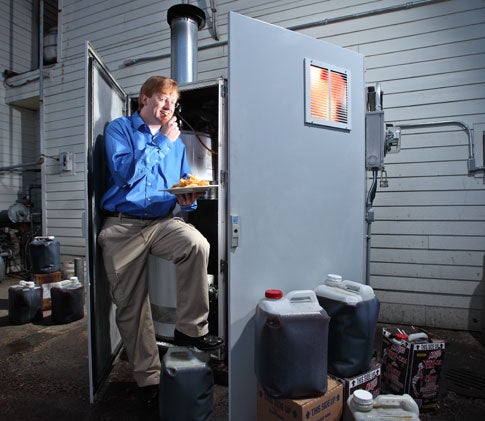
Oil Man James Peret wondered why restaurant owners gave away their excess grease instead of using it to power their business. Then he discovered that no one had given them the option John B. Carnett

Today's featured Invention Award winner kills two birds with one stone: providing a simple and cheap alternative energy source while widening the market for delicious fried foods. Everybody wins!

The nondescript six-foot-tall box behind Finz restaurant in Dedham, Massachusetts, looks like a tool shed, but actually it's a self-contained grease refinery and five-kilowatt generator. Engineer James Peret's Vegawatt is the first all-in-one device that processes grease to continuously provide a building with electricity and hot water, heralding a significant change in alternative-fuel applications. "It's a brilliant idea," says Josh Tickell, author of Biodiesel America. "A waste stream to an energy source, with no intermediary."

Last December, after a year of 80-hour weeks on the development, Peret, 33, installed the first Vegawatt at Finz, a joint that offers loads of fried seafood. With patents still pending, he's reluctant to give specifics on its inner workings, but it begins with staff members pouring in 10 to 12 gallons of used deep-fryer oil each day. Before going into the Vegawatt's generator, the bread-crumb-filled muck is deposited into a reservoir and undergoes a multi-stage cleaning, treatment and filtration process. At this stage, the oil is prepared for combustion with a method Peret devised that draws heat from the exhaust system. After that, the processed grease moves into a tank that feeds the modified 15-horsepower diesel generator. Heat from the Vegawatt's engine coolant is used to warm the water in the building's pipes, further reducing the restaurant's energy needs.

The Vegawatt can process about 80 gallons of grease a week (standard for large restaurants) and produces five kilowatts of energy an hour, which could translate to monthly savings of $1,000, a 10 percent reduction in power costs. Peret is now selling the machine through his start-up, Owl Power Company, pitching it as the perfect way to go green, save money, and serve delicious fish and chips at the same time.

Invention: Vegawatt
Inventor: James Peret
Cost: $300,000
Time: 4 years
Is It Ready Yet? 1 2 3 4 5
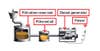
Vegawatt: How It Works: Dirty grease passes through a series of tanks and filters that scrub, heat, and refine it into fuel that burns clean in a diesel generator  Bland Designs

Check out the rest of PopSci's 2009 Invention Award winners!

Want to learn more about the environment, solar energy, sustainability, and more? Subscribe to Popular Science and enter to win $5,000!

7 Comments

I say this with all respect for the author of the article, and Mr. Peret, to wit: Duuuuuuuuuuuhh.

Once again, it takes a working stiff to point out the amazingly obvious.

Good work, Jim. No, sincerely, good work.

1000 dollar savings a month? That'll only pay for itself after 25 years! Longer if we figure in maintenance.

As for greening things up, I don't know, is there less carbon emissions involved if the power is produced at a coal plant?

Seems to me that a clearer green alternative is still burning up grease in a modified diesel car (since that represents fuel that would be burned anyway) or (this is really is a guess) feeding it to livestock instead of the fish oil which contributes to depleting our taxed oceans.

This is a wonderful opinion. The things mentioned are unanimous and needs to be appreciated by everyone.

mark456

adult

I.Q.142

from las vegas, Nevada

The $300,000 price tag was to build the prototype, if and hopefully when it is massed produced you could see it sell for a tenth or less than the original cost. Also considering coal power is the MOST polluting power source we have it stands to reason that it would pollute less. Not to mention the value of not being dependent on a central power grid. We need more inventors and innovators like Mr. Peret.

It took him $300k to buy a diesel generator? And he gets an award for it?

Ridiculous! Any diesel engine will run directly off of vegetable oil, provided two conditions are met: (1) filter the oil through a micron filter and (2) it is preheated to 150F first.

(1) is a real no brainier, you can set it up for about $20.
(2) is easy seeing how the generator creates waste heat as it runs - you just have to start up with regular diesel to warm things up and use a heat exchanger (read copper tube coil), or have a fish tank heater or something heat the oil.

That cost $300k to develop? What a waste!

Noting that this is the price of the prototype is a good point.

as for this though:

Also considering coal power is the MOST polluting power source we have it stands to reason that it would pollute less.

I don't know that this is clearly the case. Coal power may be the most polluting power source for mass production of power, but does that hold true when compared to small scale diesel engines? I would assume that mass production generally is more efficient (and potentially less polluting) than small scale power production.

This is great for showing technology and how ingenious the mind can be, but is this really an economical piece of equipment?

http://www.opednews.com/author/author37016.html


Download Our iPhone App

Stay up to date on the latest news of the future of science and technology from your iPhone with full articles, images and offline viewing


Grab the Tech Buyer's Guide iPhone App

Carry everything you need to make a smart buy on HDTVs, cameras and 14 other product categories right in your pocket


Follow Us On Twitter

Featuring every article from the magazine and website, plus links from around the Web. Also see our PopSci DIY feed


Become a Fan On Facebook

Share links with friends, comment on stories and more


February 2010: Renovating America

Innovative fixes for five of the country's biggest infrastructure messes, plus a look the quest to read the human mind, the LCD screen that might finally kill paper dead, and the world's scariest science.

Read the issue here.

Popular Science Photo Pool


Share your photos in the Pop Sci pool at www.flickr.com!