What’s cleaner than clean coal, but also, well, filthy? Bring on the BioGas (and one cool comic)
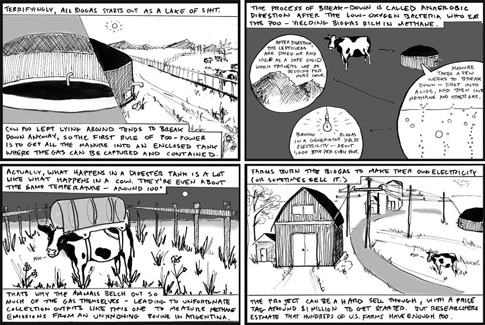
Poo is powerful stuff. That’s cow poo to be exact, though scientists say other animals' waste could also be used as an environmentally friendly energy source. 121 facilities in the U.S. are already turning their manure into electricity, and a report from the university of Texas says that the total potential across the country from existing cows could potentially serve 3% of our national energy use. And, a new bill was recently proposed asking for tax incentives for even more biogas production. This poo power stuff is really catching on.

If you're still finding it hard to visualize the transition from cow pies to flickering light bulbs, we delve into the poo-power basics here in graphic exposition.

Poo Power Panel 1:  Molika Ashford

Next Page: The process of breakdown

Page 1 of 4 1234next ›last »
Want to learn more about the environment, solar energy, sustainability, and more? Subscribe to Popular Science today, for less than $1 per issue!

9 Comments

that is the kind of common sense frugality that we need. It is simply a money maker. Another area where this could have a huge impact is the poultry farming industry. Poultry manure is a very efficient source of gas that could power these farms.

Yes, for around 40 billion dollars, we could probably outfit all dairy farms with this. This is useless for ranch land where the poo is distributed across thousands of acres. I question the "3% of all power" figure though. I wonder what the return on investment is for your average dairy farmer if the cost of entry is 1 million dollars. How many years of electricity would that be if purchased from current sources?

Revision: There are around 92,000 dairy farms, not 40,000. So that figure is closer to 92 billion dollars.

does anyone know how this "poo power" originated? and does any one know a professional in this line of buisness?

why_not_i_ask

from Snyder, New York

Why not do this with human waste? Our waste already goes to a center for treatment, where it is broken-down. Is it that our crap doesn't have as much methane? If this could work with human waste it seems that much of the mechanics of it are in place now. It seems that one could easily convert a septic system for this use.

cattleman1211

from Kouts, IN

THis works great and i would no i use it

Anaerobic digestion is a fantastic oportunity, the process has been around for a while but it just keeps getting more and more efficient and productive as new upstart firms keep the more established ones on their toes, researching new techniques, etc.

I've done some research into the area whilst at university, and it's encouraging to see the market heating up. The costs of installation/maintenance are of course site dependent, but where some of the larger anaerobic facilities may cost in the order of several million, a new firm in the UK called HiRAD has demonstrated that small facilities (for as few as 125 head of cattle) can be set up for as little as £70,000.

Providing electricity, reduced slurry storage requirements, and fertiliser, all in an increasingly Green-aware industry, I can't really see how this isn't going to take off!

Yes Junno, good point. And to obtain enough energy from this process of anaerobic digestion to become profitable it's another story. If your expenses are £70000 and you obtain the energy equivalent to £60000 you did nothing.
http://www.aeonity.com/youth4ever

This seems to be just a way for large farm corporations to justify their thousands of tons of feces being stored. http://www.naymz.com/search/john/morgan/2678516


138 years of Popular Science at your fingertips.

Innovation Challenges


Popular Science+ For iPad

Each issue has been completely reimagined for your iPad. See our amazing new vision for magazines that goes far beyond the printed page


Download Our App

Stay up to date on the latest news of the future of science and technology from your iPhone or Android phone with full articles, images and offline viewing


Follow Us On Twitter

Featuring every article from the magazine and website, plus links from around the Web. Also see our PopSci DIY feed


February 2012: The Future of Fun

Science is reinventing play, from extreme sports to gamification to ridiculous roller coasters to the playgrounds of tomorrow, and this issue is chock full of fun. Also, on a less fun note: Did global warming destroy my hometown?


circ-top-header.gif
circ-cover.gif